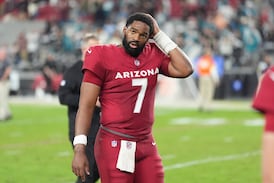
TEMPE, Ariz. -- Even though Jacoby Brissett’s holdout for a reworked contract is coming to an end this week during the Cardinals’ minicamp, his future as Arizona’s starting quarterback is still in flux.
Whether that’s deserved is the debate.
Detractors of Brissett look at his 1-11 record as the Cardinals’ starter in 2025 after replacing an injured Kyler Murray in Week 6. It’s a way -- and for many of his critics, it is the primary way -- to support the argument that he shouldn’t be holding out for a new contract.
The 33-year-old Brissett wants more guaranteed money for this season, a source has told ESPN, and Brissett stayed away from the team all offseason, until this week, waiting for a decision to be made one way or the other. Brissett will attend this week’s mandatory minicamp, sources told ESPN, meaning he’ll be at the facility, in meetings and in the weight room. The question is whether he’ll practice.
Only time will tell if holding out was the right move for Brissett, who faces these potential outcomes: (A)The Cardinals give him a reworked contract for this season, (B) they don’t and he has to decide whether to play on his current deal, or (C) they trade or release him.
However, as the debate about whether he’s to blame for his 1-11 mark -- and the greater argument about whether wins and losses are quarterback stats -- rages on, a number of statistics support the other side of the Brissett debate: that he wasn’t wholly responsibly for Arizona’s record with him behind center and that he actually has a case for wanting a new contract.
Here’s a look at what that argument looks like:
Doing his part: Sometime in the 1980s, former New York Giants coach Bill Parcells uttered a sentence that has come to define many quarterbacks: “You are what your record says you are.”
While, yes, Brissett’s record last season was 1-11, the reality is more layered and complex.
During the Cardinals’ nine-game losing streak from Weeks 10-18, Arizona had one of the worst defenses in the NFL. The Cardinals’ defense gave up 35.2 points per game in those last nine games, which ranked last in the NFL. The 378 yards per game that Arizona’s defense surrendered during that stretch ranked 31st.
“It was bad ball,” defensive coordinator Nick Rallis said of last year’s nine-game losing streak. “Yeah, bad ball.”
From Weeks 10-18, Arizona was also last in defensive efficiency, opposing QBR and opposing touchdown-to-attempt percentage, while the Cardinals’ defense finished 31st in point margin, defensive EPA, opposing raw QBR, opponent’s net yards per pass attempt, run yards per game, yards per game and third-down conversion rate. Arizona’s defense was 30th in first downs per game, and 29th in yards per play and opponents’ time of possession.
“There’s a lot of factors to that,” Rallis said. “There’s things that I felt like I could have set up plans better. Things you could say we should have been executing better. You could look at certain things and say, was it a product of this or this or this?”
However, Brissett held his own individually without having a productive run game behind him.
During Arizona’s nine-game losing streak, the Cardinals ranked 32nd in total rushes and run yards after first contact; 31st in total run yards and rush yards per game; 30th in rushing touchdowns, rushing first downs and runs 10 yards or longer; and 29th in run yards before first contact, according to ESPN Research.
Even with a struggling defense and an inefficient run game around him, Brissett was ranked first in the NFL from Weeks 10-18 in dropbacks, actual plays, completions and attempts. He was tied for third in passing touchdowns and was third in passing first downs and total passing yards. He was fourth in passing yards per game, fifth in completion percentage above expected and 12th in completion percentage.
Brissett was also hit the third most among quarterbacks in the NFL during that span and was sacked 29 times, which was 30th. His seven interceptions from Weeks 10-18 ranked 25th, as did his yards per dropback rate.
While Arizona’s defense struggled when he was on the sideline, Brissett helped wide receiver Michael Wilson go from having 52 yards on eight catches in the first five games with Murray to 1,006 yards on 78 catches. He also helped lift tight end Trey McBride to an All-Pro level.
Both players had marked increases in their output with Brissett behind center.
McBride went from 28th in receiving yards, 61st in receiving touchdowns, and 10th in receptions and targets in the first five weeks of last season to sixth in receiving yards, second in touchdowns, first in receptions and third in targets with Brissett.
Wilson had a steeper turnaround.
He went from 191st in receiving yards, 61st in touchdowns, 153rd in receptions and 104th in targets in Weeks 1-5 to seventh in receiving yards, 12th in touchdowns, sixth in receptions and 109th in targets.
And during Brissett’s run as Arizona’s starter last year, McBride was ranked first in total routes in the NFL and Wilson was second.
“I think words can’t describe how I feel about playing with Jacoby,” Wilson said. “Obviously, what he did for my career, I’m forever indebted to him.”
Brissett’s value: Part of Brissett’s desire for a reworked contract for 2026, according to a source, is that he was told by the Cardinals after free agency that he was their starting quarterback, putting to rest any chatter that there would be a competition between him and Gardner Minshew, who was signed as a free agent in March.
And a source told ESPN that Brissett believes that being a starting quarterback in the NFL should come with a paycheck that reflects that role. Hence, the holdout.
As of now, Brissett is scheduled to earn $1.5 million guaranteed in 2026, part of a contract that totals $4.88 million and could reach $5.44 million if he hits per-game active bonuses. To compare, Minshew was guaranteed $5.14 million for this season at signing.
Brissett’s guaranteed salary, in itself, doesn’t make him the lowest-paid starting quarterback in the NFL. His total compensation, however, aside from rookies on their rookie deals, does.
There are nine quarterbacks who will earn less than $1.5 million guaranteed this season, including three -- Kansas City’s Patrick Mahomes, Minnesota’s Murray and Tampa Bay’s Baker Mayfield -- who have no guaranteed money tied to their contract for 2026. However, all three will each earn more than $35 million this season due to bonuses and offset money, in the case of Murray.
With the 10 starting quarterbacks still on their rookie contracts taken out of the conversation, Brissett will earn the lowest total compensation among all starting quarterbacks this season.
New York Jets quarterback Geno Smith will earn $3.3 million this season in addition to the $16.2 million offset from the Raiders. Raiders quarterback Kirk Cousins will make $1.3 million from Las Vegas plus the $8.7 million in offset from the Falcons as well as a fully guaranteed $10 million roster bonus that’s due in March of next year. And Murray, whose contract with the Vikings is worth just $1.3 million -- the league minimum -- will make $35.5 million in offset money from the Cardinals.
However, there’s a catch in the conversation about quarterback guarantees, and it can be deceiving. A number of the NFL’s biggest stars aren’t getting eye-popping guarantees as written into their contract on a year-by-year basis. For example, Detroit’s Jared Goff is just getting $15 million guaranteed this season but is also receiving a $40 million bonus for a total payout of $55 million. Rams quarterback Matthew Stafford is getting $16 million guaranteed but his total cash will be $40 million. It’s happening all over the league.
Mahomes and Mayfield don’t have any guaranteed money this year but will be paid $56.75 million and $40 million, respectively. Buffalo is on the hook for the league minimum guaranteed for Josh Allen at $1.3 million but he’s expected to earn $55 million. There’s also Baltimore’s Lamar Jackson, Dallas’ Dak Prescott and Jacksonville’s Trevor Lawrence, all of whom will receive $2 million or less in guaranteed money on their 2026 contracts but will end up making $52 million, $40 million and $37.5 million, respectively.
Then there’s Brissett.
At the low end of the non-rookie starting quarterback scale, a guarantee of $10 million would tie Brissett with Cousins as the lowest-paid non-rookie quarterback in the NFL this season, and a guarantee of $20 million would make him the third lowest. Eclipsing $20 million would start putting Brissett in the same conversation with Steelers quarterback Aaron Rodgers, who is getting $22 million guaranteed; Chargers quarterback Justin Herbert, who is getting $24 million; Dolphins quarterback Malik Willis, who is making $1.215 million guaranteed but $23.5 million in cash; and Seahawks quarterback Sam Darnold, who is getting $17.5 million guaranteed but $27.5 million total.
As it stands, Brissett’s $1.5 million guaranteed for 2026 puts him behind six veteran backups and two rookies.
The risk: With Brissett missing the entirety of Phases 1 and 2, and all three OTAs under new coach Mike LaFleur, there has always been the chance the Cardinals could just pivot away from him, using the excuse that his win total last year just didn’t cut it -- similarly to how Arizona owner Michael Bidwill said a lack of wins cost Jonathan Gannon his job after last season despite a considerable amount of injuries.
The best-case scenario for Brissett is that he gets a reworked contract and starts the season as the Cardinals’ quarterback. However, if he doesn’t, then he’ll face the proverbial fork in the road: Play on his current deal or sit out the season.
Arizona also has two other plays it could make: Cut Brissett or trade him.
Should Brissett not be the starter for Week 1 at the Los Angeles Chargers, Arizona has two potential options. The first would be to start Minshew and the second would be to play rookie Carson Beck.
It’s likely that Beck will see the field at some point this season, even if Brissett returns to the team -- unless Arizona is on a roll headed to the playoffs -- so Arizona’s brain trust can evaluate what they have in Beck before deciding what to do in next year’s quarterback-heavy draft.
ESPN’s NFL FPI projects the Cardinals to go 5-12 with a 1.2% chance of making the playoffs, a 15.3% chance of landing the first pick, and a 61.6% chance of having a top-five pick.
The question then will be: When will Beck get his shot? If Brissett is not in the picture, does Arizona turn heads and drop jaws by starting Beck in Week 1? Does he come in a quarter-way through the season if the Cardinals are struggling? Does LaFleur wait until midway through the season or until the last four or five games?
It’s all an unknown right now and all hinges on whether Brissett gets a new deal.