
There are GOATs and then there is the GOAT of GOATs. TSN brings you GOAT of GOATs presented by Desjardins Business. Sixteen legendary athletes – eight men and eight women – square off in a bracket to determine who is the best of the best, the greatest of the greatest.
TSN personalities will present the case for each athlete, but it’s up to you to have your say. Viewers will vote on each matchup until two competitors are sent to the finals, with a winner crowned on each side of the bracket. Voting will consist of a split between viewers and TSN staff.
Today’s matchup: Simone Biles versus Ronda Rousey
--
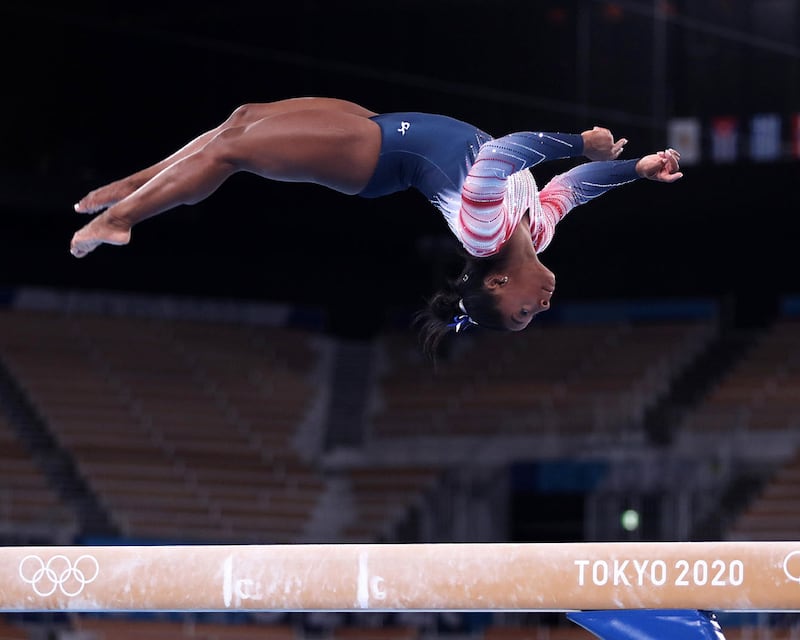
Simone Biles
To consider Simone Biles’s case as the greatest gymnast of all-time, you only need to look at her trophy cabinet for proof.
But Biles’s impressive list of accolades doesn’t tell the whole story as to what makes her so special. Biles is in a class of her own, not only because she simply could do things nobody else could, but because she constantly worked to do that. Somehow, the best got better.
Born in Columbus and raised in Houston, Biles began her senior career in 2013 at the age of 16. Winning the all-around event at the U.S. National Gymnastics Championships in August, Biles was selected to the national team for the World Artistic Gymnastics Championships in Belgium that fall. Biles announced her presence on the international stage immediately, claiming a pair of golds – in the all-around and floor exercise – in a five-medal performance.
By the time her first Olympics rolled around in 2016, Biles was already a 10-time gold medalist at the worlds. Facing expectations of greatness in Rio de Janeiro, Biles delivered. She won four gold medals (all-round, team, vault and floor exercise) in a performance for the ages. She matched fellow American Gabby Douglas as the only woman to win the all-around and team golds at the same Olympics. Her exploits earned her the role of U.S. flagbearer at the Closing Ceremonies, becoming the first gymnast to receive the honour.
The 2020 Tokyo Olympics brought with them the greatest adversity of Biles’ career and her ability to deal with it displayed another facet of her supremacy.
While she managed to qualify for all of the individual finals, the only woman to do so at those Olympics, she was uncharacteristically sloppy throughout with stumbles and falls. After struggling in warmups ahead of the vault in the team final, Biles withdrew from the competition and then also withdrew from every other individual event outside of the balance beam where she earned a bronze medal.
Biles cited “the twisties” as the reason she couldn’t continue. A version of the yips, a gymnast with the twisties experiences midair disorientation and a lack of spatial awareness. Essentially, her mind and body were no longer on the same page.
In leaving the Olympics, Biles was subjected to invective from both fans and the media. Her heart was questioned. She was called a quitter and worse.
Years later, Biles said the experience was formative in understanding herself.
“Gymnasts aren’t viewed as people who have weaknesses, and that was the first time that weakness was displayed on a global stage like that,” Biles said. “Now, I look at it as being courageous and not so much a weakness.”
Returning to competition in 2023, Biles reclaimed her spot on top of the sport. At the worlds in Antwerp, Biles won four more golds, including the all-around. A year later in her return to the Olympics, she was golden again. Biles won three golds with another all-around among them.
Turning 30 in March, the 2028 Los Angeles Olympics remain on the table for Biles. But even if she doesn’t compete, her legacy is unmatched. Multiple skills now carry her name. Competitors routinely attempt to perform “The Biles” and “The Biles II” in floor exercises and her signature double-double balance beam dismount.
Her medal haul is unprecedented. No man or woman has come close to her 41 major medals, including seven Olympic golds.
Should Biles compete in Los Angeles, she would be 31. Not since 1952 has a woman aged 30 won the all-around at an Olympics. If she were to win gold in the all-around on home soil, Biles would become the oldest woman ever to achieve the feat.
Don’t put it past her.
--
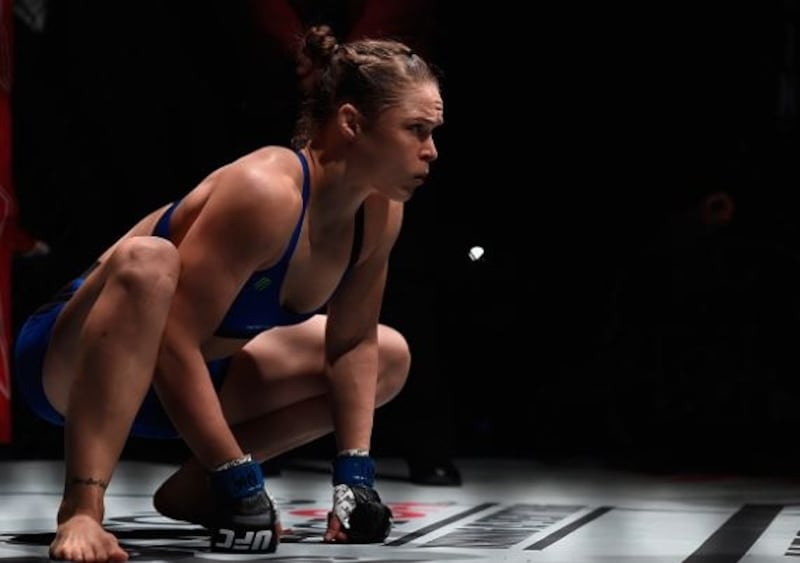
Ronda Rousey
A true pioneer in women’s sports, “Rowdy” Ronda Rousey put a spotlight on women’s mixed martial arts in a way few thought possible.
Rousey was not the first women’s MMA fighter or, perhaps, the sport’s most well-rounded, but without Rousey, it’s hard to envision a world where women’s MMA has an equal footing alongside the men’s division in the Ultimate Fighting Championship. One of the biggest draws in UFC history, Rousey proved that women could carry a pay-per-view card and stand among the giants of the fight game. Rousey’s legacy in MMA is unquestioned.
Born in Riverside, Calif., Rousey came from combat sports royalty. Her mother, AnnMaria De Mars, is a celebrated judoka. In 1984, De Mars became the first American woman to ever claim a gold medal at the World Judo Championships.
It’s no surprise, then, that Rousey’s entry into combat sports was through that same discipline. At 17, Rousey competed at the 2004 Athens Olympics as the youngest competitor in the field. Returning to the Olympics four years later in Beijing, Rousey became the first-ever American woman to medal in the sport, earning bronze in 70 kg.
Rousey then turned her focus to MMA. By the time of her first pro fight in 2011, the sport had begun to take off through the likes of Gina Carano and Cris “Cyborg” Justino in promotions like Strikeforce and EliteXC that bubbled under the mainstream radar. It was in the former that Rousey would first make her name.
From her very first pro fight, Rousey became known for her armbar. Taking it from her judo days, Rousey’s strategy was simple, but overwhelmingly effective. As soon as the bell rang, Rousey would look for a quick takedown, normally with a hip toss, before immediately moving to ground and locking in the armbar. Her first four professional fights lasted a combined two minutes and 18 seconds with all four opponents tapping out to the armbar.
Headlining her first PPV in March of 2012 against Miesha Tate, a woman who would arguably become her most noted rival, Rousey fought for her first professional title, the Strikeforce Women’s Bantamweight Championship. Tate’s resistance was far more robust than anything Rousey had experienced to date. But she was able to wear her opponent down. With a little over 30 seconds left in the first round, Tate tapped out.
With UFC buying out Strikeforce, Rousey’s title became the UFC Bantamweight Championship. She made her first defence of that title at UFC 157 in February of 2013. On a card that featured established names like Robbie Lawler, Josh Koscheck and Urijah Faber and a bout between Dan Henderson and Lyoto Machida, it was Rousey’s fight against Liz Carmouche that main evented it. It was the first time in UFC history that women’s fight headlined a PPV. Like all six of Rousey’s opponents before her, Carmouche tapped out to the armbar with 11 seconds left in the first round.
A rematch with Tate followed, with Rousey taken past the first round for the first time in her career, before Rousey’s first-ever fights won by something other than the armbar. She beat Sara McMann with a knee to the body at UFC 170 and then knocked out Alexis Davis with a punch in 16 seconds at UFC 175. She racked up two more wins – over Cat Zingano and Bethe Correia – before the stiffest test of her career to date.
At UFC 193 in Melbourne, the 12-0 Rousey took on Holly Holm. Holm was unlike any of Rousey’s previous opponents. An accomplished boxer with championships at three different weight classes, Holm was easily the best pure striker Rousey had ever come up against before. Still, the undefeated champion was considered a heavy favourite.
Attempting to end the fight quickly like she had so many times before, Rousey was repelled by Holm’s jabs and bloodied by the end of the first round. Holm’s ability to withstand Rousey’s takedown attempts won her the round on points, marking the first time Rousey lost a round in her career. It was a sign of things to come.
The second round saw a frustrated Rousey double down on her strategy, opening herself up to further strikes. After being stunned with a hard left, Holm delivered a high kick to Rousey’s head, knocking her out cold 59 seconds into the round. It was the first loss of Rousey’s career and one of the biggest upsets in MMA history.
The loss to Holm shook Rousey and marked the beginning of the end of her UFC career. She would return to the Octagon a little over a year after the loss to take on Amanda Nunes, the woman who had usurped Rousey’s throne as the queen of the sport. She was no match for the Brazilian, dispatched in only 48 seconds by a thundering right hand. Rousey’s time in the UFC was over.
In the ensuing years, Rousey embarked on a professional wrestling career, spending five years with World Wrestling Entertainment. This past spring, she made a return to MMA with her first fight in nearly a decade to take on Carano, submitting her with the armbar in 17 seconds. That fight, she said in the aftermath, closed the book on her career.
If that were truly the end, then Rousey finished up the way she started – with eye-popping dominance. The Carano fight was a microcosm of a fascinating career. Moreover, it was the perfect finish for a fighter nicknamed “The Baddest Woman on the Planet.”