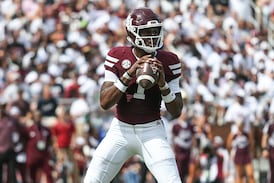
MACON, Miss. -- To much of America, he seemed to materialize at once, thrilling in the propulsive way the football left his hand, statuesque in that 6-foot-4 frame and those 230 pounds at age 19, endearing in the way he said, "Yes ma'am," in that postgame interview. In day-to-day reality, his origins seem maybe even more enchanting: a hometown of about 2,500 in a county of about 10,000 with a high school of about 400, just 14 miles inside a consequential border, a place where a young mayor with a bustling bio won a runoff last year by 432 votes to 376, a place where a throwback loyalty to a nearby university congealed. Kamario Taylor, the quarterback whose stardom just started visiting in a hurry, went half an hour up the road to Mississippi State and vows to remain there even through the transfer turbulence of the era.
If you zipped westbound past Tuscaloosa, Alabama, toward Mississippi on a promising football Saturday morning, you'd reach the two-lane Alabamian roads where the trees sometimes hover like a tunnel. You might do stints as the only car on the road. You'd pass vast farms, tiny cemeteries and the line where Alabama's State Route 32 turns into Mississippi's Highway 14, where you might think about how a border drawn 50 years before football was birthed wound up so football significant. A gigantic green farm implement passes. Cows lie in shade from the merciless October heat. Humongous cotton bales sit in yellow-green wrapping, looking pretty much like art. On the radio, Mississippi State's famed cowbells rattle during the pregame show, and a broadcaster says, "The atmosphere, even for an early start, off the charts." Rain, said to be capable of drenching, didn't show up. Puffy clouds did.
Everything seemed primed until it deflated.
Before Mississippi State quickly trailed Alabama 14-0 and eventually lost 56-23, before Taylor spilled two turnovers in the first eight minutes and looked shy of 100% physically, Noxubee County and Macon had that curious kind of American Saturday quiet. It's the quiet where you can sense that everybody's either at the game or watching the game, even if the busy parking lot at Tem's Food Market (since 1947) suggests at least a hint of otherwise. "Yes, a high portion of our population was there [among the 60,311 at Mississippi State] to support Kamario today," Macon Mayor Freddie Poindexter said in a text message. That included, he said, Joey Sanders, the former Noxubee County High and Mississippi State receiver, and it included "a majority of the Noxubee Tigers football team."
It also included more Noxubee County High alums than it might have normally, given that the Tigers played their homecoming game Friday night, beating the Philadelphia (Miss.) High Tornadoes 62-0. By Saturday, the homecoming floats had finished their work and been rolled to a space behind the high school to await dismantling. The focus had gone up the road, up U.S. Route 45 Alternate. Even during homecoming, "Everybody, you know, I'm focusing on taking photos, but everybody that I'm talking to wanted to talk about the [Alabama] game," said Eddie Henley, Noxubee County Class of 1975, former Noxubee County two-way lineman, and a mainstay photographer for decades since. "Could Mississippi State pull this off? There were a lot of people that were talking about that it could happen."
In many ways Macon is, at once, a storybook town to send off a hero and a mirror of so many other American downtowns (smaller and larger) with its mix of businesses with a pulse alongside those gone shuttered. It has a Dollar General at one end of its main road (Jefferson) and a Family Dollar at the other. Along the hushed street, two men paved a sidewalk as the heat started toward 90, even as the radio told of early and familiar trouble with the Alabama empire, against which Mississippi State has gone 18-87-3 lifetime and 0-17 since 2008. There's that American sight: the handsome, old, boxy bank building. There's a red-brick library, a fairly new drugstore, a pretty coffee place that makes 21st-century coffee variations. Two cannons sit beside the courthouse. A historical sign extols the birthplace of Black Prairie blues musicians Eddy Clearwater, Carey Bell, Jesse Fortune, Brother Joe May and Willie King. On the radio, eventually, Alabama has a 28-17 lead at halftime.
"The area we live in, it's very competitive in football, and there's some people from other towns, that because he's from Noxubee, they probably don't want [Taylor] to be successful," Henley said. "This area of Mississippi, I think if you were to stand on Highway 82 and go a 50-mile radius, there'd be more state championships than any other area." In that vein he mentioned West Point, Louisville (where you pronounce the "s") and Starkville. He said, "We've got five [championships], but we played in five out of the last six finals [all runner-up finishes]." There's lore, such as the fact that the rivalry between Noxubee County and Louisville goes by the name "Toothpick Bowl," due to the fact that legendary coach M.C. Miller coached both those schools with toothpick in mouth. The area has sent to the NFL players such as Jeffery Simmons (currently a defensive tackle for the Tennessee Titans), Deontae Skinner, J.J. Jones, Darion Conner, Buster Barnett, Willie Daniel and Nate Wayne, for whom a street is named.
"Macon is renowned as a football town," said Poindexter, on a day when a big game burned just to the north but some youth football games carried on anyway. That's even as the city's first Black mayor, 41, does not obsess on football, given he's that rare mayor who also has been a high school choral music teacher, an assistant band director, a school-bus driver, a founder of a music awards program, a graphic/website designer, a founder of a choir, a member of a statewide choir, a parks-and-recreation official, a Democratic Party chairman, an alumni association president, a human-resources agency director and a certified storm spotter, well after being a student of mortuary science and also of the Truck Driver Institute up in Tupelo. Now he has his mayoral endeavors, such as trying to raise money to hatch a new boys-and-girls club and coping with an emergency sewer system repair.
In a place where most everybody knows a lot of everybody, and people greet each other with familiarity at the grocery, he has known for years Taylor's uncle, Omarr Conner, the former Mississippi State quarterback and receiver who advises and shepherds Taylor. Taylor "has become a celebrated figure in our community, regarded as a local hero," Poindexter said. "I can't think of anyone who is not proud of his achievements at Mississippi State University." The mayor added, "Witnessing his accomplishments while he maintains humility and respect is truly inspiring. ... The sight of numerous supporters from Noxubee County in the stands because of him is particularly gratifying."
One facet of Macon's uniqueness as the hometown of a sports hero is that, at least at the moment, it lacks a place, such as a sports bar, where people might gather to watch a ballyhooed game. For that kind of thing, one is advised to go up the road toward Starkville, or "Stark Vegas," where on Saturday the game in Davis Wade Stadium wound down. Along the U.S. Route 45 Alternate, the radio told of things one never imagined in the morning hours when the football minds brimmed with Taylor's fresh heroics that had felled Minnesota, South Carolina and Missouri. Now, early in the fourth quarter after limping off in the third, Taylor was done for the day, spelled by a freshman quarterback with a movie name, Billy Puckett. The traffic already had thickened on the way out of Davis Wade Stadium. The radio told how the only people inside seemed to be the ones who had come over from Tuscaloosa. At the corner where stands a handsome brick Mississippi State University sign, the fans filed down the sidewalk. On the radio, analyst Matt Wyatt told play-by-play man Neil Price that it's "times like this, Neil, when you as a play-by-play announcer earn your keep."
It had been one of those days where the pregnant morning led to a humdrum afternoon, even a routine one, as the people around here do know what it's like to have Alabama come in and ransack things. (One resident said those people include, predictably, a certain number who have seen the Alabama dynasties and opted to join, state line be damned.)
Still, the football seasons at all the levels carry on for all, especially someone like Henley, the photographer. He's the kind of figure one finds in many a town beneath many Friday night lights. His passion for photographing football, he says, stems in part from his lament that so few photos exist of his playing days in the mid-1970s. He says he posts his photos so that players might have them, for free. And he has seen and photographed Taylor since junior high.
"The moment he ran the first time, I knew he wasn't healthy," said Henley, who watched the Alabama game on TV. "And I could tell when he walked. When you know somebody ... I definitely knew, because I know exactly how he walks, and when he walked I could see it was different. I could see it was a little bit different in his walk." This followed a week in which, Henley said, "Basically any sports show that came on television, they were thinking about Kamario and him being from Macon. It's very exciting to see the whole United States sports world talking about our hometown guy." Now, hours after the game had fizzled, as the sun started to go away and the people started coming back to town and saying how bloody hot it had been in the stadium, they await further Saturday mornings with the excitement and the quiet.