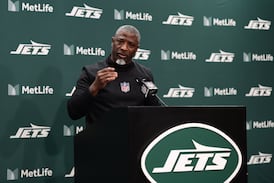
Editor's note: On July 23, one day after this story was published, NFL.com's new Rooney Rule section went live. It says the policy is "intended to ensure that qualified candidates from a wide range of backgrounds are identified and considered for leadership roles."
PATRICK GRAHAM SAT at a table set for five at a Jacksonville steakhouse in January 2025. He had shown up to meet with Jaguars owner Shahid Khan and team executives after interviewing for the head coaching job earlier that day.
The then-Las Vegas Raiders defensive coordinator waited alone for about 30 minutes, his hopes for getting the job fading minute by minute. He took a selfie with the empty chairs.
Graham didn't know it yet, but the group of Jaguars executives had not shown for the dinner because, at the same time, they were discussing a contract with future head coach Liam Coen, who had reentered the interview process after withdrawing the previous day. The dinner marked Graham's second awkward moment that day -- two NFL sources told ESPN -- as he had run into Coen while he was leaving the team facility, the first sign that Coen might have had the job in hand even as Graham interviewed for it.
The pain he felt that night as he waited at the table and for weeks after wasn't because he didn't get the job -- "that's life," he said -- it was because of the way he didn't get the job. "I was hurt through the process," Graham said.
Once home, Graham collapsed to his knees crying on the floor of his garage.
"It just made me think, like, 'Damn, I haven't done enough,'" Graham, now the Pittsburgh Steelers' defensive coordinator, told ESPN. "Football is pretty high on my priority list. And it felt like the thing that I hold in the highest regard let me down and crushed me."
Graham's story spread quickly throughout the NFL, and for other Black coaches, it sounded familiar: a perceived sham interview and a coach left questioning his worth and NFL future.
Graham was the second minority candidate to interview for the job in person, meaning the Jaguars were compliant with the NFL's Rooney Rule -- designed to even the playing field for underrepresented coaching candidates -- as soon as he walked out the door.
The Rooney Rule, which requires teams to interview minority candidates for several positions -- has seen successes over the past 23 years. (The NFL defines "minority" or "diverse" candidates under the Rooney Rule broadly, including Black, Latino, Asian, Indigenous and women candidates.) But significant progress remains elusive, and in some coaches' eyes, the NFL's interviewing process is so fraught with issues that they are taking themselves out of the interviewing process.
According to The Institute for Diversity and Ethics in Sport, in 2023, Black players made up roughly 54% of the league's rostered players. Yet only three of the 32 head coaches entering the 2026 NFL season are Black.
Today, the Rooney Rule is at a crossroads.
The policy faces a legal attack from Florida Attorney General James Uthmeier as part of his campaign to retain his seat -- the latest volley coming in May when he issued an investigative subpoena to the NFL over its diversity and hiring practices. And a lawsuit by former Miami Dolphins head coach Brian Flores, the most significant challenge to the NFL's hiring practices to date, is proceeding in federal court after the Supreme Court declined to hear the NFL's petition. Last week, a federal judge rejected another effort to move portions of the lawsuit to arbitration, ruling that those claims must proceed in federal court.
Over the past year, the NFL has walked back two programs that were a key part of efforts to improve equitable hiring. And the league is coming off the latest hiring cycle with only one minority head coach -- the Tennessee Titans' Robert Saleh -- hired among a record-tying 10 openings. Of the 16 minority candidates who interviewed for those jobs, 13 are Black. (Saleh is Lebanese American.)
Coaches remain so fearful and distrustful of the hiring process that many are not comfortable speaking publicly about it, but ESPN interviewed more than 20 executives, coaches and agents about how they view the league's efforts and the rule's effectiveness. Graham spoke with ESPN last summer about his experiences but declined to revisit them this offseason.
More than a dozen minority coaches declined to comment for this story, citing concerns that speaking candidly would jeopardize future opportunities. Among the 13 Black coaches who did speak -- some on the record but most anonymously -- the issue is clear: Even with hiring rules in place, they feel they cannot overcome ownership bias or the long-established relationships that shape hiring.
"There's no purpose of trying to rethink the rule until there's individuals in positions [of hiring power] that actually want to [hire] the best possible candidate for the job," Thomas Brown, the New England Patriots' tight ends coach and passing game coordinator, told ESPN. "... You would love to know when someone calls you about an interview that it's actually genuine.
"But if their thought process is to just check a box so they can hire whoever they want to hire ... that can't be controlled or regulated."
THE FIRINGS OF successful Black head coaches Tony Dungy and Dennis Green after the 2001 season prompted civil rights attorneys Johnnie Cochran and Cyrus Mehri to conduct a study on the performance of Black head coaches. In response to their 2002 report, which found that Black coaches performed better than white coaches but were fired more quickly, the league formed a workplace diversity committee. At the time, the NFL had never had more than four minority head coaches employed in the same season.
The committee's work resulted in the Rooney Rule, named after then-Steelers owner and committee head Dan Rooney.
The Rooney Rule initially required every team with a head coaching vacancy to interview at least one minority candidate -- internal or external -- before making a hire. Teams are now required to interview at least two external minority candidates for head coach, general manager, and coordinator vacancies, and at least one for quarterback coach and senior-level positions.
Three years after the rule's initial implementation, the number of minority head coaches in the NFL jumped to seven. But in the 20 years since, the number of minority head coaches each season has fluctuated between four and nine. Ahead of the 2026 season, there are five minority head coaches, the fewest since 2021.
Many of the rule's intended beneficiaries and the agents who represent them told ESPN that they think it is ineffective and question the rule's ability to combat ownership bias. As the league office fields such questions internally, it is also defending the rule against external legal challenges.
In March, Uthmeier threatened civil action against the NFL over the Rooney Rule, calling it "blatant race and sex discrimination." He followed up May 13 with the investigative subpoena to the league.
Following Uthmeier's original letter, the league changed the description of the Rooney Rule on its football operations website. The league removed the previously stated goal to "increase the number of minorities hired," which was a central criticism Uthmeier raised in his March challenge to the policy.
The NFL's previous Rooney Rule description (the change occurred between April 27 and May 7) said that diversity "enriches the game and creates a more effective, quality organization."
The website then said the Rooney Rule is a set of "best practices designed to expand opportunity" and the policy is intended to ensure "qualified candidates from a wide range of backgrounds are identified and considered for leadership roles."
The NFL said portions of the website had become outdated and told Uthmeier in a May 1 response letter that it was updating the site to reflect its current program and policies.
"We appreciate that your letter has brought to our attention some outdated information on the NFL's website regarding these programs," the NFL wrote to Uthmeier. "This information is in the process of being updated to accurately reflect the NFL's current programs and policies."
A spokesperson for Uthmeier's office declined to make him available for comment, instead referencing his social media post and letter to the NFL.
Then in June, the league redesigned the football operations website, and the dropdown tab labeled "Inclusion" -- which directed users to the page that highlighted the Rooney Rule, as well as pages that described inclusive hiring and the league's annual development event for women in football -- was no longer part of the site. As of publication, there was no reference to the Rooney Rule on the NFL's football operations site or on NFL.com.
An NFL spokesperson said Tuesday that the Rooney Rule and other inclusive programming content was being migrated from one platform to another and that the league planned to incorporate it elsewhere on NFL.com in the near future. (The spokesperson did not provide a specific date.)
Attorney Michele Meyer-Shipp, the interim executive director and board chair of the Fritz Pollard Alliance, an independent agency that works with the NFL on diversity initiatives in front offices and coaching, said the sociopolitical environment has shifted from supporting underrepresented groups to what she said now "feels like the exact opposite."
Even with that reality, Meyer-Shipp said that the legal standing of the Rooney Rule is what matters.
"Rather than getting caught up in all of the political banter and the ad hoc opinions of various folks across various constituent groups," she told ESPN, "it really is about what does the law allow us to do and not do? Based on what I know [the Rooney Rule is compliant]."
Jonathan Beane, an NFL senior vice president, said at league meetings in March that the NFL isn't influenced by the current political environment. Beane joined the league office in 2020 as SVP, chief diversity and inclusion officer. The word "diversity" is no longer in his job title. He is now SVP, league leadership and inclusion. A spokesperson for the NFL said the title change in November was not "cosmetic" but was "part of a broader departmental restructuring" and reflects his increased responsibility.
"I'm still here, right?" Beane told ESPN in March. "So, I think the commissioner has made it very clear that we are a league where we see the huge value proposition of diversity and inclusion."
NO DEVELOPMENTS HAVE put the Rooney Rule under focus more than the lawsuit against the NFL from Flores. In February 2022, he sued the league and three teams -- the Dolphins, Denver Broncos and New York Giants for being "rife with racism," in its hiring and promotion of Black coaches.
Flores, now the Minnesota Vikings' defensive coordinator, declined to comment for this story through a Vikings spokesperson.
Among his allegations: that Dolphins owner Stephen Ross offered him $100,000 per loss in 2019 to help with the team's draft position and that the Giants and Broncos conducted "sham" in-person interviews with him to comply with the Rooney Rule. He was fired Jan. 10, 2022, despite leading the Dolphins to their first back-to-back winning seasons since 2003.
In April 2022, Flores filed an amended complaint, adding allegations that the Houston Texans removed him from consideration for their head coach vacancy because of his lawsuit and that the Dolphins attempted to claw back money they had paid him in retaliation for filing the suit. Black coaches Steve Wilks, who sued over the Cardinals' hiring process, and Ray Horton, who sued over the Titans' hiring process, joined the lawsuit and alleged that they weren't provided genuine opportunities in their respective hiring processes.
Flores' legal team outlined several proposed changes in his complaint, including banning forced arbitration to handle legal complaints against the league. Standard NFL coaching contracts call for disputes to be settled in an arbitration organized by the commissioner.
"Teams, owners, the league should not feel that their decision-making process and their hiring processes will never see the light of the day," David Gottlieb, an attorney representing Flores, told ESPN.
A federal judge issued a split ruling in Flores' lawsuit in 2023, sending some claims, including those against the Dolphins, to arbitration, while allowing the broader claims, that Flores and other Black coaches face discrimination, to proceed in federal court. The NFL appealed that decision, but a federal appeals court allowed those claims to move forward publicly, with the court raising concerns in its ruling about the fairness of an arbitration system that could allow NFL commissioner Roger Goodell to serve as arbitrator.
The NFL filed a petition with the U.S. Supreme Court, which declined to intervene, allowing the case to proceed toward trial.
The league said in a statement regarding the decision: "We respect the Supreme Court's decision not to grant review. Regardless of the forum, we are fully prepared to defend ourselves as this matter proceeds."
On July 15, U.S. District Judge Valerie Caproni rejected another effort by the Dolphins, Cardinals and Titans to move portions of the lawsuit to arbitration, ruling that those claims must proceed in federal court. In the ruling, Caproni criticized the defendants' repeated attempts to avoid litigating the case.
"Defendants' seemingly-never-ending list of arguments why they should not have to litigate this case has run its course," she wrote.
THE EXPERIENCES OF Flores and Graham -- who are close friends from their days coming up as assistants on New England's defense -- mirror accounts from other Black NFL coaches interviewed by ESPN.
Brown, the Patriots assistant, told ESPN he learned hours before he interviewed for an offensive coordinator job that the team had already decided on another candidate, but the club needed to interview him to fulfill the league mandate.
Brown declined to name the team involved, saying it wouldn't change anything if he did.
Brown said a friend who worked with the candidate who ultimately got the job told him that the coach had already cleaned out his office before Brown's interview, a sign he knew he was getting the coordinator job. Brown said he called the club ahead of his interview to let them know what he'd heard.
"It was, of course, denied," he said.
Last offseason, New England's widely reported top head coach candidate, Mike Vrabel, was not under contract with an NFL club, so the team could hire him as soon as they complied with the Rooney Rule. Rather than wait until the Monday after the divisional round, the first day clubs are allowed to interview coaches in-person who are employed by other NFL clubs, New England interviewed Pep Hamilton and Byron Leftwich, Black former offensive coordinators who had been out of the league for two seasons. The Patriots announced their interviews with Leftwich and Hamilton in the same tweet.
"It's obvious that it was a circumvention of the spirit of the rule," Rod Graves, the former Cardinals GM and former director of the Fritz Pollard Alliance, told ESPN in an interview last fall. "There were other viable candidates available that could have been interviewed. Leftwich and Hamilton, I have a lot of respect for them, but they have been out of circulation."
Graham's experience, from the same 2025 hiring cycle, also had him labeled by some reporters and observers as an illegitimate candidate.
The Jaguars dispute parts of Graham's story. Graham and Jaguars team president Mark Lamping told ESPN that Lamping arrived late to have dinner with Graham, and that he was the only Jaguars executive to ultimately show up. Lamping told ESPN that he was about 25 minutes late for the 6:30 p.m. reservation because of a misunderstanding. Lamping said he was under the impression Graham no longer wanted to have dinner because Lamping had heard thirdhand through Jaguars employees that Graham was upset after finding out that Coen had also been in the building that day. Graham said he never told anyone with the Jaguars that he didn't want to go to dinner, and he also never heard from anyone that the dinner was off.
Jaguars executive vice president of football operations Tony Boselli was part of the interviews for Graham and Coen, and he told ESPN that despite multiple reports that Coen was discussing his contract to become the next head coach, the team was simply interviewing Coen and there was, "no negotiation of a contract during that night."
The Jaguars, in a statement to ESPN last September, said: "Our interview process for Patrick and candidates was conducted professionally, in compliance and always in good faith. The team considers this matter closed and wishes nothing but the best for Patrick throughout his career."
In a statement to ESPN in May, Graham added: "During the interview process with Jacksonville following the 2024 season, I mentioned previously that the communication and transparency could have been better. But I am also glad it worked out for Liam [Coen], and I wouldn't be here in Pittsburgh without that experience. I am grateful to be with the Steelers and excited about the opportunities that lie ahead in 2026 and beyond."
This year, Graham again interviewed for a head coaching position just before a club hired a white candidate. On Jan. 19, the Dolphins announced on X that they'd completed an interview with Lions defensive coordinator Kelvin Sheppard, who is Black. A few hours later, the team announced on X that they had also interviewed Graham. Later that afternoon, the team announced that it had completed a second-round interview with Jeff Hafley, and that night, Miami agreed to terms with Hafley to become its next head coach.
Dolphins general manager Jon-Eric Sullivan, who was hired 10 days before Hafley, denied that Sheppard or Graham were illegitimate candidates, but he acknowledged the tension the rule creates.
"The truth of the matter is, there's a pace and a timing as to which you have to move to make sure that you're going to get your guy, you can't get left holding the bag," he said at the NFL combine in late February. "At that point in the process, it was clear to us that Hafley was who we wanted to go after, and he had other options on the table."
Privately, coaches say that tension is well understood around the league. Publicly, few are willing to discuss it. "They'll purposefully blackball you for saying stuff that's controversial, even though it's true," an AFC assistant coach said.
"We can never say what we feel," said Hue Jackson, a former Cleveland Browns and Raiders coach, who is now the offensive coordinator and quarterbacks coach at Georgia State. "Because then you're seen as an outcast and somebody that could create turbulence in a building."
IN PRIVATE CONVERSATIONS among coaches and agents, the word "Rooney" is often used as a noun and metaphor for a token interview.
"My guys will use the term, 'I don't want to be the Rooney,'" said coaching agent Brian Levy, who represents former Steelers coach Mike Tomlin and former Atlanta Falcons and Tampa Bay Buccaneers coach Raheem Morris, among others. "'I'm not going to interview for that job because I don't want to be the Rooney.'"
Levy said he has talked to the league office's inclusion staff about how he thinks the Rooney Rule "has become a mockery" particularly at the coordinator level. He said most head coaches already have their ideal staff planned out well before they are hired, and the young white head coaches with an offensive background who are being hired tend not to be as familiar with marginalized coordinator candidates.
The NFL's Beane said he regularly talks to agents like Levy and coaches around the league about their frustrations with the Rooney Rule, but that the league doesn't intend to make any changes to the rule right now. "I would rather be on the side of us having a policy that expands the talent pool, than not having something where somebody can just go and hire whoever they want," Beane told ESPN.
Levy said each year he receives multiple calls from clubs to request interviews with clients who are minorities for jobs that he knows are already filled or promised to other coaches. "It's obviously a broken system," he said.
"Candidates start to get fed up two or three cycles in and getting gratuitous interviews. Guys just want to be really careful, because every time you interview and don't get something, it's a failed interview. And (agents don't want to send) Black coaches into an interview setting where they have no opportunity."
Coaching agent Juan Lozano, who represents several minority assistant coaches for Red Envelope Sports, said disingenuous interviews greatly affect coaches.
"Coaches internalize their lack of success going through the process and think, like, 'What's wrong with me?' When it could have nothing to do with you," Lozano said. "... No amount of what you say or do at the interview is going to change the fact that they're going to go for the guy that they've already envisioned."
Lozano said that when he looks for opportunities for marginalized offensive assistant coaches, he considers the club's hiring history and how it sets up coaches within the organization. "Has the organization let the minority coaches around the QB?" he said. "Because there are many instances of minority quarterbacks that got into coaching that are coaching wideouts and running backs in perpetuity."
One assistant coach told ESPN that he interviewed for several NFL quarterback coach jobs over the past two hiring cycles even though he knew that the jobs were already promised to different coaches. In each case, he said he didn't tell anyone about his interview so that it wouldn't be reported publicly and held against him later as a person who had been rejected for other jobs. Teams are required to share their interview candidates with the league office, but outside of head coach interviews, don't have to announce them publicly. Some interviews are kept secret often at the request of the interviewee.
"If you don't play the [Rooney] Rule game, they're going to say this person doesn't play," another assistant coach said. "'He doesn't abide by the rules,' So it's darned if you do, darned if you don't. They just need [Black coaches] to play the game."
On Jan. 8, 2025, 49ers coach Kyle Shanahan overlooked the Rooney Rule. At his end-of-season news conference, Shanahan announced the team would be promoting Klay Kubiak, a white coach, from passing game specialist to offensive coordinator.
It was only after that statement that the 49ers then interviewed two Black college coordinators -- Noah Pauley, who was then the receivers coach and pass game coordinator at Iowa State, and Junior Adams, who was Oregon's co-offensive coordinator -- before officially promoting Kubiak on Feb. 25. The Dallas Cowboys hired Adams to be their receivers coach shortly after he interviewed with the Niners and the Green Bay Packers hired Pauley in March as wide receivers coach. A Packers spokesperson declined to make Pauley available for comment. Adams also declined to comment.
The 49ers faced no discipline.
"We're in a profession where there's not a lot of people in the higher-ups that look like us," one former NFC assistant said. "The people that look like us are the players. It's a bigger problem than coaches just talking about it."
The league's ownership ranks remain overwhelmingly white. The NFL has no Black majority owner. Jacksonville Jaguars owner Shahid Khan is Pakistani, Buffalo Bills co-owner Kim Pegula is South Korean and new Seattle Seahawks controlling owners Vinod and Neeru Khosla are Indian.
"It's just checking off boxes -- and the owners don't have to comply," one former NFL offensive coordinator said of the rule.
THE MODERN HEAD coaching pipeline runs through the offense. Twenty-two of the 32 current head coaches have offensive backgrounds. Yet there are only three minority offensive coordinators entering the 2026 season: Mike McDaniel (Los Angeles Chargers), Eric Bieniemy (Kansas City Chiefs) and Nathan Scheelhaase (Los Angeles Rams). Of those, McDaniel is the only playcaller.
There are five minority quarterback coaches: Israel Woolfork (Ravens), Bush Hamdan (Dolphins), Ashton Grant (Patriots), D.J. Williams (Washington Commanders) and J.T. Barrett (Chicago Bears).
The most coveted coaching pipelines flow through the offensive staffs of Shanahan and Rams coach Sean McVay -- two of the league's most-respected minds, both white. Nine current head coaches have ties to Shanahan's or McVay's staffs, including six from the offensive side of the ball. All six are white.
Shanahan worked with Packers head coach Matt LaFleur, McDaniel and Saleh when Shanahan was the offensive coordinator for the Texans in 2008, coaching under Gary Kubiak. Years later in San Francisco, Shanahan hired Mike LaFleur, Matt's younger brother, McDaniel, Saleh and two of Kubiak's sons, Klint and Klay.
"There has yet to be in the history of the NFL, a Black offensive coaching family," one former AFC coach said. "There is not a circle that we have that says, 'Hey man, Tee Martin is out with the Ravens, man, let's pick him up.' 'Brian Johnson is out with the Eagles, man, let's pick him up.' Or whoever, right? 'Jerrod Johnson is out, man, let's pick him up.'
"Whereas our counterparts, they could circle the track four or five times before they're out."
To address that imbalance, in 2022, the NFL introduced two programs aimed at creating a pipeline for minorities, the diversity accelerator and a minority offensive assistant hiring mandate. Neither of those initiatives lasted into 2025.
The minority assistant mandate mirrored a proposed change listed in Flores' suit, which called for teams to be required to employ a Black quarterbacks coach or assistant quarterbacks coach to help create a pipeline to the offensive coordinator and head coach positions. In Florida AG Uthmeier's subpoena, he requests documents showing that the league discussed implementing the mandate before Flores' suit.
The accelerator connected minority candidates with team owners and senior executives for networking and professional development.
The league paused the program in 2025 to "reimagine" it, and when the program returned in May, 48% of participants were not minorities, and it shifted its focus to more senior-level candidates.
One offensive assistant told ESPN that he declined invitations to the accelerator program multiple times because the timing always fell during OTAs, when he said he was already getting on-the-job development. He also said he viewed the program as a "mild slap in the face."
"To say we [minority coaches] need an accelerator, and no one else is there," the coach said. "So no one else needs development?"
The minority assistant mandate required all 32 teams to hire a minority offensive assistant, with half of their salary reimbursed by a leaguewide fund. The resolution stated that the assistant must have "regular and direct contact" with the head coach and the offensive coordinator, offensive line, quarterback and tight end coaches with duties that included contributing to offensive game-planning.
The league office touted the resolution widely at the start. Beane, the NFL SVP of leadership and inclusion, said that all 32 clubs were in compliance with hiring a minority assistant used somewhere on offense, but that the league office couldn't ensure that every team actually used that coach in the QB room or in offensive game-planning, key developmental roles that often produce head coaching hires.
ESPN reported May 13 that ahead of the 2025 season, the NFL quietly stopped requiring clubs to hire a minority offensive assistant and stopped reimbursing clubs for half the salaries, essentially ending the initiative after only three seasons.
"I think [the hiring mandate] had some success in some areas and not as much success in other areas," Steelers owner Art Rooney II, the chair of the league's diversity committee, told ESPN in March.
One offensive assistant coach who was hired under this requirement told ESPN he was supposed to be in the quarterbacks room until the club he worked for decided that their quarterback couldn't have too many voices in his ear, so the coach was moved to work with a different offensive position, not among those required by the resolution.
Scheelhaase, one of three minority offensive coordinators this season, got his start in the NFL in 2024 with the Rams through the mandate. He said it placed him in rooms he wouldn't have been in otherwise, and he's hoping it returns.
"There is a lot of value in programs like that because they create access and exposure -- especially to the offensive side of the ball," he told ESPN. "With league [hiring] trends, to be involved on the offensive side of the ball in the NFL ... that's where there's opportunity for growth.
"Certainly, that's what happened in my situation. Being in L.A. and learning from Sean [McVay] and the staff he put together ... I know how much it benefited me."
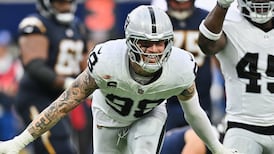
IN APRIL 2025, Graham stood in front of his defensive players and showed them the photo he'd taken while he sat alone at the Jacksonville steakhouse table set for five. It was the first day of the Raiders' offseason program, and he wanted his new group of players to see him at his most vulnerable.
As Raiders players listened to Graham's story, some shook their heads and muttered, "Can't believe it went down like that."
"Part of him was broken," said Las Vegas defensive end Maxx Crosby, who was in the meeting that day. "... You're telling somebody they got a chance, but really, they already had their mind made up, which is super disrespectful."
Graham, a 17-year NFL coaching veteran, was the Raiders' defensive coordinator for four seasons, leading one of the league's biggest turnarounds in 2023, when Las Vegas jumped from 26th in points allowed to ninth (19.5). The Raiders' defense took a step back in Graham's final two seasons, but his work in Las Vegas made him one of the league's most respected coordinators and earned him a job on Steelers coach Mike McCarthy's staff.
In Pittsburgh, Graham will have another opportunity to prove he has the skill to become a head coach, with one of the league's more talented defenses, and to shake the Rooney Rule label some reporters and observers attached to him.
"For my life's work, I never wanted there to be a question about my worthiness, aside from my merit," Graham said.
But many minority coaches say there is a limit that merit alone can take them.
"You have to accept that you have a glass ceiling and golden handcuffs on," one assistant coach said.
For Graham, that lesson was learned while sitting alone at a table in Jacksonville.