
It goes without saying that optimism about the Canucks is hard to come by right now in Vancouver.
The roster is thin on talent, and the organization has signalled it is prepared for a deep rebuild. There’s persistent chatter about the team’s internal budget, trade speculation is rampant, and they enter the 2026-27 regular season with the NHL’s longest odds at winning the Stanley Cup.
It’s ugly, for now, in Vancouver. But this league is reliably cyclical, and what comes after a painful rebuild can be incredible if executed correctly. The first step is an organizational tear down, and the Canucks attempted that this off-season.
Back in May, the Canucks parted ways with both general manager Patrik Allvin and head coach Adam Foote, replacing them with familiar faces from AHL Abbotsford. To that end, Ryan Johnson has taken over the managerial reins, and friendly face Manny Malhotra was promoted to his first NHL head coaching gig. It’s a start.
Up next? Figuring out which parts of this roster are part of the future in Vancouver. With former captain Quinn Hughes gone to Minnesota, most of the focus has been on the struggling Elias Pettersson and his sizable $11.6 million cap hit. Jake DeBrusk has also been at the forefront of the discussion. The veteran winger seems like an inevitable trade piece to a contender, perhaps as early as next season’s trade deadline.
But the most interesting opportunity, painful as it may be in the short term, concerns another veteran winger in Brock Boeser. Boeser has been in and out of trade speculation as well, but a $51-million extension (with a no-movement clause) in the summer of 2025 put a lid on that – temporarily, anyway.
I think Boeser, 29, is better than he’s shown in the past couple of years (injuries have not helped here) but dealing a player whose best days are likely behind him should be on the board for Vancouver. Teams around the league see a guy who scored 40 goals as recently as two seasons ago, but longer-term trends suggest that sort of production might be in the rear-view mirror forever.
What’s made Boeser such a productive player over the years is an elite, highly accurate wrist shot that leads to chunks of goals. Consider his rate scoring over the years, the left at even strength and the right on the power play:
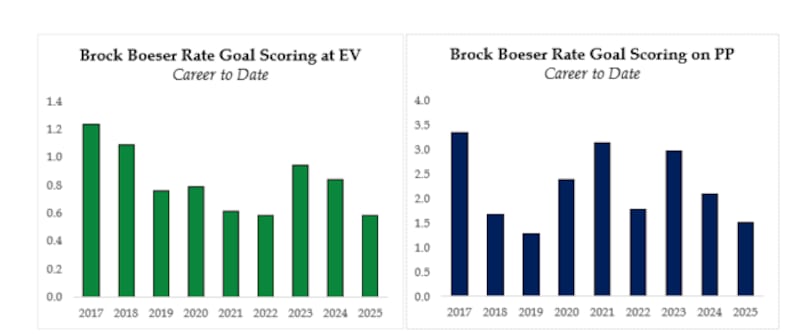
This is still a very productive middle-six winger, but neither of these career-long trends are encouraging about future performance. Boeser’s even-strength scoring has considerably slowed, and his power-play production last season was also near a career low.
I think there’s an interesting debate about how much team effects might be playing a role here. On one hand, Vancouver is a relatively talent-thin team these days and in the post-Hughes world, their power play looked rancid.
On the other hand, it’s not like Boeser didn’t have weaponry around him. His most common teammates over the past two years were defencemen Filip Hronek and Hughes, as well as forwards DeBrusk, Pettersson, and J.T. Miller – more or less the best of the best of what Vancouver had to offer.
Boeser’s two-year scoring comparables at even strength are a quality group, but other than the injury-ravaged Mikko Rantanen, there are no first-line forwards to be found:
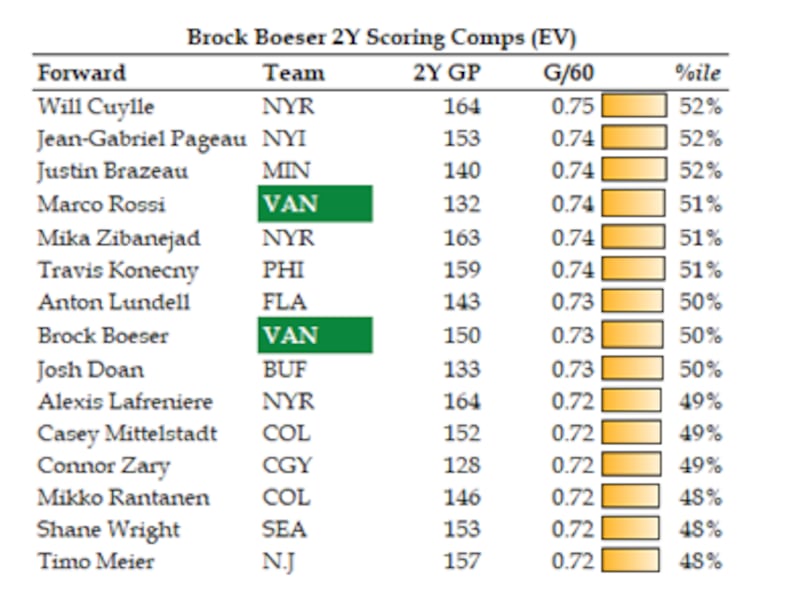
Scoring, of course, is just one element of the game, albeit an important one for a shooter the calibre of Boeser. It’s worth highlighting that broad statistical measures are also starting to show caution flags in Boeser’s game.
Consider Boeser’s percentile rank amongst forwards by way of Goals Above Replacement, which isolates for a player’s individual impact across all game states relative to a replacement-level player. (via Evolving Hockey).
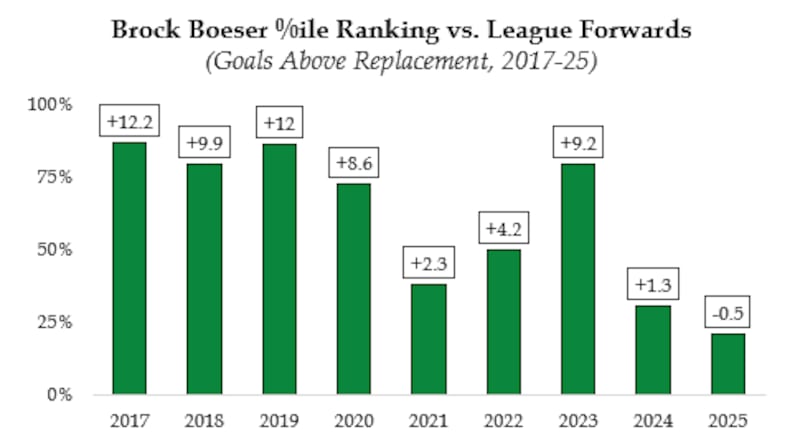
The question I think Vancouver must consider here isn’t whether or not Boeser will see a rebound in his play as the team around him improves. I think you can accept that as your best-case scenario, but it’s the timeline that is the real issue.
Boeser is 29, coveted around the league, and playing on a team that’s going to get worse before it gets better. Given the fact we have likely seen his best years already, does the timeline of keeping Boeser around make sense, or is he the coveted trade asset you cash in on to accelerate the quality of this rebuild?
It can be painful to part with such a pivotal part of the organization, but hockey is a business, and I suspect the business case of shipping Boeser out is more compelling than the case for keeping him around.
Data via Natural Stat Trick, NHL.com, Evolving Hockey, Hockey Reference