The Edmonton Oilers and Toronto Maple Leafs went into this summer with an aggressive plan to upgrade the goaltending position. And they landed on two veterans with incredible experience - the Oilers inking Frederik Andersen to a one-year deal, and the Maple Leafs signing 37-year old Sergei Bobrovsky for three seasons.
There’s no questioning the Stanley Cup pedigree of either; we just watched Andersen carry the Carolina Hurricanes to a Stanley Cup, and Bobrovsky’s collected so much individual hardware the Hockey Hall of Fame might already be working on his statue.
But given their ages and the mileage they’ve incurred over the years, there’s a fair question about how much they can reasonably move the needle for two teams with meaningful post-season aspirations this year.
Goaltenders age much more gracefully than their skating counterparts, but the injury risk and degradation in play is still heightened for guys in their late thirties. I think both organizations recognize this and as such have insulated their depth charts at the position.
In Edmonton, we expect Andersen to rotate minutes with the likes of Tristan Jarry and Devon Levi. In Toronto, there several options as well – including Anthony Stolarz and Artur Akthyamov.
Statistically speaking, I was curious about the track record of late thirties goaltenders in the modern NHL. Most of the goalies tabled below provide good comparables for baseline purposes; they were very successful for a long period of time (and accumulated heavy mileage as a result), were pushed into minute-sharing or platoon roles later in their career, and yet were still expected to provide credible play on contending teams.
How did these goalies fare?
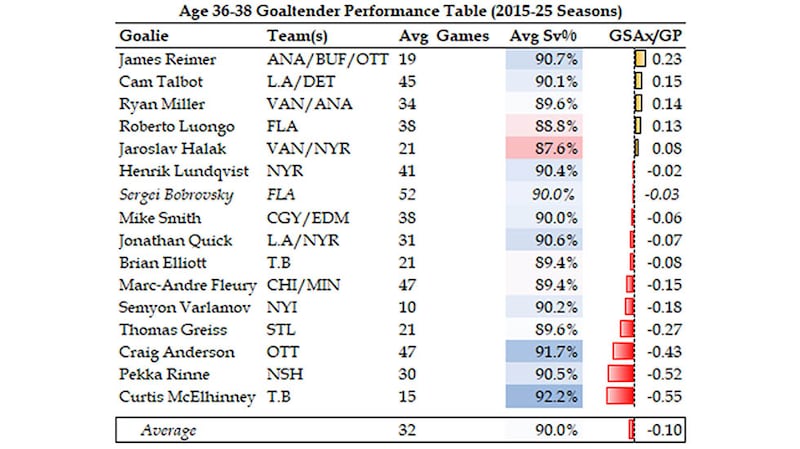
The straightforward answer to that question: the floor may be somewhat high, but the ceiling is also limited. There may be heaps of Vezina Trophies on this table, but outperformance from goalies in their late thirties is exceptionally hard to find. Relatively speaking, it’s easier to find blow up seasons; Craig Anderson’s end behind a talent-thin Ottawa team in 2017-19 and Pekka Rinne’s illustrious career ending with two ugly seasons in Nashville (2019-21) are likely the most notable here.
I did also include Bobrovsky’s final season in Florida at age 36 here because it qualifies; like Anderson and Rinne, the team in front of him was weaker and likely had an impact on his overall play. His season was OK – good enough to believe there’s more juice in his tank, but certainly less impressive than his trophy-collecting years.
More broadly, consider a distribution of every late thirties goaltender’s single-season performance (measured via Goals Saved Above Expected); you can see there’s a bit of an ugly left tail here, which indicates there’s more risk of a blow-up than catching a goaltending heater:
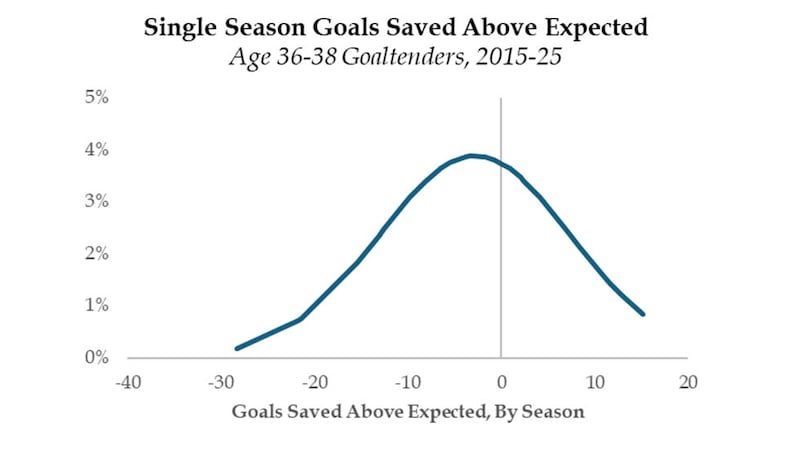
I think the most encouraging thing both organizations have done is destress the anticipated workload for each goaltender. When you have depth, coaches can not only avoid goaltenders playing back-to-backs altogether, but they can also strategically rest older goaltenders through stretches of the schedule in advance of a postseason push. That may be more important for Andersen than Bobrovsky; Andersen’s injury history is significant and a likely reason why he was only signed to a one-year contract versus Bobrovsky’s three.
Overall, I think both bets by the front office are reasonable; there’s no doubt Andersen and Bobrovsky bolster the goaltending depth chart and are dream options to man the crease come playoff time. But fans should also be realistic about what these goalies are likely to contribute at this point of their respective careers – history tells us veteran goaltenders still have a place in this league, but their ability to outright steal games may be no longer.
Data via Natural Stat Trick, NHL.com, Evolving Hockey, Hockey Refference