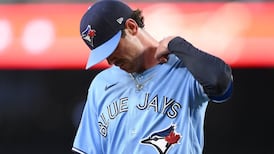
This year’s postmortem is a far cry from the positivity of the 2025 season. There was no champagne spilling this season for the Blue Jays. No goggles and cigars. Just disappointment and awkward press conferences.
The season started poorly and never got better. The Jays went 14-17 in March and April. They went 15-14 in May, 11-15 in June, 11-13 in July, 17-11 in August and 11-14 in September. It all adds up to a 79-83 record and a last-place finish in the tough AL East.
So, what went wrong?
Injuries were an issue
Health was certainly a challenge. The season began with Shane Bieber, Jose Berrios, Yimi Garcia, Trey Yesavage and Anthony Santander on the injured list. Santander, Berrios and Garcia missed the entire season.
Then, in his first start of the season, Cody Ponce tore up his knee and was lost for the year.
Shortly after that in early April, the Jays lost two key players to injuries: Alejandro Kirk fractured his thumb and missed two months. Addison Barger had bilateral ankle sprains and only returned for a single game in May before an elbow injury cost him the rest of the season.
In mid-April, George Springer broke his toe and landed on the injured list for a couple of weeks. Later in April, Nathan Lukes injured his hamstring and missed substantial time.
Oft-injured Max Scherzer had forearm issues and ankle inflammation that landed him on the sideline as well at the end of April. Scherzer returned in early June only to be placed back on the IL with back spasms where he would stay for six weeks before his return at the end of July.
In late May, ace starter Dylan Cease had a hamstring injury that cost him four starts.
At the end of June, lefty-hitting outfielder Jesus Sanchez hurt his ankle and missed an entire month. The Jays called up Jonatan Clase to replace Sanchez and he lasted three weeks before plantar fasciitis sent him to the IL.
With all of the pitching injuries at the end of spring training, the Jays got desperate and signed free agent Patrick Corbin, who was at home awaiting an opportunity. The Jays added him the roster on April 7 and he lasted until July 23 when he suffered a teres major strain, which cost him the rest of the season.
Yesavage started the season injured but was activated at the end of April and he stayed healthy until a balky knee in early August landed him back on the IL and on the operating table. He missed six weeks before a late-season activation. At that point it was too little, too late.
There were also injuries to depth players along the way. These are players who replaced players who had been injured. Lenyn Sosa (wrist), Luis Urias (hamstring), and outfielder Rudy Martin Jr. (hamstring) also missed time. Relievers Tommy Nance (elbow), Joe Mantiply (knee), and Lazaro Estrada (elbow) missed significant time as well.
It got even worse when Jays traded for Jameson Taillon from the Cubs and got 10 innings out of him before his elbow gave out.
Even Vladimir Guerrero Jr. missed time on the concussion injured list.
I felt it was necessary to lay out all of the injuries to truly appreciate how in flux the Jays’ roster was during the season. It is hard to get a rhythm with so many moving pieces.
The Jays used 38 different pitchers and 23 different position players in 2026, compared to 30 pitchers and 24 position players in 2025.
Offence stuck in season-long swoon
Underperformance was certainly an issue as well for the poor outcome in 2026. The pitching numbers this year are not dramatically different than a year ago. In fact, if anything the pitching was slightly better as they allowed 28 fewer runs.
The offence was another story. The Jays scored 798 runs in 2025, which was the fourth most in baseball. In 2026, they scored the fewest runs of any team (643). That is 155 fewer runs, which is almost a run per game less. Therein lies the reason for the failures of the 2026 season.
That decline begins with the two heart-and-soul players on the team – George Springer and Guerrero. In the run to the World Series last year, these two were the most important players on the team.
Springer, 37, hit .309/.399/.560 with 32 home runs with 84 RBI and 106 runs scored last year compared to .249/.321/.405 with 15 homers and 54 RBI in 2026. He wasn’t anywhere near the same player.
Guerrero was even worse than Springer in his age-27 season. He hit .260/.332/.356 with only nine home runs and 57 RBI. In 2025, he hit .290/.381/.467 with 23 homers and 84 RBI and 96 runs scored. He only hit one homer at home the entire season. It was one of the biggest drop-offs from one season to the next that I have ever seen for a superstar player. Considering that it is the first year of the 14-year, $500 million contract extension that he signed last year makes it even worse.
Age can certainly explain some of Springer’s decline but that is not an excuse for Vladdy. The most surprising thing was that Guerrero could not make any adjustments to get back on track.
In 2025, the Jays got major run production from four key players who didn’t come close to the same numbers this year due to injuries and/or underperformance: Kirk (dropped from 76 RBI to 43), Lukes (65 RBI down to 43 RBI), Addison Barger (74 RBI down to 2 RBI), and Dalton Varsho (.832 OPS down to .682 OPS).
The team had a collective offensive slump among their key contributors that they never solved.
Thank goodness for off-season acquisitions Kazuma Okamoto, Dylan Cease, Tyler Rogers and Spencer Miles.
Okamoto led the team in home runs (33), RBI (92) and runs scored (81). Plus, he played an adequate third base and fit in well in the clubhouse. He is a keeper and a bargain with a four-year, $60 million contract.
Cease (11-6, 2.40 ERA, 239 strikeouts) will likely finish second to Yankees starter Cam Schlittler for the Cy Young Award. The Jays righty was consistently good all season until he ran out of gas in mid-September with shoulder inflammation. He proved to be a workhorse and a bulldog on the mound and a leader of the staff.
Rogers appeared in the sixth most games (74) among relievers and pitched to a 1.77 ERA. He was outstanding in high-leverage situations. He was one of the best relievers in baseball.
Spencer Miles (6-2, 2.63 ERA) was a pleasant surprise this year too as the Rule V draft pick emerged as an impact pitcher who could factor as a starter or reliever moving forward.
Schneider and Atkins will have to dig for answers
Despite the poor season, I actually think GM Ross Atkins did a good job overall. He had a roster that went to the World Series last year and added four players who performed very well. He plugged holes all season long whenever there was a need. He made trades, waiver claims and call-ups keeping up with roster needs.
He was very creative at the trade deadline as he sold and bought at the same time. Brett Bateman, acquired from the Cubs in the Kevin Gausman deal, is a solid outfielder with excellent plate discipline. He will be the starting centre fielder next year. The Jose Soriano acquisition from the Angels gives the Jays a head start on rebuilding the rotation for next season.
John Schneider didn’t turn into a bad manager this season. His team underperformed. I do think he could have managed Guerrero differently, though. Schneider was reluctant to move Guerrero down in the lineup when he was struggling. He didn’t want to upset his star player. After all else failed in getting Guerrero going, a demotion in the lineup was warranted. If it made him upset, then so be it. Disrupting a player’s energy and emotion is needed sometimes, in my opinion.
Schneider and Atkins will have to dig for answers for the offensive malaise that was contagious this year with the returning players and get their off-season plans in place now. Remember, once the current CBA expires on Dec. 1, there will likely be a lockout and clubs will not be able to interact with their players in any way. The players will need to have their off-season plans in hand, as there will not be accountability to the team until a deal gets done.
In the meantime, Atkins will have to be prepared to rework his offense and rotation as soon as the game reopens. He won’t be able to negotiate with agents of players during the lockout. He will need a clear decisive plan when the flood gates open again as a quick reconstruction needs to be done on the roster.