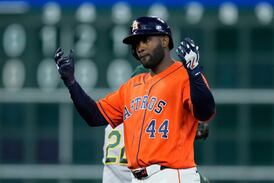
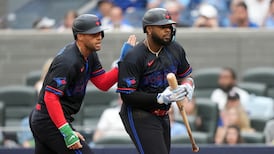
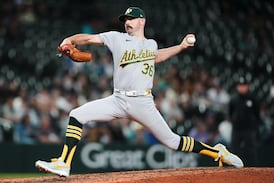
Last October, Cal Raleigh and Vladimir Guerrero Jr. faced off against each other in the ALCS. Raleigh was coming off a 60-homer campaign, and Guerrero went off over the course of the postseason, hitting .397 with eight home runs and 15 RBIs in 18 games.
Their encore performances in 2026, however, have been a disaster. Raleigh, while hot of late (he was the AL Player of the Week last week), is still hitting just .172 with 20 home runs, with fewer hits (64) than the 65 home runs he totaled in 2025. Guerrero has a .693 OPS and remarkably hasn't homered in Toronto all season.
Those two aren't the only stars of 2025 who have suffered through injuries or performance issues this season. Reigning AL MVP Aaron Judge hasn't played since May 31 due to a stress fracture in his right rib. Garrett Crochet, last year's AL Cy Young runner-up, has missed most of the season. Juan Soto, Francisco Lindor and Hunter Brown missed time with injuries. Jose Ramirez has had his worst season since he was a part-time player in 2015. Julio Rodriguez is on track for the lowest batting average, on-base percentage and slugging percentage in his five seasons in the majors. Paul Skenes is trying to keep his ERA under 4.00 instead of 2.00. Trea Turner finished fifth in the NL MVP voting a year ago with 5.4 WAR but has been below replacement level in 2026.
Indeed, this has been one of the most important storylines of the season: the fallen stars of 2026. We'll look at how some of these performances have affected the playoff races, but first let's check: Is 2026 an outlier?
You would expect any group of players who had great seasons to be collectively less valuable the following season. To check out how 2026 compared to other seasons, I went back to 1995 and used Baseball-Reference WAR to see how the top 10 players in the MVP voting and top three in the Cy Young voting fared the following season. This gave a list of 21 to 26 players for each year, depending on how many pitchers finished in the top 10 of MVP voting (for National League pitchers in the pre-DH era, only pitching WAR was considered). WAR numbers for 1995 were prorated to 162 games, as were the current figures for 2026.
It turns out that, yes, 2026 has seen a pretty extreme decline in value -- and these numbers don't even include Guerrero, who finished 13th in the MVP voting so wasn't included in the study. The 2025 group of 23 players combined for 145.1 WAR and are on pace for 87.2 WAR in 2026, a 39.9% decrease. That would be the third-largest decline since 1995:
1. 2011-12: 44.0%
2. 2009-10: 42.8%
3. 2025-26: 39.9%
4. 1995-96: 39.5%
5. 2004-05: 38.0%
The average year-to-year decline in value is 31.3%, with a low of 16.6% from the 2017 group. While a high starting value of collective WAR can affect the following season's decline, that wasn't the case for our 2025 group of top 10 MVP/top three Cy Young finishers. The average WAR of 6.3 per player is right at the overall average of 6.3 over the 29 years in the study.
Obviously, these declines have had a big impact on the success of these players' teams this season. Let's dive into the causes behind their down years, as well as the extent of that impact.
Cal Raleigh, Seattle Mariners (7.2 WAR to 0.9)
Primary cause: Higher strikeout rate; much lower hard-hit rate; can't catch up to fastballs; might have played through an oblique strain earlier in the season before finally going on the injured list for a month.
The Mariners finished ninth in the majors in runs per game in 2025 with Raleigh leading the way. This year? They're last, at 3.96. That's not all on Raleigh, but after creating an estimated 49 runs above average in 2025, he's at seven runs below average in 2026, a 56-run difference. The Mariners are on pace to score 124 fewer runs than last season.
Julio Rodriguez, Seattle Mariners (6.6 WAR to 2.5)
Primary cause: Declining hard-hit rate (95th percentile as a rookie, career-low 65th percentile in 2026); unimproved chase rate; poor defensive metrics.
Like we said, it's not all on Raleigh. J-Rod was 24 runs above average in 2025 and is just two runs above average in 2026 -- with a significant decline in his defensive metrics as well (plus-9 runs saved in 2025, minus-4 in 2026).
Rodriguez was so good as a 21-year-old rookie in 2022 that his future seemed unlimited, a player who would contend for MVP awards on an annual basis. But his batting average and on-base percentage have declined each season as he hasn't made the adjustments that we've seen other players make, such as Pete Crow-Armstrong this season. At times, J-Rod has been one of the top all-around players in the league -- the Mariners can only hope that 2026 won't be a permanent step backward.
Vladimir Guerrero Jr. (4.6 to 0.9), Toronto Blue Jays
Primary cause: Shocking lack of power; declining chase rate (89th percentile in 2025 to 44th percentile); drop in number of "barrels."
George Springer (4.8 to 0.8), Toronto Blue Jays
Primary cause: Struggled against fastballs; more ground balls; lower rate of "fast swings" leading to a lower hard-hit rate (78th percentile down to 36th percentile).
Guerrero didn't finish in the top 10 of the MVP voting, but Springer did -- and his OPS has dropped from .959 last season to .743. Springer's decline was certainly more predictable, given that his 2025 season was the highest adjusted OPS of his career (at age 35). With Guerrero and Springer leading the decline, the Blue Jays have dropped from 4.93 runs per game, fourth in the majors in 2025, to 29th in 2026 at around 4.00, better than only ... the Mariners.
Paul Skenes, Pittsburgh Pirates (8.0 WAR to 2.4)
Primary cause: Worse luck on balls in play; four-seamer velo has dropped from 98.2 mph to 96.9 (although it appears to be a deliberate choice in an attempt to stay healthy); changeup has been less effective; .309 average allowed with runners in scoring position compared to .181 in 2025.
This is a shocking one given Skenes' 1.96 ERA through his first two seasons in the majors and because it doesn't appear to be injury-related (that we know), like most of the year-to-year declines you'll see from pitchers. The Pirates are 5 games out of the final wild card, so a better Skenes would have them right there in the playoff picture. While he has certainly seen some bad BABIP (batting average on balls in play) luck with a porous Pittsburgh defense behind him, that alone doesn't explain his 4.97 ERA since May 17. Philly's Cristopher Sanchez has an even worse BABIP than Skenes (.337 to .310), but he has still managed a 2.52 ERA.
Aaron Judge, New York Yankees (9.7 WAR to 1.9)
Primary cause: Injury
After back-to-back 50-homer seasons and MVP awards, Judge's rib injury has led to a distressed Yankees offense that is on pace to score 114 fewer runs than in 2025. Since June 1, without Judge, the Yankees are 25th in the majors in runs scored -- although Yankees right fielders are actually seventh in the majors in OPS since that date. That suggests the offensive problems haven't so much been an inability to replace Judge, but a result of declines from other players as well, such as Austin Wells, Trent Grisham and Jazz Chisholm Jr.
Garrett Crochet, Boston Red Sox (6.0 WAR to -0.5 WAR)
Primary cause: Injury
This has perhaps been the biggest injury of the entire season, as Crochet went down after six starts with a 6.30 ERA -- and yet the Red Sox have managed pretty well without him. They are just outside the top 10 in rotation ERA, but after bottoming out at 29-43 on June 18, the Red Sox have the best record in the majors and the rotation is just outside the top five in ERA. Offseason acquisition Sonny Gray has led the way, going 16-4 with a 2.82 ERA, while rookies Payton Tolle, Jake Bennett and Connelly Early (before he was traded) have all posted ERAs under 3.50.
Trea Turner, Philadelphia Phillies (5.4 WAR to -0.5)
Primary cause: Batting average down against fastballs; terrible defensive metrics due to lack of range; career-low BABIP compared to lifetime mark.
Turner won the NL batting title last year with a .304 mark and also posted much-improved defensive metrics after rating poorly in 2023 and 2024. This year: He's hitting a lackluster .239/.292/.376 and his defense has been noticeably worse again. He ranks in the fourth percentile of Statcast's outs above average and is last among all shortstops with minus-14 defensive runs saved. The Phillies have allowed a .308 average on balls in play, with only the Athletics and Colorado Rockies worse in that department, and Turner's lack of range is a big part of that. The Phillies will make the playoffs barring a September collapse, but a better Turner would have them neck-and-neck with the Atlanta Braves in the division instead of four games behind.
Juan Soto (6.1 WAR to 2.8), New York Mets
Primary cause: Injury
Francisco Lindor (5.8 WA to 1.3), New York Mets
Primary cause: Injury and performance (suffered a calf injury in April); worst defensive metrics of his career; hitting just .211 against fastballs; struggles against left-handers
Injuries are the big factor here, as Soto has played in 89 games and Lindor 83. Soto has been excellent at the plate when he has played, but Lindor has his worst numbers since his difficult first season with the Mets in 2021. He'll be 33 next season, so there will be concerns heading into 2027 about whether he can still be an elite top-10, MVP-type player. As for the Mets, even a healthy Soto and Lindor wouldn't have saved this disaster of a season.
Jose Ramirez, Cleveland Guardians (5.9 WAR to 2.2)
Primary cause: Probably the injury (but age could also be a factor).
Ramirez has been so consistent for so long -- a top-10 MVP finish in eight of the previous nine seasons -- that it seemed like he would just roll along forever. He fractured his hamate bone on June 13 and missed a month, and he has a .651 OPS since returning. He's 33 now, and his numbers were also down before the injury (.757 OPS), so his season is difficult to assess. From June 14 to July 21, without Ramirez, the Guardians went 15-15 with a .691 OPS, right at their season OPS total of .686, so missing Ramirez didn't have a big impact on the AL Central race.
Tarik Skubal, Detroit Tigers/Los Angeles Dodgers (6.4 WAR to 3.5)
Primary cause: Injury
Well, maybe Skubal's injury will prove to be the biggest of 2026 -- especially if he helps the Dodgers win another World Series. He missed over a month of action, April 30 to June 12, after elbow surgery, and the Tigers went 14-25 when he was on the injured list. The Tigers were 6½ games out of first place on Aug. 1 when they agreed to trade Skubal, and 3½ out of the wild card. If Skubal hadn't missed that time and the Tigers won two or three of the starts he missed, maybe they would have been close enough in the race that they would have keep Skubal (and Casey Mize). Maybe.