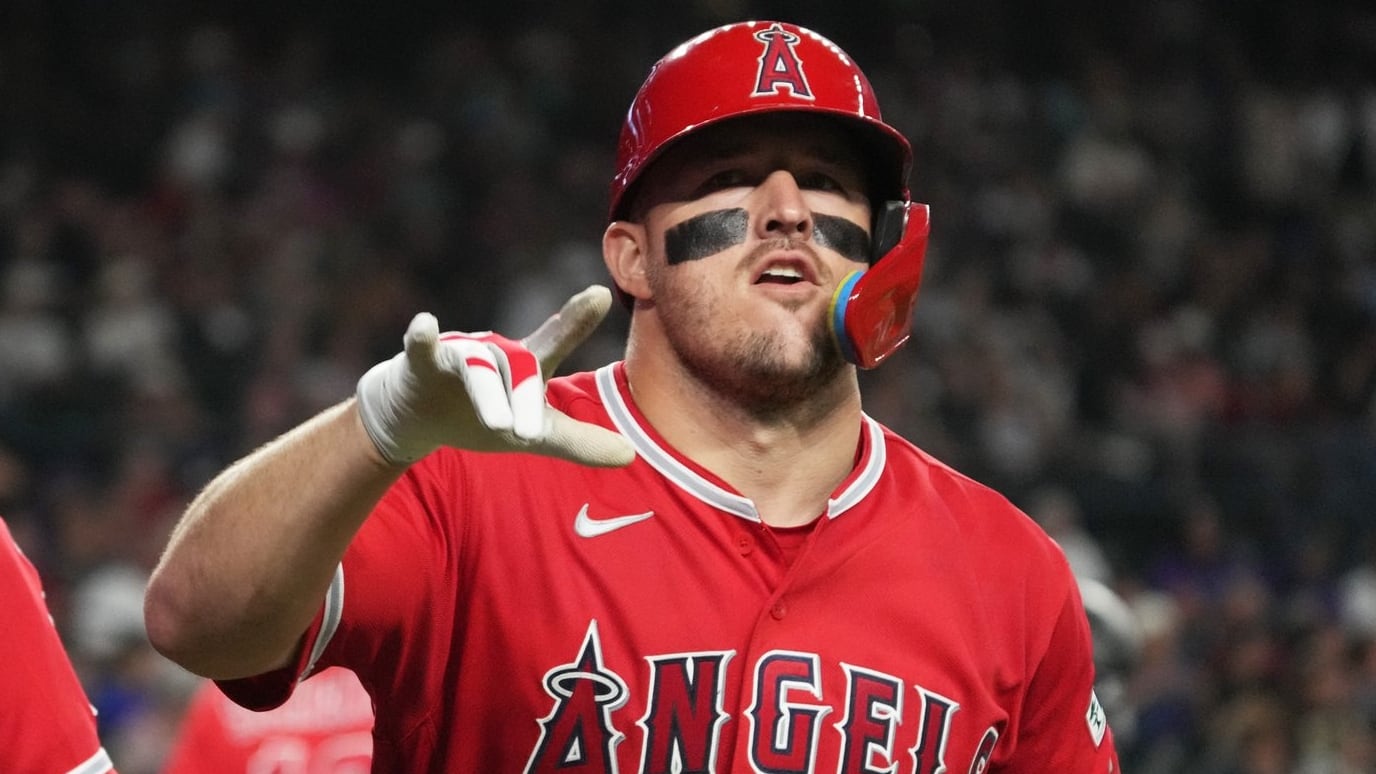
Mike Trout’s loyalty to the Los Angeles Angels had become a subject of fascination to some of his former teammates and coaches, never more so than in the leadup to this year’s trade deadline.
The Angels were trending toward an 11th consecutive losing season with no discernable path to contention. But Trout was healthy and productive, and many of those who once shared a clubhouse with him began to wonder whether he was finally opening up to the possibility of leaving, even if he did not say so explicitly. If not at midsummer, then surely, some thought, Trout and the Angels would figure out a way to cut ties over the offseason.
Then everything changed.
On Sept. 1, Stan Kroenke, one of the wealthiest people in the world, agreed to purchase the Angels from Arte Moreno, widely considered one of Major League Baseball’s worst owners, for a record $4 billion. And with that, any suppositions about Trout demanding a trade essentially ceased. For the first time in a long time, Trout had hope -- real, legitimate hope. To those around him, he seemed engaged and reenergized. He wasn’t shy about expressing it, either.
“It’s exciting,” Trout told ESPN a little more than two weeks after the sale. “Everybody knows why I want to be here -- I want to win. And with a change like this, it can make a big impact.”
When Kroenke officially takes over -- a vote among the 29 other owners could come before the end of the year, with the sale expected to be finalized in the early part of 2027 -- he will inherit a franchise 12 years removed from its last playoff appearance and 17 years removed from its last playoff victory.
For the better part of a decade, Trout reached unprecedented heights while the franchise rotted around him, falling woefully behind the rest of the industry in innovation and ingenuity. As the years went on and the injuries piled up, it became increasingly clear that Trout, one of the defining players of his era, might never get a legitimate opportunity to win.
He is 35 now, a father of two, with four years remaining on his contract and, in all likelihood, his career. Trout’s 2026 season was promising -- an .803 OPS, 22 home runs, 11 stolen bases and 4.1 Baseball-Reference wins above replacement as baseball’s oldest regular center fielder -- but also a reminder that he’s no longer in a class of his own.
Help might have finally arrived.
Kroenke’s net worth, estimated by Forbes at $27.6 billion, would make him MLB’s richest owner, wealthier than even the New York Mets’ Steve Cohen. Every one of his major sports teams -- the NFL’s Los Angeles Rams, the NHL’s Colorado Avalanche, the NBA’s Denver Nuggets and the English Premier League’s Arsenal Football Club -- has won a championship under his watch.
“Talking to other athletes and seeing the other franchises that he’s owned -- they win,” Trout said. “It’s exciting for an organization. For me. I’m excited about it.”
When a new season starts -- whenever that is -- Trout will play under his sixth head of baseball operations and seventh manager. This year has been the most turbulent of all. It began with John Carpino, Moreno’s longtime right-hand man, retiring as team president in March, prompting Molly Jolly to be elevated to his position. Perry Minasian was fired as general manager in June, paving the way for longtime St. Louis Cardinals executive John Mozeliak to be brought in as an interim advisor. Kroenke, 79, purchased the Angels from Moreno, 80, a little more than two months later. Then, in October, the new ownership group decided Kurt Suzuki would not return as manager.
Trout had already spoken to prominent members of Kroenke’s team before the 2026 regular season ended, “and the feeling I got,” he said, “is that they’re ready to get going quick.”
What exactly that looks like remains to be seen.
“There’s just so many unknowns,” Trout said. “But it’s exciting unknowns.”
For all the transgressions of Moreno’s 23-year reign over the Angels, perhaps his most defining one came before the start of this past season, after a spring training workout on Feb. 20. Moreno was talking to a small group of reporters about his focus on improving the team’s ballpark experience and listed safety and affordability as top priorities. When it comes to what Angels fans want, Moreno said, “winning is not in their top five.”
Social media erupted. The Major League Baseball Players Association, which visited Angels camp two days later, expressed discontent. And inside the Angels’ clubhouse, sources said, players were angry. It set an ominous tone for what became the first 100-loss season in franchise history.
“I think winning should be the No. 1 most important thing in an organization,” a veteran Angels player told ESPN. “And when it was said that that’s not the main priority, it’s a little tricky. It’s weird hearing somebody up top say that.”
Moreno purchased the Angels in 2003 to great fanfare. The franchise was coming off its first World Series title, and Moreno instantly took it to new heights. He signed Bartolo Colon and Vladimir Guerrero Sr., lowered beer prices and watched as the Angels became one of the American League’s most dominant teams under manager Mike Scioscia, winning five division titles from 2004 to 2009. Not long after that, Moreno secured a transformative television deal with Fox worth $3 billion.
But bad signings piled up, player development stalled, success dwindled and Moreno’s reputation deteriorated. By the end of his tenure, he was not only known as the man who wasted Trout’s prime but also the one who bungled Shohei Ohtani -- by not winning around him, not marketing him effectively, not trading him before free agency and ultimately not doing enough to bring him back.
He was panned for striking disastrous deals -- with Josh Hamilton and Anthony Rendon especially -- and not spending enough elsewhere to make up for them. For cutting corners in all aspects of the organization, from staffing to infrastructure to nutrition. For overseeing a franchise stained by the overdose death of young pitcher Tyler Skaggs and exposed through a wrongful death trial in the wake of it. For the types of gaffes that became singular to the Angels, from claims of faulty air conditioning to placing players on waivers weeks after acquiring them to signing a rookie manager to a one-year contract.
The 2026 season began with Moreno’s claim that fans don’t value winning and continued with “sell the team” chants reverberating throughout the ballpark. On most nights, a mob of shirtless patrons serenaded Angel Stadium with pleas for Moreno to rid himself of the franchise. He rarely saw it up close.
“It got so bad he couldn’t go to games,” a longtime business associate said, “and that’s something he loved to do.”
Moreno initially put the Angels up for sale four years ago, then walked away despite sources saying he could have secured up to $3 billion. The widely held belief was that he would sell eventually. Some thought he would wait until after a new collective bargaining agreement was reached, hopeful a salary cap that would boost franchise values might be part of it. Others thought he might wait until after MLB centralizes its media rights and sells them for a haul in 2028. Others believed he’d wait for expansion, which would trigger another influx of cash. That he sold when he did caught even some of those close to him by surprise.
The animosity from fans played a part, people around the Angels believe. The mounting costs that come with supporting a franchise these days -- from rising player salaries to the price of renovating a ballpark and making it run -- was a major factor, too. The price tag, shortly after the nearby San Diego Padres sold at a $3.9 billion valuation, was probably the biggest reason. But some of those close to Moreno believe there was something else at play -- that he truly wants the Angels to succeed, and that he believed Kroenke’s deeper pockets could help them.
“He really cares about this place,” a former Angels player who considers Moreno a friend said. “I think that gets lost sometimes.”
When a deal was struck, the players were almost as jubilant as the fans.
The most prominent among them made that known.
Some former Angels players were hopeful that Trout would express gratitude to Moreno in his first public comments since the sale, showing his respect to the man who signed him to two extensions totaling $571 million. Trout, though, wasn’t in the mood for reverence. He wanted to make a point. And though he didn’t deliberately criticize Moreno, he didn’t go out of his way to compliment him, either. Instead, Trout stood in front of a swath of cameras and recorders on the afternoon of Sept. 1 and looked forward.
“Fresh start,” he said then. “You kind of felt that it was needed. No hard feelings with Arte, but we’re super excited. The guys are excited. There’s a good vibe around the clubhouse.”
Under Moreno, top-tier candidates shied away from the Angels’ GM job. Now, as one rival executive put it, that position is “infinitely” more desirable.
“It might be the most attractive job in baseball, to be honest.”
Prominent members of Kroenke Sports & Entertainment, the holding company that manages Kroenke’s teams, have spent the past several weeks meeting with current and former members of the Angels in basically every department, including coaches, players, baseball executives and ticket reps. Interviews for the new head of baseball operations began during the GM meetings in Las Vegas last week, though a hiring isn’t expected to be made until after owners formally approve the sale. A vote has not been scheduled.
The Angels are open to hiring a GM or a president of baseball operations, the latter a title Moreno never handed out, but they’re not expected to poach another team’s head of baseball operations, sources familiar with their thinking said. Kroenke’s teams tend to prefer younger, up-and-coming executives for that position. The Angels’ search has seen them interview several current assistant GMs, but also executives in the baseball-operations and player-development spaces, as well as ex-GMs currently serving as advisors, according to sources.
Mozeliak was brought in after Moreno and Kroenke began talking about a potential sale, but the new owners were not responsible for his hiring, according to a source. He is expected to depart when his contract expires at year’s end. Mozeliak is still technically serving as GM, but his role is akin to that of “an innkeeper,” he said. He’s surveying the trade and free agent markets, taking notes to pass along to his eventual replacement and steering the franchise through the early markers of the offseason.
The Angels are not expected to make any substantive moves with their major league roster before the Dec. 1 lockout, which will freeze transactions and cut off communication between teams and players. The next several weeks will be about finding a new head of baseball operations, empowering that person to hire a new manager and essentially filling out all other departments. The new group has yet to wrap its arms around the roster, but the sense is it will be a slow build-up.
Kroenke has shown he’s willing to chase stars and support high payrolls, but he doesn’t do so until his teams are nearing contention. To get there, they build through the draft. And so the focus will be on continuing to beef up the Angels’ farm system, historically among baseball’s worst. It’s a process that began with Mozeliak, who did what Minasian was never allowed to do ahead of this year’s trade deadline: use established-yet-controllable players to acquire prospects. He recommends patience.
“Obviously every team wants to get to the playoffs, every team wants to win the World Series,” Mozeliak said. “But most importantly, you can’t just do that without having a strategy and a plan. And I think from the Angels’ standpoint, the mindset right now is to build from within. And so that simply means draft well, develop well, and hopefully when that core group of minor league players are ready to hit the big leagues, then you can build around that or support that.”
The opportunity is what drew Kroenke to the Angels. The franchise resides in Southern California, arguably the most desirable location in the country, and is surrounded by 130 acres of land just waiting to be developed. It possesses the resources of a big-market team, and yet, other than Trout, has no players on the payroll beyond 2027. Even the ballpark’s name, with no sponsorship attached to it, represents a significant financial opportunity.
The Angels are widely referred to as a sleeping giant, one that can rival any franchise with the right investments and the right people. Cultivating young talent -- and doing away with a draft-and-develop strategy that continually saw Minasian select seasoned college players he could then rush through the minor leagues -- is a must, some of the Angels’ players told ESPN. But so is spending on so many of the behind-the-scenes pieces Moreno and his leadership team often ignored.
Trout has spoken several times this offseason with KSE’s leadership team, most notably Kevin Demoff, president of teams and media operations, and Rams COO Tony Pastoors. Often, he has jokingly asked for fantasy football advice. His overall sense, a source familiar with those talks said, is that Kroenke is willing to spend whatever is needed to make the Angels a first-class organization, even if not through free agency just yet.
As bleak as it often looked for the Angels in 2026, some of their players believe they’re not far off. They point to a bullpen that blew 30 saves, tied for third most in the majors, and an expected record that was nine games better than the actual mark largely because of it. They note an intriguing nucleus of young pitching, headlined by Reid Detmers and Walbert Urena. And they look at a team like the Chicago White Sox, which went from 102 losses in 2025 to the AL Division Series in 2026, as a sign of how quickly fortunes can turn in this sport.
“With some moves,” Trout told ESPN, “I think we’re closer than people think.”