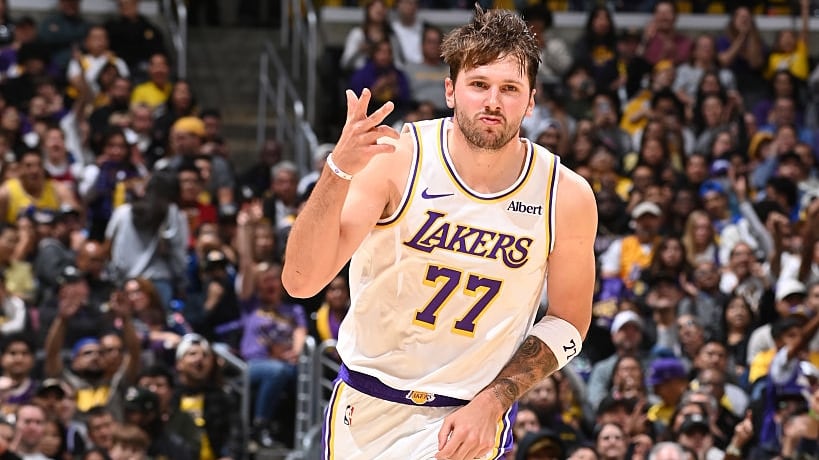
Is there such a thing as too much Luka magic?
That question might seem blasphemous to Los Angeles Lakers fans savoring Luka Doncic's scorching start for the NBA's third-ranked offense, but it's one worth monitoring as he pushes the boundaries of basketball production.
Doncic has jumped to the front of the NBA MVP conversation by averaging 38.1 points per game, which would eclipse Michael Jordan for the highest scoring average since the 1976 NBA/ABA merger. But the Lakers guard is also posting a historic usage rate -- the percentage of his team's possessions he ends with a shot attempt, free throw attempt or turnover -- that sidles him with one of the heaviest offensive burdens in league history.
Given that ultra-high usage stars have always fallen short of winning a championship, should Doncic's heavy load start to raise alarm bells?
Los Angeles is tied for the league's best record at 13-3, largely because none of its opponents have effectively slowed down Doncic, who already has seven 40-point and two 50-point performances. The Lakers have a juicy plus-15.3 net rating when the Slovenian star is on the court and have racked up seven double-digit victories.
L.A.'s extraordinary reliance on Doncic rekindles a debate about the perils of ball dominance. When one player is so responsible for his team's success, it leaves the roster exposed if he sustains an injury and increases the possibility the player might succumb to diminishing returns.
This is well-worn narrative territory that dates back decades: Jordan needs to pass more. Allen Iverson can't do it by himself. Russell Westbrook is a ball hog.
Now, the Lakers' title aspirations will hinge on whether they can avoid some of the pitfalls that tripped up previous high-usage superstars.
Why Doncic faces a daunting precedent
The conditions are just right for Doncic to break calculators with his scoring and usage: The Lakers lost five of their top seven scorers from last season and don't ask any starting forwards to be major offensive contributors. At 27, he is in his prime, has worked his way into excellent shape and is seemingly on a mission to make the most of his new status as the face of the post-LeBron James Lakers.
"[Doncic excels because of] the volume of the three-point shot combined with his ability to get to the free throw line," Lakers coach JJ Redick said Wednesday. "If you look at most elite scorers, it's a tale as old as time. Jordan, Kobe [Bryant], they got to the free throw line. It's that, and when you're shooting 12 or 13 shots a game at 40 percent from three, you can really score at volume."
As a result, Doncic's early work has been off the charts.
This graphic shows the scoring and usage rate for the 285 players who have logged the most minutes during the 2026-27 season. Doncic sits all alone in the upper right corner with a significant gap between himself and a tier of A-list stars that includes Shai Gilgeous-Alexander, Victor Wembanyama, Stephen Curry and Giannis Antetokounmpo.
Doncic's 40.4 usage rate is currently the third-highest mark since tracking began in 1967, trailing only Westbrook's 41.7 on the 2016-17 Oklahoma City Thunder and James Harden's 40.5 on the 2018-19 Houston Rockets.
While Doncic's usage represents a career high, his performance this season is an extension of his preferred play style, not a radical one-off experiment. In fact, Doncic's 37.6 usage on the 2022-23 Dallas Mavericks and his 38.1 usage for last season's Lakers are among the top 10 marks ever posted.
Here's a splash of cold water: While 41 players have posted a usage rate above 35.0 for a season, none won a championship that year. This group includes Hall of Famers such as Jordan, Iverson, Bryant and Dwyane Wade, plus future Hall of Famers such as Harden, Westbrook, Antetokounmpo and Joel Embiid.
The explanation is straightforward: It's easier to win championships with multiple stars and reliable supporting scorers, and it's more difficult and less sensible for one player to completely dominate his team's offense when he's playing with another star or stars.
Jordan is the quintessential example. His Chicago Bulls were swept in the first round by the Boston Celtics when his usage peaked at 38.3 in 1986-87; but Scottie Pippen's growth, the supporting cast's development and some coaxing from coach Phil Jackson brought Jordan's usage rate down to a more reasonable baseline throughout the 1990s. During each of Chicago's six championship seasons, Jordan still led the league in scoring, but his usage ranged from 31.7 to 34.7.
Similar circumstances shaped the championship years of Bryant and James.
Bryant's usage peaked at 38.7 in 2005-06, when the Lakers lost to the Phoenix Suns in the first round. Once Los Angeles reloaded with Pau Gasol and Lamar Odom, Bryant's usage landed at 32.2 and 32.3 during the 2008-09 and 2009-10 championship seasons.
James posted a career-high 33.8 usage for the 2008-09 Cleveland Cavaliers, who lost to the Orlando Magic in the Eastern Conference finals. During his four championship seasons, James' usage landed between 30.2 and 32.0 as he enjoyed successful pairings with Wade, Kyrie Irving and Anthony Davis.
Doncic vs. the two MVPs of usage rate
While Doncic is still seeking his first championship, his career has told a similar "less is more" story.
In 2025-26, his highest-usage season to date (38.1), Doncic suffered a hamstring injury in April that sidelined him for the Lakers' entire postseason. In 2022-23, his next-highest-usage season (37.6), the Mavericks endured a late-season collapse and didn't reach the playoffs.
By contrast, Doncic's deepest playoff run -- a 2024 NBA Finals appearance with the Mavericks -- came in his fifth-highest-usage season (36.0). Though his role narrowed slightly in his first full season playing with Irving, Doncic was nevertheless worn down by the end of the five-game Finals loss to the Celtics.
The Lakers' 109-97 loss to the lowly Utah Jazz on Wednesday provided a glimpse of what can go wrong when Doncic isn't firing on all cylinders. With Doncic scoring 29 points on 10-for-28 shooting and Austin Reaves sidelined with a heel injury on the second night of a back-to-back, the Lakers were held under 100 points for just the second time this season.
"The shot creation that is required from [Doncic] takes its toll," Redick said after Wednesday's loss.
Given that Doncic's current usage rate is hovering above 40, let's look back at what happened when Westbrook and Harden exceeded that threshold.
Westbrook's 2016-17 campaign with Oklahoma City shares some similarities with Doncic's current season. The polarizing All-Star guard was free to cook after Kevin Durant departed for the Golden State Warriors in free agency, much like Doncic's new reality following James' summer exit to the Philadelphia 76ers. That season, Westbrook led the NBA in scoring, won his only MVP award and captained a 47-win team. All those accolades are in reach for Doncic this season.
Yet there are some key differences between the two players: Doncic's 64.4 true shooting percentage this season is much better than Westbrook's 55.4 true shooting percentage in his MVP campaign, and the Lakers' offense is much more efficient than the 2016-17 Thunder's attack, which ranked 15th despite Westbrook's career campaign.
When the Thunder fell to Houston in five games in the first round of the 2017 playoffs, there was little doubt that their offense suffered from an unhealthy balance. In a memorable Game 2, Westbrook scored 51 points and attempted 43 shots, but OKC still lost. That season is remembered as a cautionary tale: A one-man offense, no matter how determined the man is, will struggle in the playoffs.
Harden's 2018-19 season is more comparable to Doncic's current run. That season, Harden averaged a career-high 36.1 points and captained a 53-win squad. Harden's true shooting percentage that season was 61.6 -- close to Doncic's current number -- and Houston boasted the NBA's second-best offense.
That Rockets team had a legitimate chance to win the title, but it ultimately lost a second-round series against the defending champion Warriors in six games. Harden and Chris Paul couldn't overcome Golden State's talent and experience, even though Durant was sidelined for the series finale with a calf injury.
Despite their success, the Rockets' 2018-19 campaign also is remembered as a cautionary tale: After the loss to the Warriors, Harden and Paul reportedly clashed over the lack of ball movement and heavy reliance on isolation sets. The Rockets traded Paul before the next season.
Can Doncic be the one? A recent champion offers hope
There is one relevant data point working in Doncic and the Lakers' favor.
Gilgeous-Alexander led the Thunder to the 2025 title with a 34.8 usage rate, the highest mark for a championship-winning player since tracking began in 1967.
As analytics have helped refine modern offenses, many teams have decided to empower their best players. More than half of the top 50 usage seasons since 1967 have occurred in the past decade, and Doncic's remarkable start can be viewed as the purest example.
NBA teams have also gotten more sophisticated in measuring workload with advancements in player tracking data.
"I don't believe in usage rate," Redick said Wednesday. "True usage rate is a better approximation, that's time on ball. [Doncic] has really bought into playing more off the ball, and he also just generates points for us.
"You have to factor in all the potential assists we get with him having the ball in his hands and coming off actions. [His usage rate] is not a concern."
By Redick's preferred definition, Doncic is more in line with his fellow stars. Through Tuesday, he ranks fourth leaguewide with 9.4 minutes of possession per game.
If Gilgeous-Alexander and the Thunder successfully pushed the usage boundary two years ago, can a closely monitored Doncic push it even further this season?
That's a fair question. But don't forget that Oklahoma City possessed the NBA's best defense in 2024-25 and Jalen Williams was a very strong secondary option in the postseason. Even so, the heavily favored Thunder barely outlasted the Indiana Pacers in seven games because Gilgeous-Alexander's scoring volume and efficiency dipped noticeably by the end of the playoffs.
While the 2026-27 Lakers don't possess a 2025 Thunder-like defense, they do have some structural and stylistic advantages that could help Doncic fare better than Westbrook and Harden.
Most importantly, Los Angeles has a proven secondary scorer and playmaker in Reaves, who is averaging 24.7 points and 4.7 assists in pursuit of his first All-Star selection. Westbrook's oft-overlooked sidekick in 2016-17 was Victor Oladipo, who averaged 15.9 points and 2.6 assists. Paul averaged 15.6 points and 8.2 assists as Houston's second option in 2018-19, but he and Harden often operated in my-turn, your-turn fashion before their partnership dissolved.
Doncic and Reaves appear to be more natural stylistic counterparts, and they haven't exhibited any interpersonal tension.
Pace is another potential advantage for the Lakers as compared with Harden's Rockets. Houston ranked 27th in pace in 2018-19, slowing the game down so that Harden could attack his man with an array of one-on-one moves or force double-teams that would create open 3-pointers for his supporting cast.
The Lakers rank in the middle of the pack by pace this season, and Doncic leads a more free-flowing attack that has generated lots of transition opportunities. Keeping the entire team involved and invested is crucial to winning when one player controls as much of the action as Doncic.
But the Lakers' hopes are highly leveraged on the health and productivity of Doncic and Reaves. They will always welcome consistent scoring contributions from center Walker Kessler and the likes of Quentin Grimes, who poured in a career-high 47 points in an overtime win over the Charlotte Hornets on Tuesday.
Nobody was happier to see that breakthrough performance than Doncic, who repeatedly overruled Redick's playcalls to force-feed the veteran guard down the stretch.
"[Grimes] got it going and he brought us back in the game," Doncic said. "We tried to give him the ball as he deserved. What an amazing game."
Doncic is bound to face questions about his durability and fitness until he breaks through for his first championship. But his passing ability and willingness to spread the wealth are among the best reasons to believe he and the Lakers can defy the challenging history of high-usage stars.