TORONTO – A couple years after its long-awaited return to the highest level of international competition, the Canadian men’s basketball team has some unfinished business.
The players who were fortunate enough to wear the red and white at the 2024 Olympic Games in Paris have all tasted success. They led the program to a historic bronze medal finish at the FIBA World Cup the summer prior, punching its ticket to the Olympics for the first time in more than two decades. They experienced what it’s like to represent their country on the world stage. And, crucially, the sour taste from the way it ended – a quarterfinals loss to host France – still lingers in their mouths.
And so, it’s no surprise that most of them have signed up to do it all over again, itching for the chance to get back to the pinnacle and, this time, earn their way onto the podium.
On Monday, Canada Basketball announced its 23-man player pool for this summer’s qualification games, which features eight of the 12 players that represented the country in Paris. The headliner is two-time NBA MVP Shai Gilgeous-Alexander, but it’s a loaded group that also includes his cousin and reigning Most Improved Player Nickeil Alexander-Walker, Raptors swingman RJ Barrett, and defensive stalwarts Dillon Brooks and Luguentz Dort, along with some exciting new additions like Bennedict Mathurin, Kyshawn George, and Ryan Nembhard, joining his brother Andrew.
Some combination of those 23 players will make up the roster that hosts Puerto Rico and Jamaica in Hamilton on July 3 and 6, respectively, as well as an undetermined opponent in Quebec City on August 31. But, more importantly, that list gives us an indication of what the team could like next summer, assuming Canada continues its path to qualify for the FIBA World Cup in Qatar, and then, if they’re lucky, at the 2028 Los Angeles Olympics.
The group was selected from more than 50 athletes who expressed interest in participating this summer and beyond, featuring 12 current NBA players. Several pros who wanted to play (and could factor into future rosters) did not make the cut, including Raptors guard A.J. Lawson, Dalano Banton, Caleb Houstan, and Olivier-Maxence Prosper. It’s a good problem to have, a reminder of how far the program has come. However, the list is not without a few notable omissions.
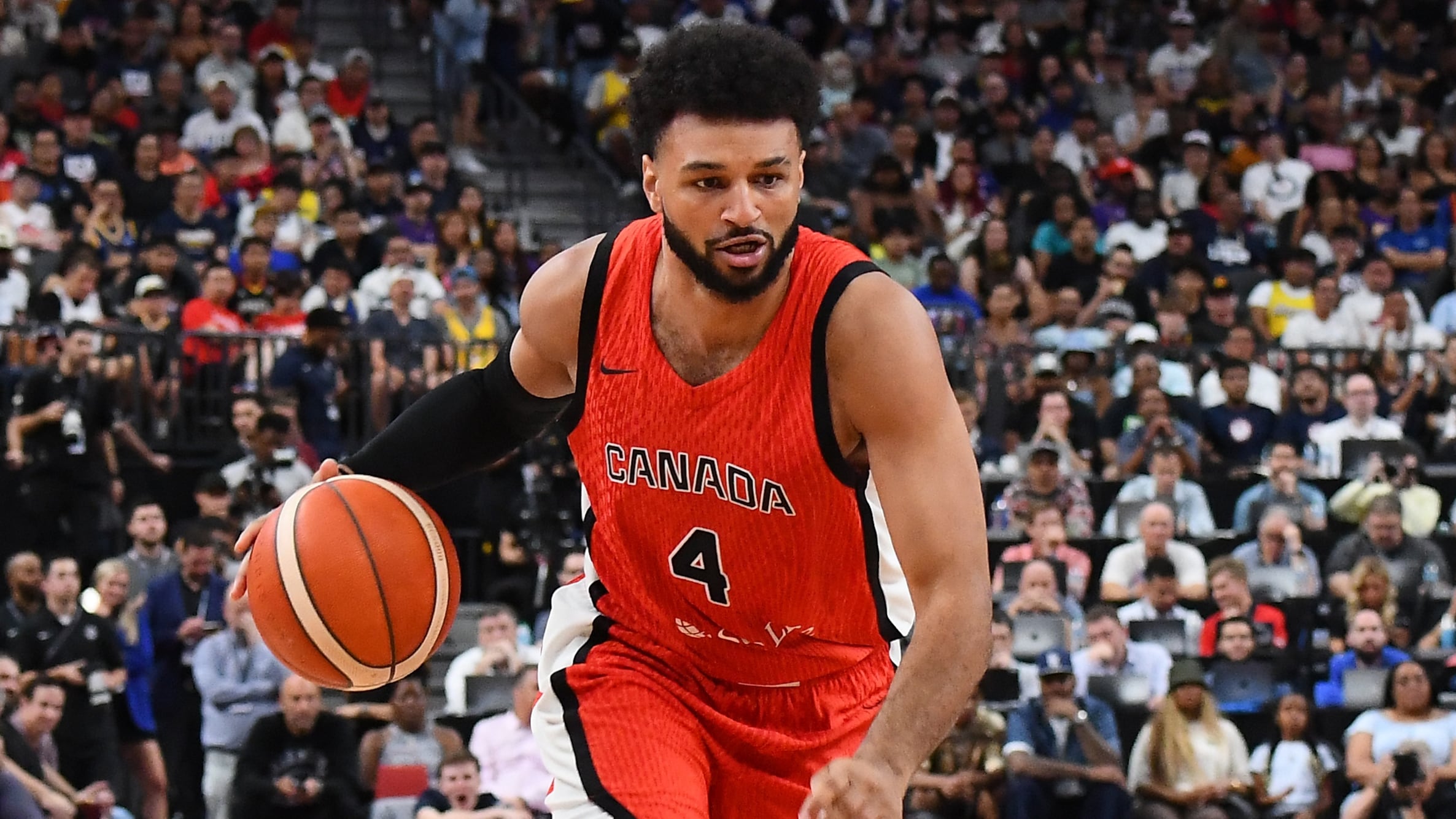
Absent, among the players returning from the 2024 Olympic roster, is Jamal Murray.
The sense is that the Nuggets all-star guard was in the mix until very late in the process; there were high-ranking people inside the program who believed he was locked in. The sticking point was that Murray could not or would not commit to being available for each of the next three summers.
Prior to 2022, that wouldn’t have been a problem. Happy to simply have them show up, Canada Basketball used to allow its best players to drop in and out – maybe they wouldn’t attend training camp but meet the others at the tournament or skip one summer and play the next. But what kept happening is that the team would fall short in the biggest games of the biggest events, often due to a lack of chemistry and continuity. And so, ahead of the last quadrant, they implemented a commitment system. Players were either in for the entire Olympic cycle or they wouldn’t be eligible to participate in any of it. Famously, Gilgeous-Alexander was the first to stand up and declare his allegiance.
By all accounts, incoming head coach Gordie Herbert – the team’s third bench boss in the span of three years – will continue to enforce it and prioritize continuity. It served the British Columbia native well during his stint at the helm of the German National Team, leading them to a gold medal at the 2023 World Cup and a fourth-place finish in Paris.
“If guys don’t commit this summer, they’re not in,” said Herbert, who served as an assistant with the Raptors in 2008-09 and has coached around the globe, currently in the Australian National Basketball League. “When I was with Germany, we had six or seven NBA guys and three guys didn’t come, they didn’t want to come. All of sudden they wanted to come [in] Year 2. Sorry. You can’t be successful in anything without commitment, in my opinion.”
It’s a strong stance to take with Murray, the country’s second-best active player and, probably, third-best player ever. If they qualify for the 2028 Olympics and he calls them up, are they really going to hang up the phone? Turning away an NBA player, let alone an All-NBA player, would have been unfathomable a decade ago, but here we are. They’ve accepted the reality that chemistry might come at the expense of some talent.
Murray is a serious talent, to be sure. The 29-year-old is coming off his best season as a pro, averaging career-bests of 25.4 points, 4.4 rebounds, and 7.1 assists while appearing in 75 games for Denver, his most since 2018-19. He’s represented Canada since he was a teenager, debuting for the Under-16 team in 2013. While his showing at the Olympics was a disappointment – he played hurt, came off the bench, and shot 29 per cent – he’s more than proven his loyalty to the program over the years.
If you were going to make an exception for anybody it would be Murray, but it’s a slippery slope, especially with the country’s best player championing the all-in or all-out mentality. What would it say to Gilgeous-Alexander and the many players who have followed his lead if they were to break precedent?
In fairness to Canada Basketball, they’re not asking for much. The mandate isn’t that each player suits up every summer. That’s not a reasonable expectation, with so many factors that are out of their control, including injuries, contractual complications, and personal obligations, among other things. For instance, Zach Edey and Dwight Powell are both recovering from injury but expected to be on hand when the team trains in Toronto later this month. They won’t play in this summer’s qualification games but should be in the mix for next summer’s World Cup roster, which is good news given the country’s lack of front court size depth.
Even if they can’t play, for whatever reason, the ask is that players attend at least three days of training camp each summer to stay engaged with the program and build cohesion with the rest of the player pool. That’s been the minimum requirement to maintain a spot in the player pool, and according to multiple sources, Murray wasn’t willing to make that commitment. Neither were Andrew Wiggins, who has a turbulent history with the program, or Shaedon Sharpe, who was meant to be one of the faces of the country’s next generation.
To close the door on two of the best players the country has ever produced and one of its rising stars is bold, to say the least, but if those guys can’t be bothered to show face for a few days in late June – a small fraction of their offseason – then what’s the point in leaving it open?
What’s left may very well be the most talented collection of basketball players Canada has ever had to pull from, a group that is clamouring to wear the maple leaf across their chests again.
“Don’t ask stupid questions,” one prominent player replied when general manager Rowan Barrett texted to confirm he was on board for this cycle. “Of course, I am.”
“The vision I give for us going forward is gold medal at the World Cup, gold at the Olympics,” Herbert said. “I’m talking to the players: are you in or are you out?”
“In the past, we used to say with the national team, get our best group of players to play but it’s not enough anymore. You need your best group of players to commit to the national team, commit to the program, commit to the timetable. My definition of commitment is this: a player, a person who is focused on what he can give. These are the players we want.”