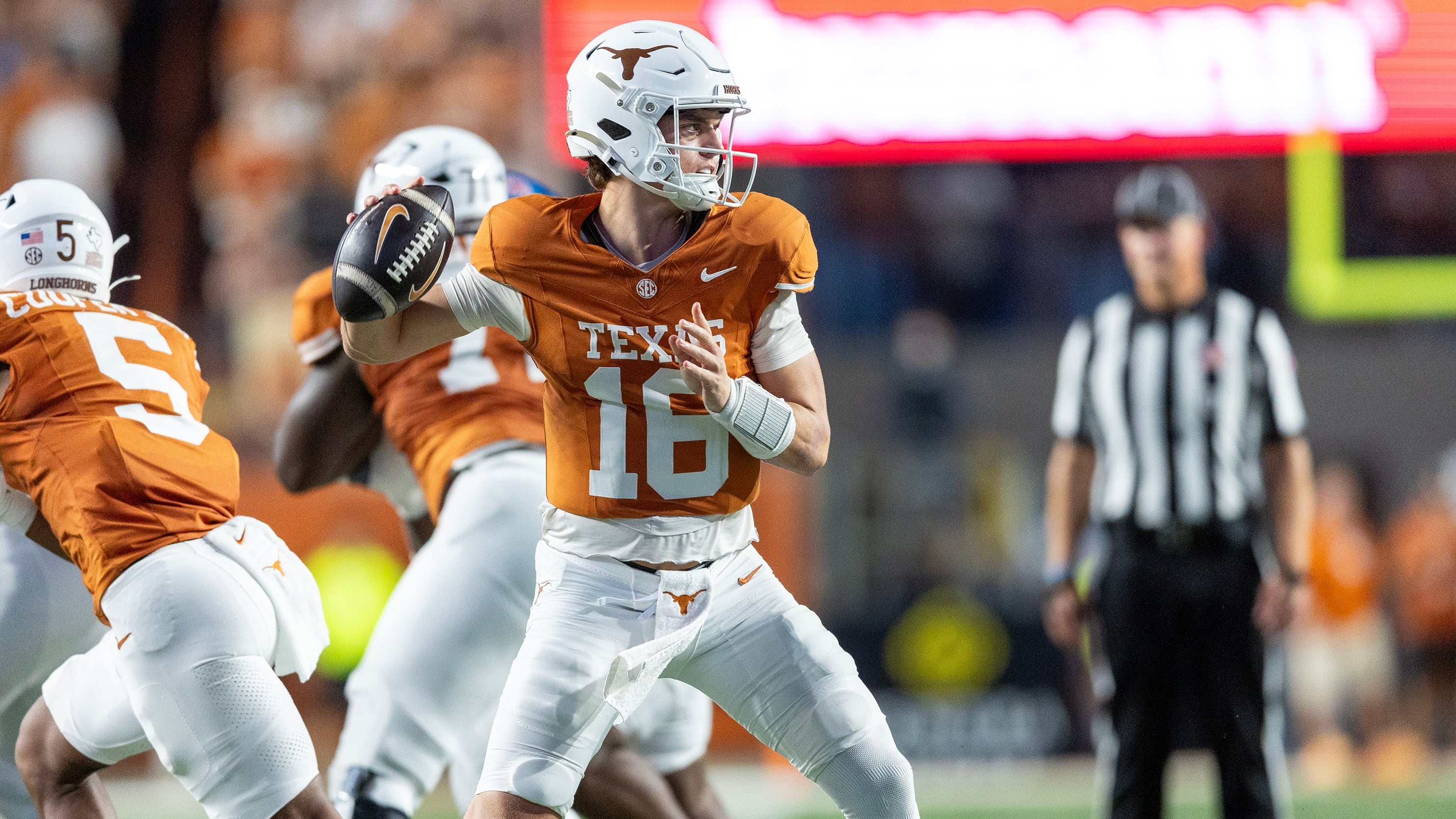
During this crazy, chaotic calendar of a 2026 college football season, we in the business of words and pictures have been left scrambling for ways to explain and describe the unprecedented wackiness that has been thrust upon us by those on the playing fields. But in the end, this fall’s greatest indication of its unpredictable goofiness hasn’t been the avalanche of losses by top-10 teams, the greased pole of the Heisman Trophy race or even the rise of UCLA and Wake Forest as College Football Playoff party crashers.
In the end, the answer lies at the end. Of the games. When the clock has dipped past the still-new two-minute timeout. When the scoreboard no longer requires numbers other than zeroes to the left of the big digital colon. And especially now, with only two weeks left in the regular portion of this most irregular of seasons, 2026’s true supernatural power seems inevitable and unavoidable.
The ability to bend the rules of time.
How else does NC State lose to Vanderbilt after having the football and a 3-point lead with six seconds remaining? How else does Western Kentucky score not one, but two touchdowns in two seconds, to defeat Jacksonville State? The Hilltoppers did that during the same evening Arch Manning stretched the final six seconds beyond the reach of the Grim Reaper to beat LSU at Death Valley? Iowa’s clock-expiring TD pass to beat Michigan. Notre Dame’s would-be final second at BYU that vanished into the Rocky Mountain air. It has been an autumn that resembles a timepiece painted by Salvador Dali.
A second should always be a second so a minute should always be a minute, and thusly 60 minutes should always be 60 minutes, right? Well, that depends on where you’re standing as you look up at that big end zone chronograph. Just ask Albert Einstein. Or Western Michigan.
“I know that by the rule of the clock or physics or whatever, that the first few minutes of the game are the same as the last few minutes,” said Eliah Drinkwitz, Missouri head coach and amateur internet scientist. (Drinkwitz has some questions about the moon landing.) “But depending on which side of the scoreboard and line of scrimmage you are on, time, even the same time, it sure does feel a whole lot different.”
The college football clock multiverse
That’s called relativity. Or, as it was explained by another very smart guy, Stephen Hawking (Go Oxford Blues!): “Each observer must have his own measure of time, as recorded by a clock carried with him, and that identical clocks carried by different observers would not necessarily agree.”
As we have learned this fall, college football is indeed ruled by clocks -- plural -- and we used to assume those were indeed identical, but alas, from time to time they do not keep the same time. Not to bring up Western Michigan again, but it was the Broncos’ clock-bending loss to Michigan in Week 1 that got these cosmic tumblers started.
In case you don’t remember -- or, like at the end of daylight saving time, your brain has yet to fully process the time shift -- the game appeared to end on an incomplete Hail Mary pass by the then-16th-ranked Wolverines as time expired, resulting in a historic 12-7 upset victory for the Broncos. But officials in the Big Ten’s instant replay command center ruled that one second was remaining, and added that tick back to the Big House clock. This, ahem, time, the Wolverines completed the desperation heave and escaped with a 13-12 win. The Big Ten eventually acknowledged the officials had erred, but the game was in the books.
In the end, it was a lesson for all on how the mechanics of college football timekeeping actually work. There isn’t one clock. There are three, and at times there have been four. The stadium scoreboard clock is still the master timepiece, at least it is supposed to be. That is the ticker with which the television production truck’s game clock has been carefully synced, and the clock in the conference replay command center is in turn synced with the TV truck’s, all done 90 minutes before kickoff. For years, one of the on-field officials kept a backup game clock on their wristwatch, typically the back judge (the one playing center field among all the safeties) or the downfield officials on the sideline, either the side judge or field judge. These days, they don’t keep the time on their wrist, but they do monitor the clocks -- game and play -- for any anomalies.
The literal fingers on the stop-and-start buttons can be found in the press box operations booth, where an active or retired game official mans the clock, carefully taking their cues from the officials on the field, looking for signals along the sideline on out-of-bounds plays, but especially watching the referee (the one in the white hat), who is the game’s ultimate timekeeper, determining when the clock restarts on each play.
The issue in the would-be Western Michigan upset was a story that Einstein might have used to explain relativity, or Christopher Nolan would have liked to have worked into his film “Interstellar.” The Big Ten was in the process of implementing a newer sync system with the TV clock and it did so at the T-minus 90-minute mark, right as rain. But as the game went on, that system departed on its own tiny timeline, bleeding time by the microsecond over the course of 3 hours, 18 minutes.
By the time the rest of the world, including the NBC Sports and Michigan Stadium clocks, had reached the end of the game, the ticker at the replay center in Chicago was one second off. Though the rule is that officials are to defer to the clock seen by the most people -- NBC’s clock, superimposed onto the screen during the broadcast, was seen by 4.1 million viewers -- the clock they went with was the one being looked at by the smallest handful, the ones in the conference command center.
That time drag has since been corrected, and no one in any conference command center is likely to violate the “clock most seen” rule again, lest not to mess with the larger rules of college football space and time. But no matter how much the men and women in stripes get their timelines tightened up, the real H.G. Wells work must be done by those whom the officials are there to govern.
Clock watchers
“Our goal as coaches has to be to do our job and prepare our teams as best we can, so that maybe we can avoid those situations where the clock has the power to determine the end of the game,” said Vanderbilt head coach Clark Lea, another very smart person -- that seems to be a theme here -- and the beneficiary of the bizarre Week 3 finish with NC State. “If you want to make a living in this sport, those finishes are unavoidable. But even if you find yourself in a position as we did in that game, you need to be as prepared as you can be. That’s why we all practice situational football.”
They practice it. They drill it. They shout it.
In what should be a surprise to no one, the king of situational football was Nick Saban. Since the days of Knute Rockne, it has been commonplace for teams to spend their last practice session of a game week running two-minute drills. Saban ran them nearly every single day, punctuating every play by announcing whatever Kobayashi Maru no-win/can’t-lose scenario he could conjure up. Like, say, “It’s fourth-and-goal from the 31 and we have no way to stop the clock and there are 43 seconds remaining, go!”
“I don’t think people believed me when we beat Auburn on that play and I said we’d practiced it so many times,” said Isaiah Bond, now with the Cleveland Browns, as he recalled the play he revealed to the postgame media as “Gravedigger,” aka the very scenario described above, aka the pass Bond caught from Alabama quarterback Jalen Milroe to torpedo Auburn in the 2023 Iron Bowl. “But people probably didn’t think that Coach Saban had his team ready for the exact situation when Tua threw his TD pass that won the national championship. But I guarantee they had.”
Bond was referencing 2018, or “Tua and 26,” the strike that Tua Tagovailoa threw to DeVonta Smith to beat Georgia for the CFP national title, one play after he’d been chased and sacked for a loss of 16 yards.
“It’s situational, but it is also conditional,” Saban said. “The goal is to train the mind to be able to slow those moments down and do it at a time when everything seems to be moving faster than normal, when all hell is breaking loose because the clock is winding down, or in overtime when there’s no clock at all and you know the game could end on any down. You’ve trained your body to be ready for that challenge. But you have to train your mind too.”
That also applies to coaches. Why? Because in case you need more evidence of just how unforgiving a game’s closing moments can be, don’t forget that Saban was undone in 2013 by an added tick of the clock, and an Auburn Tiger hiding in plain sight downfield, that added up to the legendary kick-six.
Phase 1: Situational repetition
The training Saban referred to takes place in three parts. The first is situational repetition, a practice that is one half actual, well, practice. The other half is education.
Long before coaches had charts for every play on every down in every situation -- those three-ring binders of “What do we do here?” compiled by the likes of Championship Analytics, Inc. (CAI) and constantly flipped through by the “book guy” with suggestions for the head coach -- there have been four- and two-minute situational cheat sheets.
Many FBS coaches still live by the paperback clip-and-save “Do this/Don’t do this now” pages from books that anyone can buy on the internet. Situational sheets reading: “Estimated consumption in seconds for a play: 10 or 5, for spike: 2, for taking a knee or falling on the ball: 5, for a hurry-on of kicking personnel: 20,” all torn from the likes of John Sterner’s “The Football Coaches’ Guide to Clock Management” or “The Complete Handbook of Clock Management.” The latter was penned by former Princeton fullback-turned Davidson/Pacific/Army head coach Homer Smith decades ago, ominously beginning his stopwatch scripture readings with a somewhat biblical warning: “You cannot escape clock management, not when there is a scoreboard clock.”
When Smith coached at West Point, he was monitored by an assistant coach/advanced scout from archrival Navy named Steve Belichick. Steve’s son, Bill, followed in their clock-management obsessed footsteps, and from Cleveland to New England to Chapel Hill, he has always designated a trusted staff member as his clock watcher/late-game whisperer.
With the Patriots that was Bill O’Brien, now head coach at Boston College, who became renowned throughout football for his situational film cutups and suggestions. When Saban was thinking about hiring O’Brien in 2021, Belichick called his pal and told him about his former assistant’s situational prowess. So it doesn’t seem to be a coincidence that O’Brien’s spreadsheets, when blended with Saban’s already intense two-minute drill approach, produced the likes of Gravedigger the year after O’Brien departed to rejoin the Pats.
In a testament to just how mind-swallowing the clock can be, the supposed situational guru O’Brien freely acknowledges to having made a lot of awful late clock-management decisions in both the NFL and college. Perhaps that’s why he and others rely on their color-coded CAI notebooks, but only to a point.
Kirby Smart, who served on Saban’s staffs for more than a decade, has his own late-game situational sheet he carries with him on the Georgia sideline, where he is the clock-stops-here decision-maker as the seconds get short. That same sheet is in the pockets and the same it’s-on-me responsibility is on the shoulders of many of Smart’s former assistants, including Shane Beamer at South Carolina and Dan Lanning at Oregon. It’s a list sculpted from years of conversations with the striped-shirt clock keepers.
“There were several coaches, all Hall of Fame level guys, who had me come in to hold skull sessions with their quarterbacks,” said Steve Shaw, who now serves as an ESPN rules analyst but for nearly a decade was the NCAA’s secretary-rules editor and coordinator of officials. Before that, he worked 22 years as an on-field official, 15 in the SEC. Shaw was a referee, the “white hat” who dictates every start of the clock. “So much of those conversations were concentrated on clock management. When do we stop it? When do we start it? That sounds basic, but it’s really not. And the good quarterbacks and coaches, they understand that and want to understand it better. Knowing those things is a competitive advantage because so many others do not.”
Those conversations continue during a game, especially in the closing minutes. Truthfully, it’s the reason college football introduced the two-minute timeout in 2024. It is not, we repeat, not a two-minute warning, which fittingly was introduced in the NFL during the old analog scoreboard clock days to let everyone on the field know the end was nigh. In college, it serves as a similar pause, but also as an in-game reset that coincides with the start of new clock rules, as officials don’t pause the game clock on made first downs until the final two minutes of each half.
The smart coaches, quarterbacks and linebackers (reminder: clock burning or extending isn’t just an offensive exercise, the defense also has its tricks) use that break to discuss how to approach those final two trips of the second hand around the dial, with one another and with the white hat.
“I am constantly asking for reminders, and that includes at the end of each play,” Georgia quarterback Gunner Stockton said. “When will the clock stop? When will it start? I know that I already know, but it gets easy to lose little details like that when so much is happening so fast. The fear of letting that affect your decision-making is a heck of a motivator.”
Phase 2: Fear factor
The second part of clock training is just what Stockton referenced. Fear, instilled by showing players clips not only of their own mistakes, but of the moments that still keep other teams awake at night crying to the haunting ticking of a clock from across the room.
“The first thing we do on Fridays when the players come over here is we have a meeting where all it is, it’s just situational football,” said Beamer, whose South Carolina team has had its heart ripped out in the final moments twice in three weeks by Mississippi State and Kentucky, only to return the favor against Tennessee and Texas A&M. “I show examples of stuff that I have found from the week before that happened all over football, across high school, college and the NFL, just to help them learn. The hope is that you hit it enough and hit them in the heart and head enough that when that clock gets tight that they have a little bit of muscle memory in there to handle the moment.”
There is one particular clip that is still making its way into these time-training reels of terror a full unlucky 13 years after it happened. It was Sept. 16, 2013, and 20th-ranked Wisconsin was on the road at unranked Arizona State, trailing 32-30. The Badgers had just marched 68 yards in six plays, four of which were pass completions by quarterback Joel Stave. His performance was a clinic in cool until it wasn’t. With 18 seconds left, Stave was running the ball for no reason other than to set up his kicker in the middle of the field to attempt a potential winning field goal attempt. Instead, Stave ran, started to kneel, bumped into an offensive lineman, then placed the ball on the ground before quickly bouncing back up.
The image of it all was so out-of-body that everyone on the field just stood there, for several seconds, before the Sun Devils finally started diving onto the ball as the officials appeared to signal the play dead. But the clock kept running and the game ended as Wisconsin scrambled back to the line of scrimmage unable to get off one last play.
Stave has always owned the moment for what it was. “A lot of learning came from that,” he said of the ASU loss when asked about it two years ago. He acknowledged he should have slid instead of kneeling. He wishes that when he stood up he had immediately handed the ball to the officials and put the onus on them to spot it and reset.
But he also knows he put his knee to the turf, no matter what others might have thought. “We had practiced that scenario so many times,” he said. “But this was also a game situation. Guys were blocking, not walking through it. It is just different when it’s real.”
Every replay of Stave shown in film rooms is a reminder of one of Homer Smith’s hammer-it-home mantras: It is not enough to merely practice two-minute drills. Situations can’t be simulated unless they are truly replicated, in the stadium where the clock sightlines are real, as are the collisions and chaos of the game.
“That guy was a really smart quarterback,” Urban Meyer recalled of Stave. Meyer’s Ohio State team narrowly escaped its matchup with Wisconsin that season, 31-24. “He won more games than any Wisconsin quarterback ever, and that was a smart football team front to back. It just shows you what that clock can do.”
Phase 3: The clock as the mirror
And that brings us to the third part: awareness. A personality study conducted by combining the first two steps, preparation plus fear. A coach knowing that he can look into the eyes of a player and what he sees looking back at him reveals who that player is in that moment. Like one of Einstein’s theoretical light-speed travelers, affected only by what is immediately around him and moving at his relative speed rather than looking out the window of his time machine, wide-eyed and screaming, “Oh, damn! This is moving too fast!”
It doesn’t take an Einstein- or Hawking-like mind for a player to be prepared for the pressures of time, though it is worth noting that former Tennessee quarterback Josh Dobbs, he of the 2016 “Dobbs-Nail Boot” Hail Mary win over Georgia, is also known as the “passtronaut” as he holds an aerospace engineering degree and has worked for NASA. No matter how much education a football player might have, whether it be from the teachings of Sir Isaac Newton or Kirby Smart, the “right stuff” that it takes to manage the moment is either in them or it isn’t.
“You can coach situational plans all you want, but in the end, you have to have the right guy behind center or behind the defensive line who can remain unaffected by that situation you have coached them for,” Meyer said. “When you have a Tim Tebow back there, it can make you look pretty smart as a two-minute drill football coach.”
“What is it that Mike Tyson says?” Tebow asked, already knowing the answer. “Everyone has a plan until they get punched in the face. There is no greater punch in the face than when a play goes bad and you look up at the clock and it feels like it’s moving five times faster than it has all night. But you either look at that and think, ‘Well, we’re screwed’ or you look at it and think, ‘This is an awesome opportunity to do something we will never forget.’ I loved it.”
Tebow’s numbers back that up. Consider his 35-6 record as a starter at Florida, including a 2008 BCS title clinched via a late-game clinic in clock bleeding. And during his brief stint as an NFL starter, while his numbers over the first three quarters of those starts were decidedly average, his fourth-quarter quarterback rating in that span was second only to Aaron Rodgers, not to mention his sudden death 80-yard touchdown pass to Demaryius Thomas that secured a playoff upset over the Steelers.
“You can be the greatest coach who ever lived, and you know I might have worked for him,” Smart said. “But the ability to slow that clock down in your mind, to make rational decisions during a very irrational time, when there are only a few seconds left and they are disappearing fast, knowing you have to end the game on a scoring play and you know that’s your only option, and oh by the way, you have a dozen different people talking to you or looking to you asking, ‘What the hell do we do now?’ Can you slow all that down and turn all that noise down and make the right decision, and then execute it?
“You can prepare a player for that, sure. But I don’t know if you can coach it. He is either built to handle it or he isn’t. That comes from the Almighty.”
Smart paused and laughed, adding, “And to be clear, I’m talking about God, not Coach Saban.”
Or, as Sir Albert himself once put it, perhaps after sitting in the stands at Palmer Stadium watching his Princeton Tigers take an Einstein-Rosen Bridge wormhole through the red zone as time expired: “There comes a point where the mind takes a leap ... and comes out upon a higher plane of knowledge, but can never prove how it got there.”