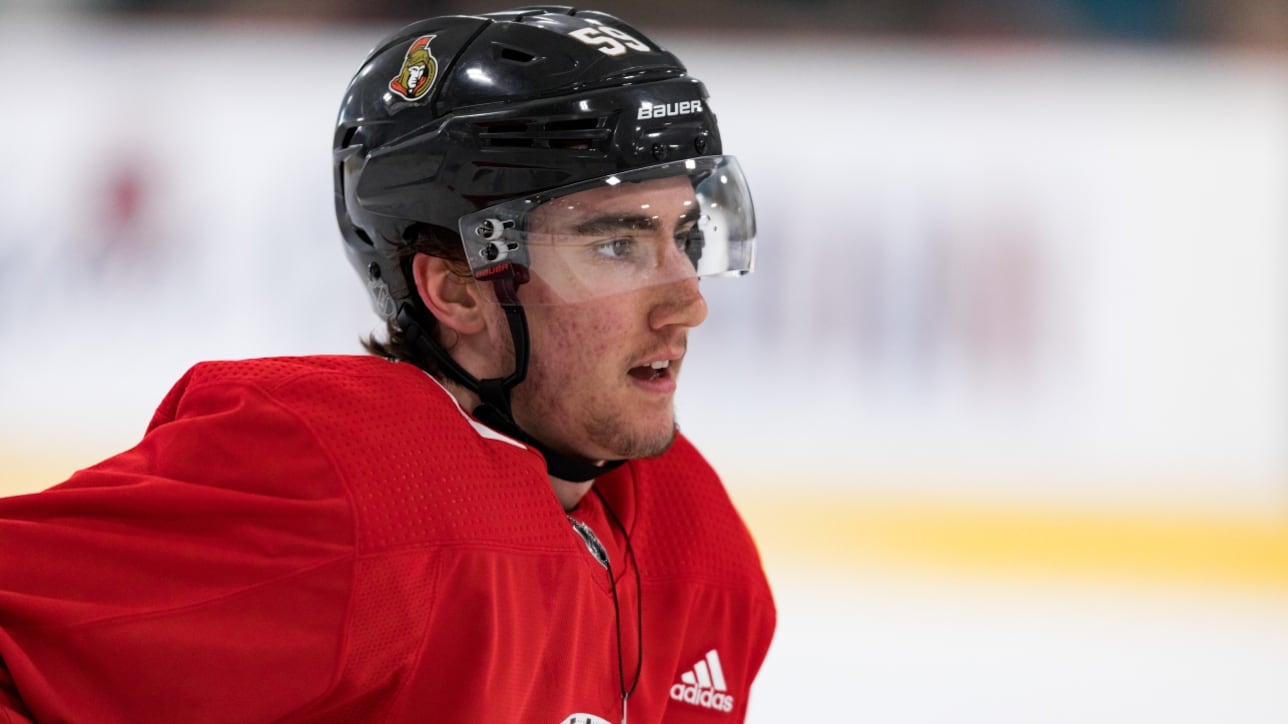
The Edmonton Oilers announced Wednesday that the franchise had reached a one-year, $850,000 deal with free-agent forward Alex Formenton.
Formenton, who has not played in the NHL since the 2021-22 season, is one of five players, along with Carter Hart, Michael McLeod, Dillon Dube and Callan Foote, who were charged with sexual assault following an incident in a London, Ont. hotel room in 2018 after a Hockey Canada event celebrating their World Junior title.
All five players were acquitted in July of 2025 after a high-profile trial that lasted for months.
Formenton was reinstated by Hockey Canada, effective immediately, last month despite an independent appeal board confirming that the five players breached the federation’s code of conduct.
The appeal board recommended staggered suspensions from Hockey Canada-sanctioned programs and reinstatement dates for the five players, which were accepted by Hockey Canada.
Formenton was the only played reinstated immediately, with Foote set for reinstatement in November, Hart in 2027, Dube in 2028 and McLeod in 2030.
TSN’s Ryan Rishaug spoke with Oilers GM Stan Bowman on Wednesday about the process the franchise went through in deciding to sign Formenton, who spent last season with Switzerland’s HC Ambri-Piotta.
This transcript has been edited for length and clarity.
Rishaug: Take me through the process of how you guys landed on Alex Formenton for your team. How long has this been considered and how did you come to the decision?
Bowman: It really kicked into gear when Matt Savoie sustained his injury and it became obvious that he was not going to be ready to start our season. You know, [we’re] looking at our PK as an area that we think has to improve, but Matt was one of the bright spots last year. But with him being unavailable, we felt we needed to look around at our options, and so that was a few weeks ago.
It was around the same time, I think or maybe shortly prior to that, when Alex was reinstated by Hockey Canada. So, we started to look at options – whether it was through trade or through signing other free agents that are still available. Through that process we did a lot of our own due diligence and homework on Alex and his situation. Obviously, he was different than some other players on the market, but looking at his situation in particular, the strength of him as a hockey player has always been his penalty kill and his speed and that’s an attribute Alex, the hockey player, has always been talented and successful at. So, we started looking at other options and the players that are available right now, and that’s not really their strong suit. So, from a hockey perspective, Alex was a very interesting player.
But we had to do some of the other work on his situation. When we looked into it, the Hockey Canada reinstatement played a big role. Obviously, they’re closer to the whole situation than anybody is, and the fact that he’s been returned to Hockey Canada availability certainly played a large role. I got a chance to have multiple conversations with Alex and go through lots of things. Over the last few weeks we’ve reached the decision that we think this is the right move to bring Alex in and to help our group.
Rishaug: It’s been a while since he’s been in the National Hockey League. What reports did you get on his play last season and how realistic is it for a guy that hasn’t been in the league since 2021-22 to be able to pick up and resume an NHL career like he’s going to be challenged with doing here?
Bowman: Yeah, I mean, he has been playing hockey. He hasn’t been in the NHL, of course, so there will be an acclimation necessary and we recognize that. I don’t expect it to take that much time. I think the biggest thing like I mentioned, is just his skating and his style of play. He plays a very up-tempo game. He’s always been a very successful penalty killer which is - not everybody kills penalties, so I think if he’s been doing that for a long time, you sort of understand there’s an art to it, and when you become a primary penalty killer, whatever league you’re in, I think those attributes are transferable.
To answer your specific question, yes, it will take them some time and we recognize that. But I don’t think his knowledge of how to play that pressure game and play the fast-paced game - you know, he’s a power forward-type style with speed, he’s at a good age, doesn’t have a lot of miles on him, hasn’t missed a lot of time with injuries and whatnot. So, I think he’s certainly eager to get his NHL career restarted, and he’s got a history with [Oilers assistant coach D.J. Smith] in Ottawa, he had a good season there not only as a penalty killer but he scored some goals and played an important role on the team. So I think D.J. was comfortable and had a real close knowledge of what he brings to a team and that also played a role in the decision.
Rishaug: Stan, there will be those who don’t like the optics of this. There will be those who are opposed to this. We saw that when Carter Hart returned to the National Hockey League as well. I’m sure you guys are expecting that to a degree, but what would you say to fans and people who take that position?
Bowman: Yeah, I understand that. I think certainly our fans are entitled to how they want to view a situation. I think what we tried to do was look at the facts and circumstances as well as, you know, the Hockey Canada portion. I think that that played a big role for us in our decision making that they were certainly closest to this. They had the most information. So for them to single Alex out as being the one who was deserving of reinstatement immediately, we did feel like that played a large role.
Some of the other players are situated differently than Alex, so I understand that people are going to have their own opinions of it and we certainly respect that. But we also have to look at Hockey Canada being intimately involved in the entire process from the beginning, and for them to make that determination it gave us a sense that he was ready for an opportunity.
Rishaug: Bigger picture here, this organization has not hesitated to provide a landing spot for people and for players who have come with what would be perceived as some negative PR on the way in. Stuff in their past to varying degrees, whether it’s Evander Kane, the situation you dealt with in Chicago, Mike Babcock and his situation in Columbus, Corey Perry with the Blackhawks. The Oilers have consistently gone down this path where other teams might be shying away from it for PR reasons. What is the organization’s philosophy on handling these situations and giving second chances?
Bowman: That’s a good observation Ryan. You’re right, something that has been more than just once or twice with the Oilers is giving people an opportunity to – you learn from situations and you go through a process. I think this one is no different than some of the other ones you referenced and I think all those people you talked about have shown a willingness to try to be good people, be good teammates, be good citizens, be good members of the community and try to give back.
Primarily your role is to, to play hockey or be part of the organization but you’re part of a larger collective in the community, and you want to try to make a positive influence, and I think that those people, pretty much across the board, have done that. You’re right that the Oilers have probably been different than some organizations who may be not as willing to do that, and I guess to each their own.
I’ve been fortunate and been treated well by the organization as well as the community. I’ve loved my time in Edmonton and I know in talking to Alex that he’s very determined here to make positive impact on his team on the ice, but also off the ice in the community. I know he has a heartfelt desire to make a good impression and we certainly hope that’s the case.
Rishaug: Anything else expected before the start of training camp, Stan? Are you guys looking at adding anything, any injuries that have cropped up? You want to break any news here for me today?
Bowman: No, luckily knock on wood, no other injuries. I don’t expect any other action. I mean, there’s always conversations with teams, certain players. I don’t know that we’re necessarily in the mix for those players but part of your job is to always be trying to make your team better, so you interact with other managers and see what’s happening. But no, I would say there’s nothing imminent on the transactional part besides this addition.