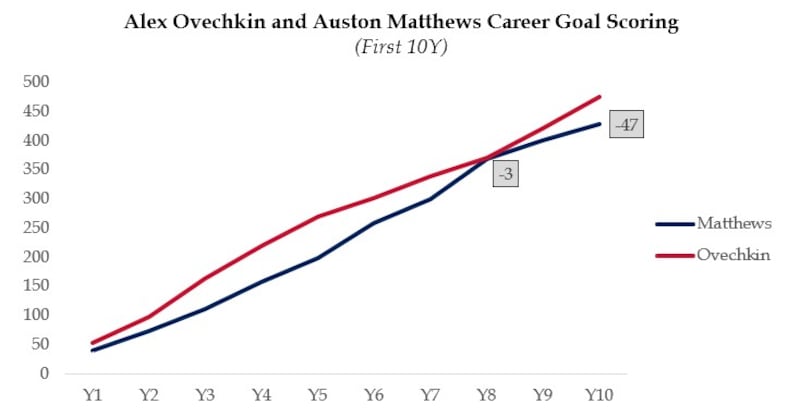
Two years ago, we looked at Auston Matthews’ theoretical chase of Alexander Ovechkin’s all-time goal scoring record.
Crazy as it may seem, the Maple Leafs’ star had tallied 368 goals eight years into his NHL career, a staggering accomplishment, and was just three shy of where Ovechkin was at the same point of his career.
It goes without saying that maintaining such an elite level of offensive contribution year over year is extraordinarily difficult and requires some luck along the way.
The puck has always screamed off of Ovechkin’s stick, but we didn’t see a slowdown in his legs until late into his 30s, and he’s been one of the most durable players of the 2000s – adjusting for shortened seasons in 2012-13 and 2020-21, Ovechkin has averaged 77 games per season in his career, a remarkable feat.
He’s also largely played on competitive teams with quality forwards surrounding him, insulating him from scoring slumps and providing him with the requisite playmakers necessary to find the back of the net in bunches.
But the past two seasons have been a challenge for Matthews, and for several reasons.
The first and perhaps most prominent is some tough injury luck. The Maple Leafs captain missed 15 games in 2024-25 with an upper-body injury, and missed another 22 games last season with a combination of a lower-body injury and season-ending knee surgery after a knee-on-knee hit courtesy of Radko Gudas.
Couple that with the loss of his most offensively prolific teammate in Mitch Marner, and the team’s general scoring decline under former head coach Craig Berube, and you have a bit of an ugly stretch for one of the most talented scorers in the world.
The relative slowdown in scoring has put some real daylight between Ovechkin and Matthews once more. It’s not an unconquerable gap, but Matthews can ill-afford a third consecutive decline in scoring:
Now, I think Ovechkin is probably the last thing Matthews or the Maple Leafs organization more broadly has in mind. Toronto was something of a disaster on the ice last year, and will struggle again this upcoming season if Matthews can’t find his elite scoring touch.
But there may be a meaningful tailwind for Matthews’ game here in the form of 18-year-old first-overall pick Gavin McKenna. You don’t want to put too much on the plate of any teenager, but McKenna is a supernova talent – his scoring profile with Medicine Hat in the WHL and one year with Penn State at the NCAA level speaks for itself.
We don’t know quite how new head coach Jim Hiller will dress Toronto’s top-six forwards, but there’s a good chance McKenna is on Matthews’ wing come opening night. And if McKenna does slide down to the second line with John Tavares, it places names like Matthew Knies and William Nylander on the wing of Matthews – all credible options, and all players who should be additive to Matthews game.
It’s an encouraging group of teammates around him heading into this season, but that’s just one part of the story.
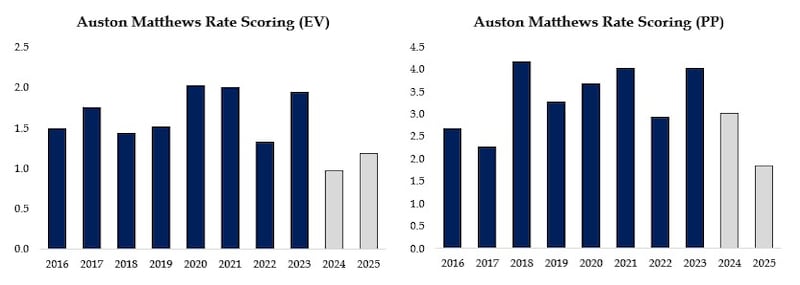
There were times, especially last year, where Matthews was on the ice but visibly not 100 per cent. And it’s important to highlight that Matthews’ scoring slowdown wasn’t just a function of missed games. On a rate-basis across the games Matthews did play, there has been an observable slowdown in production at even strength, and even his power-play scoring last year took a hit:
How you apportion the blame for the past two years is up for debate. But heading into the 2026-27 season, I think it’s right to be cautiously optimistic about Matthews having a bounce-back year.
Assuming he’s returned to full health, he’s going to have credible firepower on the wing and a new coaching staff that has talked about giving their star forwards more freedom on the attack. That in and of itself is encouraging.
But Toronto needs a big rebound season from their captain. Return to form, and we might once more wonder about where Matthews will finish his career on the all-time goals list – and if he still has a shot at chasing down the greats.
Data via Natural Stat Trick, NHL.com, Evolving Hockey, Hockey Reference