The Calgary Flames are winless through the first week of the regular season, losing by scores of 6-1, 4-1 and 6-1. The games have been every bit as ugly as the box scores indicate.
Expectations were low to start the year in Calgary – in fact, no team had longer odds to win the Stanley Cup this season than Ryan Huska’s Flames. And for good reason. This is an organization deep in the throes of a rebuild, one that is thinking more about next year’s draft lottery than sneaking into a wild-card berth.
But even by rebuilding team standards, this has been a harrowing start. The Flames looked noncompetitive in these three games, all three of which came against non-playoff teams from a season ago (a pair of games against Seattle, plus one against rival Vancouver). The offence was punchless, the defensive results just as putrid, and the level of concern across the organization must be higher than where it was to start the year.
Let’s go through all three phases of this nightmarish start: offence, defence, and the goaltending, and see if there’s any hope of a rebound.
Offence
Three goals (one apiece from Morgan Frost, Ryan Strome, and Matt Coronato) in three games isn’t going to cut it, and what’s even more concerning is two of these three goals came on the power play. That means Calgary’s managed just one even-strength goal in 154 minutes of play.
What might be a bit encouraging here is that Calgary was able to find moments of sustained pressure against the Kraken and Canucks; a complete absence of puck luck might be contributing to this futile start.
Consider expected goal rates from the first few games of this year versus the prior two seasons at even strength. If nothing else, Calgary has been more active in the offensive third, though score effects (and how decisively they’ve been losing these games) is likely contributing somewhat here:
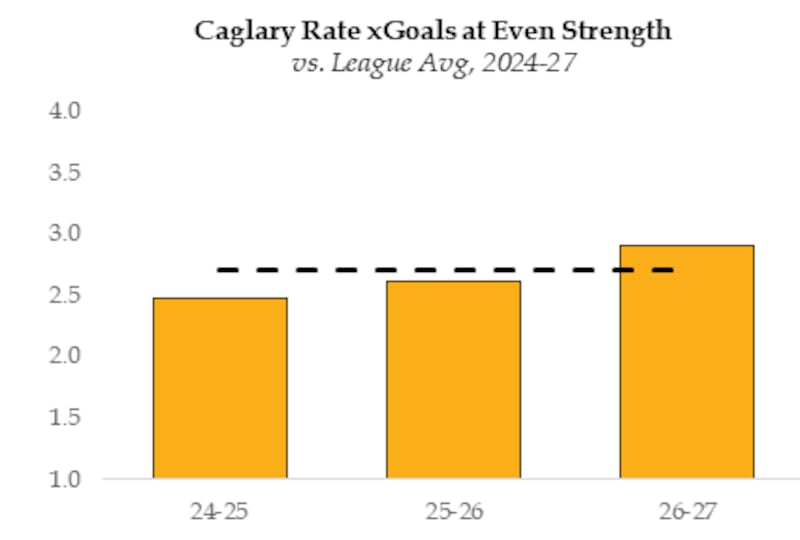
Expected goals are only interesting to the extent they translate to real goals, and it goes without saying Calgary’s expected goal numbers (as well as scoring chances) are being uplifted by how decisively they have trailed in these games. Opposing defences simply don’t need to play with the same vigour and intensity when protecting big leads, and that means simply pushing the Calgary attack to the perimeter, where goal scoring falls.
A heat map of shot production (via HockeyViz) captures this well. Though Calgary is doing a good job of generating volume, a lot of it is coming from the point and well outside of the circles – and too little of it is coming inside of the circles, where scoring probabilities surge:
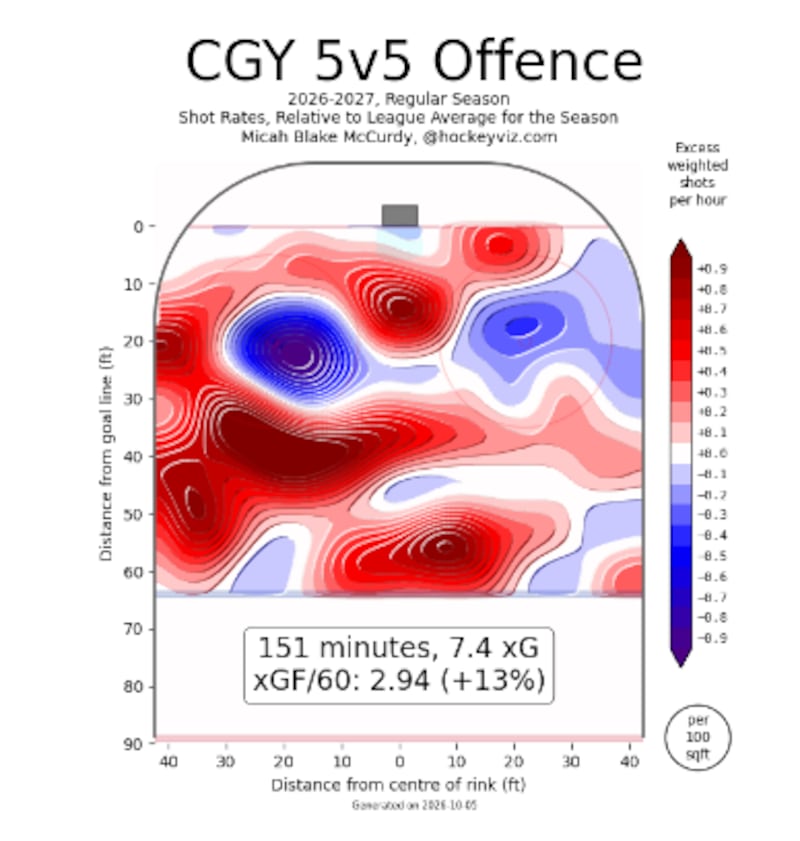
We’ll need a few more games to better understand the capabilities of this offence. The Flames seem capable of gaining the offensive third, but less so at funnelling the puck into dangerous areas and converting on those chances. They simply may not have the horses to make it work this year, but it’s something worth monitoring.
Defence
It has been ugly. Full stop. The Flames have already conceded 14 goals at even strength; compare that to the Seattle Kraken (three), Boston Bruins (three), and Florida Panthers (two), and it feels like a five-alarm fire.
We will get to the goaltending component in a moment. What’s concerning to me about Calgary’s defence is if you strip away the goaltending impact (which has been terrible) to start the year, the Flames still look like a sieve.
Expected goal rates for Calgary this season compared to years past is veering towards “off the charts,” and not in a good way:
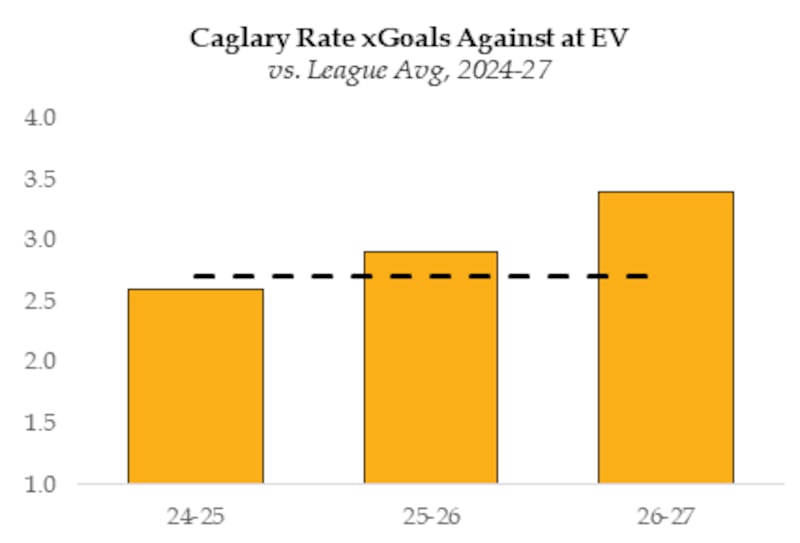
Given how much Calgary has trailed by in these games, the expected goal numbers against are alarming. The opposition doesn’t have nearly the same incentive to play aggressive and attack while protecting big leads, and yet the Kraken and Canucks had little problem putting pressure on Dustin Wolf and Devin Cooley.
The Flames’ blueline is, like the rest of the team, a work in progress. The two regular pairings have been Zach Whitecloud with Kevin Bahl, and Jacob Middleton with Zayne Parekh. The recently acquired Simon Nemec has split his minutes with Bahl and Yari Kuznetov.
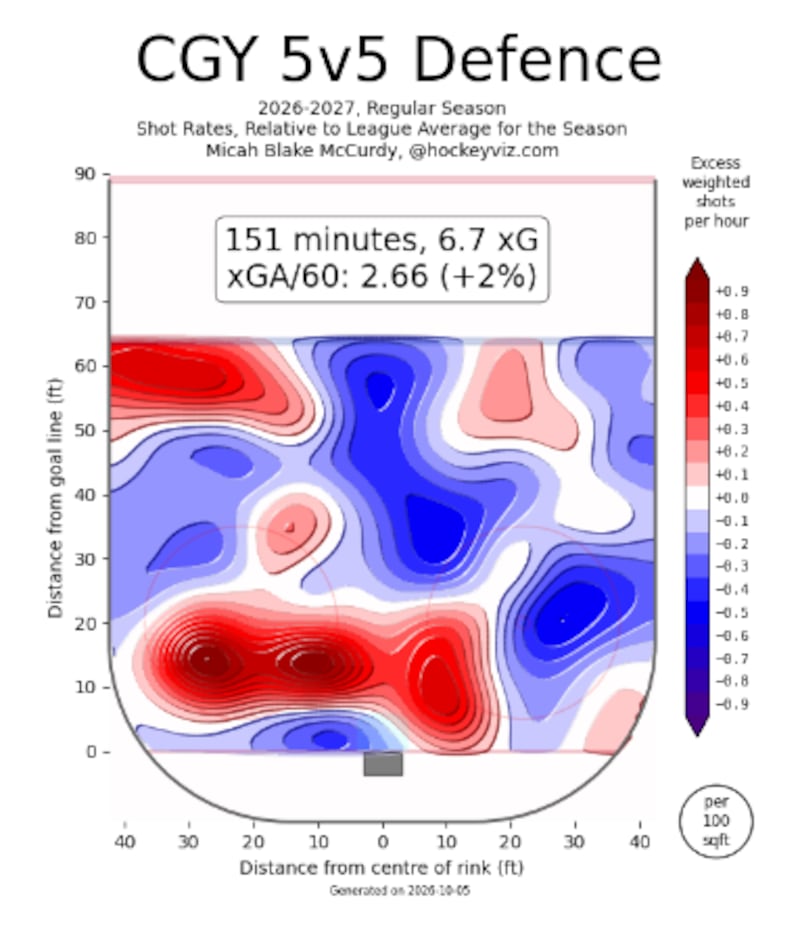
In contrast to the offence, volume isn’t so much the problem defensively – it’s how easy the shots are being generated from the net mouth and between the circles against Wolf and Cooley. I don’t care who your goaltenders are, when shots are being flurried from this area of the defensive third, it’s going to be a problem:
Goaltending
To say Calgary’s goaltenders have a difficult task so far this year would be an understatement. The offence is thin on scorers, the defence is young and developing, and the division is full of teams who can score at will. Calgary has a solid goaltending tandem headed by the 25-year-old Wolf, who was extended to a $53 million contract one year ago.
But over the first three games, Wolf and Cooley have been -4.6 goals worse than a replacement-level goaltender (via Evolving Hockey) given the shot profile they have faced. For Wolf specifically, that’s in stark contrast to years past, where he finished +26 goals saved versus expected in 2024-25 (seventh in NHL), and +18 goals saved versus expected in 2025-26 (27th in NHL) – in both instances, playing behind similarly weak Flames lineups.
This is the one group you would hope to be optimistic about even in a challenging year like this, but so far there’s been little help from the goalies, and it’s why you have seen some ugly scores at the end of these games.
Let’s hope the weeks ahead reveal a bit more fight from this rebuilding Flames roster. It’s one thing to embrace a rebuild and maintain realistic expectations, but it’s another to spend an entire season getting your clock cleaned.
History would suggest that teams that bottom out this violently often take a long time to return to a competitive state, and that’s the last thing Flames fans want to think about right now.
Data via Natural Stat Trick, NHL.com, Evolving Hockey