Six weeks into the regular season, the Montreal Canadiens and Ottawa Senators sit inside of the playoff cutline despite punchless power-play units.
Ten years ago, you may not have blinked at such a sentence. But succeeding in today’s NHL without a productive man advantage is an incredibly difficult task, and to that end, pressure is ramping up on the coaching staffs led by Martin St. Louis and Travis Green.
Montreal and Ottawa are two of the more talented teams in the Eastern Conference, and moreover, returned this season with largely the same personnel groups that drove healthy power plays last year. The Canadiens finished 10th in power-play scoring (8.5 goals per 60) last season; the Senators finished just ahead of them in eighth (8.6 goals per 60).
But this season has been a nasty slog for both. Injuries to key players have certainly had an impact - Nick Suzuki has missed time for Montreal, while Jake Sanderson has only played 11 games for Ottawa (to say nothing of the loss of Brady Tkachuk), but that hardly can explain the drop-off.
There are warning signs everywhere. Goal scorers who feel inevitable, like proven snipers Cole Caufield and Tim Stutzle, have just a pair of power-play goals on the season, and heaps of other players – including Chris Kreider, Juraj Slafkovsky, Suzuki, Noah Dobson, Claude Giroux, Sanderson, and Thomas Chabot – have combined for zero goals. Zero!
The year-over-year results are startling:
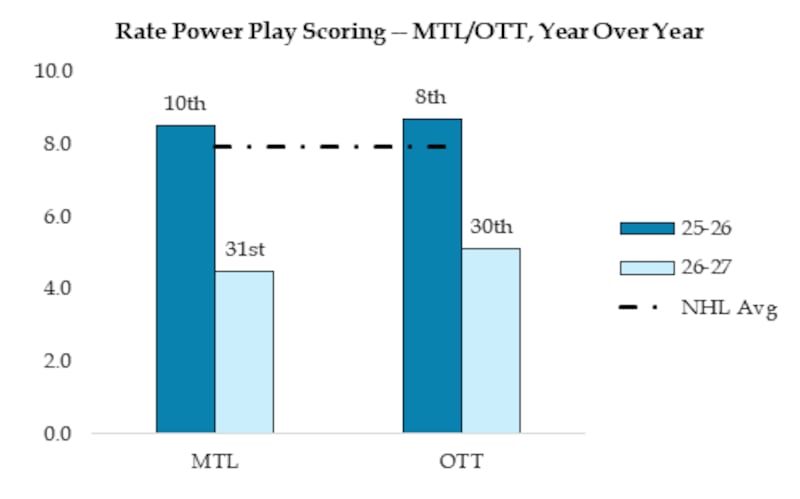
You don’t want to overreact to a six-week sample given some of the injuries, but you also cannot write off such a material slowdown given the state of the NHL. Around the league, power-play scoring continues to explode to the upside.
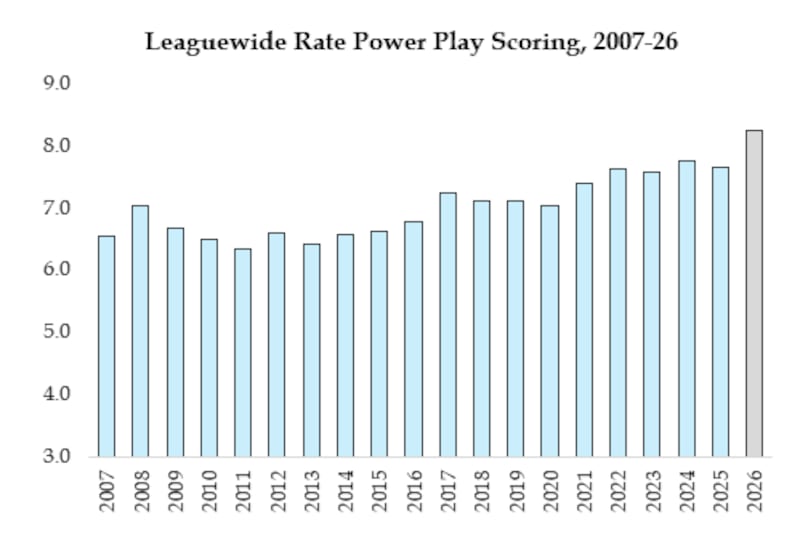
I’ve written in the past about how power-play production has become a meaningful differentiator in a team’s ability to compete for a playoff spot and/or title, and that relationship is only strengthening with each passing year. This season has seen the highest rate of power-play scoring in the NHL’s statistical modern era (post-2007), and by a considerable margin:
There are many reasons why power-play scoring continues to surge, but I think it’s a combination of strategy and personnel. Teams have leaned into four- and five-forward deployments, but there is also much more intelligence about how goals are created.
In years past, it was common to see teams dumping pucks in deep on the power play and setting up low-probability shots from the point to create pressure. Now, teams focus on gaining and sustaining the offensive zone and funneling pucks between the circles, where defences can break down and goal-scoring probabilities surge.
Add a modern blueline where every team in the league has a defender or three that can skate and distribute the puck just like his forward counterparts, and you have a recipe for sustainable success.
I emphasize teams working towards the interior because I think that’s where the Sens and Habs are both lacking right now. Consider the shot profiles of both teams (via HockeyViz), because I think they’re illuminating.
Let’s look at the Canadiens first:
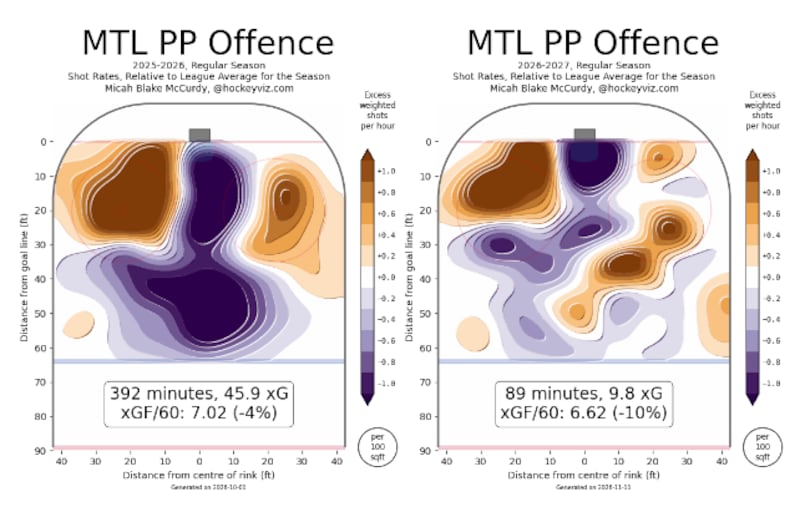
At first blush these profiles look consistent with one another and that largely makes sense – there’s a focus to get the puck to elite snipers like Caufield near the circles for good reason. But what’s notably missing in both seasons is an inability to get to the front of the net. I think Montreal’s incredible perimeter shooting masked the net-mouth difficulties they had last season; that’s no longer the case in 2026-27, and you’re seeing a power play that just can’t find the net right now.
Now, let’s look at Ottawa:
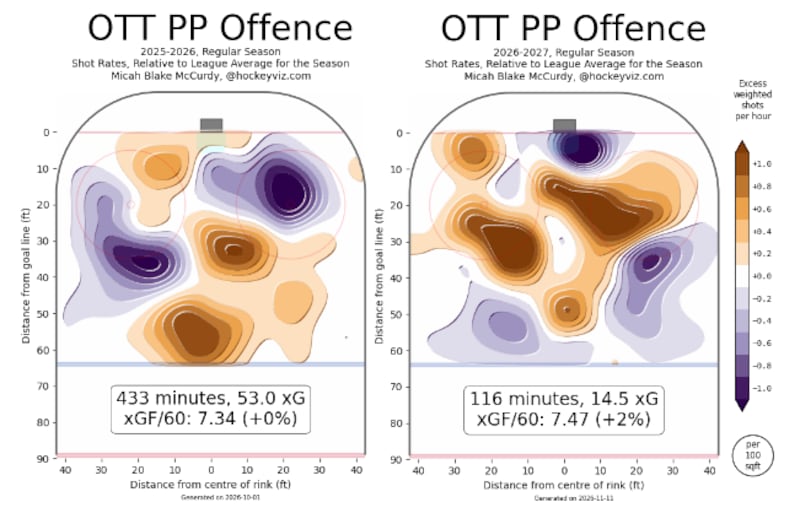
Again, these profiles appear similar, sensibly so given the lineup and coaching structure are nearly identical year over year. But this is one area where I think the loss of Tkachuk may have had an impact. For whatever you think of the former Senators captain, he was and is a sensational player around the net; he’s a big-bodied havoc creator who also plays the screener role incredibly well. This season, Ottawa’s been pushed out of that area, though they’re still generating dangerous shots (especially from the circles).
I think both of those heat maps are encouraging – there’s a steady stream of shot volume from both units and it’s not as if the teams have a dearth of goal scorers. Both are in the top half of even-strength scoring (Montreal is sixth; Ottawa 15th).
But for two teams with meaningful aspirations well beyond game 84 of the regular season, this is an issue that needs correcting with urgency. Surviving in today’s NHL without a sharp power play is just a difficult way to live.
Data via Natural Stat Trick, NHL.com, Evolving Hockey, Hockey Reference