Timing is everything in life. Don’t believe me? Ask the Montreal Canadiens.
Over the weekend, Colorado Avalanche superstar defenceman Cale Makar inked a massive extension – an eight-year, $162-million deal that will carry a $20.4-million cap hit into the future. Makar is one of the best players in the world, and, fortunately for him, his contract negotiations came around at the same time as the league was seeing meaningful salary cap growth.
For now, he’s the highest-paid player in the NHL, and deservedly so.
After the Makar news broke, I couldn’t help but immediately think about Montreal GM Kent Hughes and the Canadiens blueline.
It started last summer with a mega sign and trade for defenceman Noah Dobson, whose new contract with Montreal came in at eight years and $76-million ($9.5-million AAV). Three months later Montreal extended then 21-year old Lane Hutson to an eight-year, $71-million deal ($8.9-million AAV). It was an aggressive bet on two young defenders, but the payoff strategy was simple: If Hutson and Dobson continued their development trajectory, Montreal could head-off the looming impact of the salary cap surge and sign the core of their blueline at a fraction of the future cost.
That’s not an investment without risk. Betting on young players isn’t foolproof, and even one miss would’ve anchored Montreal with a bad deal on their books for the foreseeable future.
But one year later Montreal’s decision looks impeccably timed – the combination of Hutson and Dobson’s deals come in at $18.4-million, 10 per cent lower than that of Makar’s deal. Neither defender is as gifted individually as Makar, but the sum of the parts is the story here.
Montreal’s vaunted top line (commonly featuring Nick Suzuki, Juraj Slafkovsky, and Cole Caufield) deservedly draws tremendous praise for how deadly they are on the attack. One thing that helps them tremendously is playing in front of Hutson or Dobson – or in some cases both impressive young defenders.
Consider Makar’s performance in Colorado versus Hutson and Dobson last year as a function of on-ice goal share. Of note, Hutson’s most common partner, excluding Dobson, was Jayden Struble; Dobson’s most common partner, excluding Hutson, was Mike Matheson.
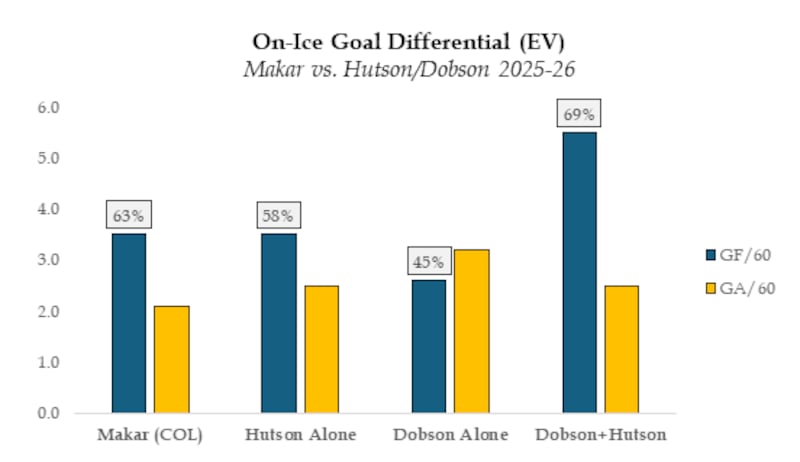
It’s just one season of data, but look how electric the pairing of Dobson and Hutson was. They outscored the opposition 31 to 14 (+17) when paired up, a blistering number. When the lineup was more equitably balanced and the pairing split, Montreal still had incredibly strong results with Hutson deployed (58 per cent goal share); Dobson’s number slipped a fair bit (45 per cent), owing to a weak on-ice shooting percentage.
Winning in the modern NHL requires considerable depth, and it’s not lost on me there’s real value in having Hutson and Dobson anchor separate pairings, but when Montreal loads up their best players they have the look of a freight train on par with that of Colorado.
Consider the results of Makar (whose most common partner was Devon Toews) when playing with the Nathan MacKinnon line versus the Hutson and Dobson pairing when playing with the Suzuki line from last season:
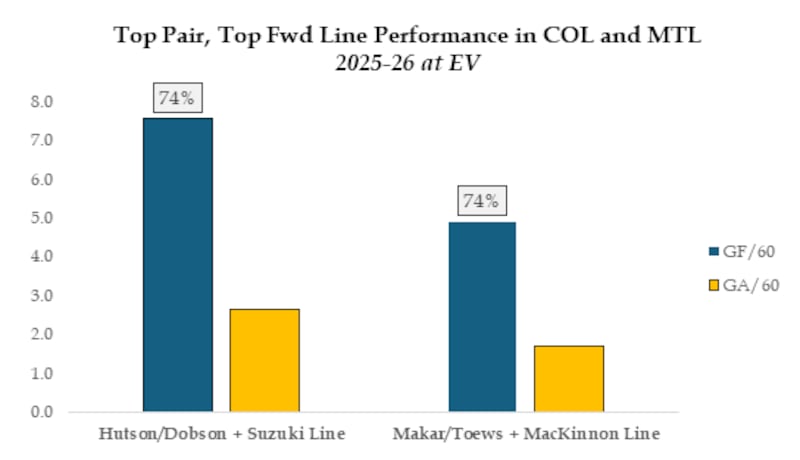
The results were identical, which is quite the statement. We are talking about an Avalanche team that blew the doors off the rest of the competition en route to another Presidents’ Trophy. There’s nuance in this data to be sure; the samples aren’t massive, and Colorado’s longevity in this space is outsized compared to that of Montreal. If you were a betting man, you would be directionally more confident of Colorado repeating this level of performance than Montreal.
But even conceding that, it does feel like the Canadiens are sitting on something of a gold mine here. Their young and talented roster is locked up long term, and their investment on the blueline has considerably upskilled the team and their stable of forwards in front.
You cannot simply find a Makar, but you might be able to create him in the aggregate. Montreal found the right pieces, timed their extensions perfectly, and enter the 2026-27 regular season as a considerable threat to emerge from the Eastern Conference.
It’s been a good summer for Makar. It might have been a better one for the Montreal front office.
Data via Natural Stat Trick, NHL.com, Evolving Hockey, Hockey Reference