The Nikita Kucherov trade sweepstakes have arrived. And though this is going to be a difficult trade to engineer given the market circumstances, it is exceptionally rare that a superstar of this calibre comes available mid-season.
To that end, every contender around the league is going to have to wrestle with the prospect of a Kucherov deal, and what would make sense for their organization.
There are several hurdles to overcome with respect to a Kucherov deal. He’s a 33-year-old winger on an expiring deal with a cap hit of $9.5 million this year – a difficult number for most teams to fit in organically, given how most contenders are already up against the salary cap ceiling.
But the bigger problem here is whether Kucherov is a pure rental, or a sign-and-trade type of target. Teams are typically uninterested in dealing major futures for pure trade rentals for obvious reasons, but a Kucherov sign-and-trade isn’t without risk either. The player is reportedly looking for a multi-year deal with a near $20-million cap hit, a colossal number that would fundamentally change how an acquiring team operates into the future.
As it stands today, not a single contender could swap Kucherov’s salary into their payroll without money going out or retention of some kind, though teams like the Carolina Hurricanes (estimated $8.1 million in space), Boston Bruins ($7.8 million), and Utah Mammoth ($4.9 million) do have a little wiggle room.
Other teams (the Toronto Maple Leafs, Montreal Canadiens, Washington Capitals, Edmonton Oilers, Vegas Golden Knights - it’s a big list) are sure to be engaged here as well, but they’re going to need to figure out both this year’s cap commitments and future years’ commitments as well in the event of a sign-and-trade.
Yes, the Tampa Bay Lightning could “rent” Kucherov for the remainder of the season and let him walk to free agency, but the cost of losing a player for nothing in an already competitive Eastern Conference is hard to believe.
One thing is for certain: the acquiring team is going to get one of the league’s most dynamic players. Over the past three years, the evidence of Kucherov’s dominance has been everywhere. Consider just his point totals over the past three seasons and where he grades against some of the league’s best:

He’s only looking up at Edmonton’s Connor McDavid, who might be the league’s most prolific offensive player since Wayne Gretzky, so this is outstanding company.
Point totals for forwards are a quality gauge as to how involved a player is on the offensive side of the ice, but on-ice goal differential is just as important – you understand how players like Kucherov drive meaningful goal differentials that lead to wins in the win-loss column and defensive play is inherently baked in.
Kucherov has been otherworldly at 5-on-5 over this same time span. He is one of 11 players with an on-ice goal share above 60 per cent:
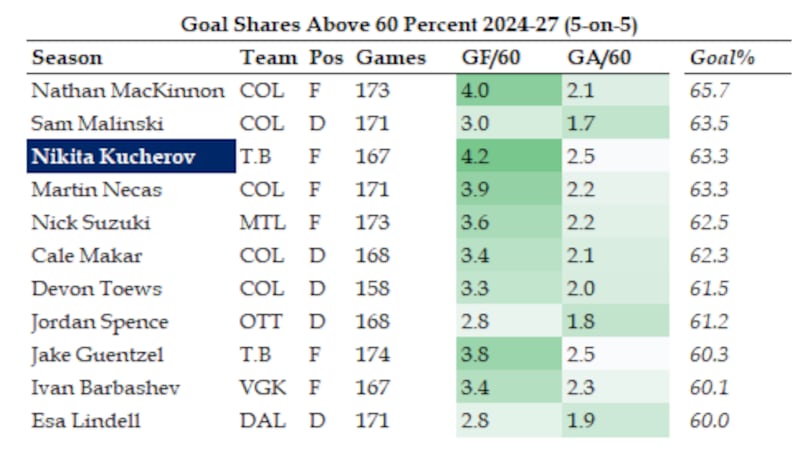
It’s a list loaded with good players on great teams, certainly two boxes Kucherov checks.
While he has been the straw that stirs the drink for Tampa Bay, it would be remiss of me not to acknowledge his playing environment – like other players in this group – has been very good. His most common linemates over this timespan were Brayden Point, Jake Guentzel, and Brandon Hagel. Kucherov might be a wizard of a playmaker, but he’s still reliant on teammates finishing plays. Tampa Bay’s bevy of forwards have done that for years around Kucherov, to great success.
Simply put, he’s been one of the best forwards in the league for some time now, but I think it’s important to underline there are no signs of any sort of aging slowdown here.
Father Time comes for every player in this league, but Kucherov is still scoring at will, and the only question now is which team around the league is going to take the biggest of big swings in the weeks ahead.
Data via Natural Stat Trick, NHL.com, Evolving Hockey, Hockey Reference