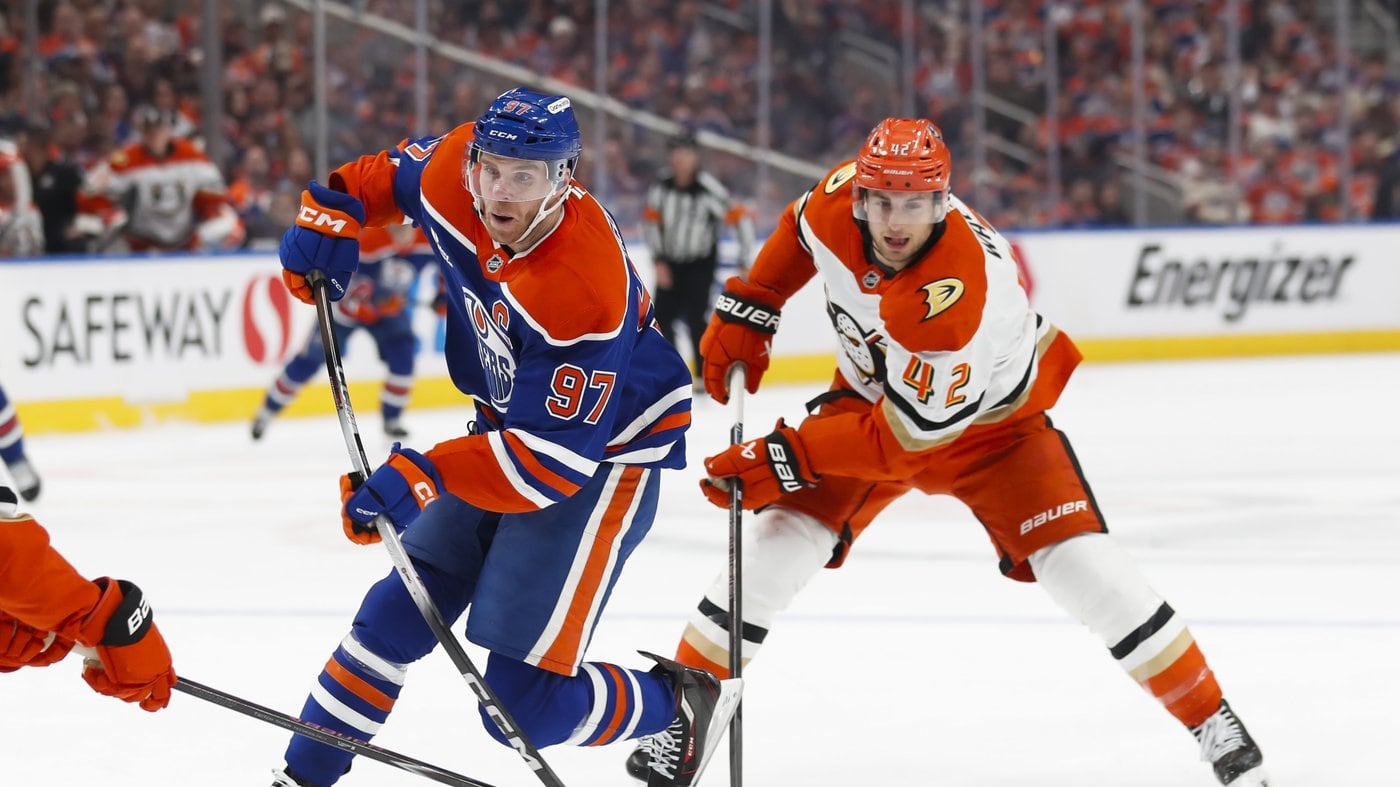
What do Connor McDavid, Tim Stutzle, and Elias Pettersson have in common?
Other than playing big-minute roles for Canadian teams, there is notable connective tissue here: they are three of the NHL’s best players at creating incremental power plays for their team.
All three players are great at drawing penalties and disciplined enough to not take penalties in their own right. And in the league’s heightened scoring environment – underpinned by an unrelenting upwards shift in power-play production – the ability to maintain such a positive penalty advantage is becoming even more valuable.
One of the interesting wrinkles about drawing penalties as a skill is that it’s multi-faceted. McDavid, who relies on extreme top-end speed to break down opposing defences, is as good as any player in the league at putting opposing players in compromised positions. Caught flat-footed, defenders routinely grab, hook, or trip McDavid in feeble attempts to slow him down.
Then there are players like Pettersson and Stutzle, who rely on playmaking and close-quarter stickhandling to create offence. The closer they are to the opponent’s net mouth, the more likely an opposing defender is to bring them down.
Most importantly, drawing penalties is a repeatable skill; something that every team in the league should covet. But there’s also a balancing act here. Some of the league’s best players at drawing infractions – think of more physical forwards like Matthew and Brady Tkachuk in Florida, Josh Anderson in Montreal, or the legendary Brad Marchand – are susceptible to taking penalties of their own. These guys have made their mark in the NHL as ultra-physical players. That pays dividends on many fronts, but their ability to create net power-play advantages are muted because of what they give back.
Given the quietness of this part of the off-season, I wanted to refresh penalty numbers league-wide and see who else fills in our leaderboard. On the left-hand side, you have the league’s 20 best skaters over the past two seasons at drawing penalties outright; on the right hand side, you have the league’s 20 best skaters when it comes to net penalty advantage. Both tables are even-strength specific:
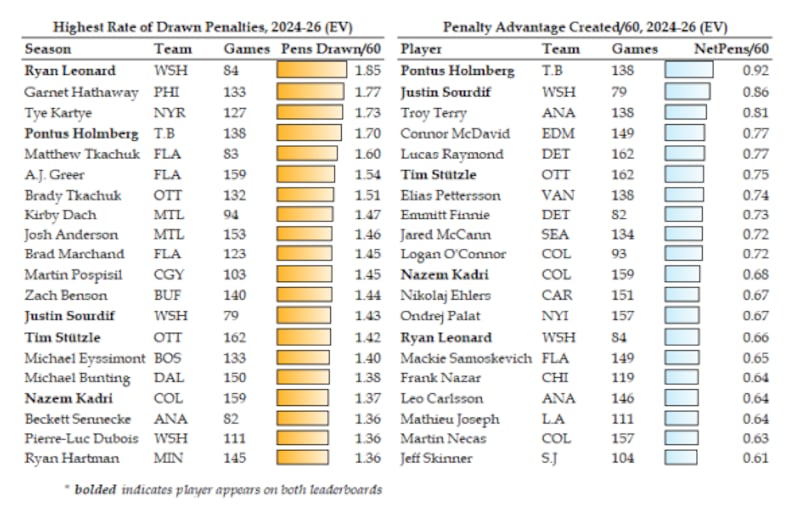
McDavid, Stutzle, and Pettersson all slide into the top 10 for net penalty advantage, and given the minutes they play and the quality of competition they face in these games, that’s a meaningful finding. Anaheim’s Troy Terry and Detroit’s Lucas Raymond are in similar position; exceptionally adept at finding more power plays for their respective teams.
There are five players (including Stutzle) who have used league-leading penalty draw rates to create big net penalty advantages. Two of them reside in Washington in the form of 21-year-old winger Ryan Leonard and 24-year-old forward Justin Sourdif; both are light in experience, and it will be interesting to see if this trend shows up again next season.
Then, two former Toronto Maple Leafs who have found success heading south: Pontus Holmberg in Tampa Bay, and Nazem Kadri in Colorado.
Holmberg, and Kadri in particular, are established veterans who have made a living off sending the opposing team to penalty boxes. Look at their penalty draw rate over the past four seasons versus the league average for forwards. Sprinkle in power plays converting at 22 per cent, and you are finding extra goals (and wins!) in the standings.
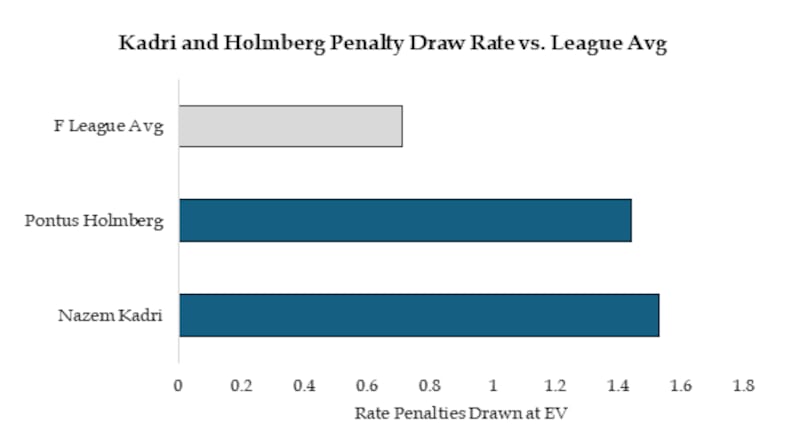
In a league that is increasingly defined by special teams efficiency and tight scoring margins, the ability to draw penalties while staying disciplined is a covetable skill. Teams that can identify and develop penalty advantage players carry a tangible edge. Over an 82-game season, it can be the difference between qualifying for the playoffs and an early summer vacation.
Happy hunting, general managers!
Data via Natural Stat Trick, NHL.com, Evolving Hockey, Hockey Reference