On paper, the Toronto Maple Leafs appear better than the 13th best team in the Eastern Conference. But the results on ice have been shockingly poor, and Jim Hiller’s group currently looks like a one-line team at risk of missing the playoffs for the second year in a row.
Every team in the NHL goes through losing stretches and the Maple Leafs are in the throes of a nasty one right now. Their current six-game losing streak has sunk them to the depths of the Eastern Conference, now pacing for a 68-point season (and -27 full season goal differential).
The good news is there are plenty of games remaining. The bad news? This team looks a lot like last year’s team, and identifiable strengths are hard to come by.
One jarring statistic that stands out from the first six weeks of the regular season is just how dependent this Toronto team is on their top line (more specifically, that of Auston Matthews). The Maple Leafs’ first unit has been sensational, but not nearly sensational enough to obfuscate the results of the rest of the lineup.
If you look at the on-ice/off-ice splits for Matthews (he’s played most of his minutes with Jack Roslovic and Easton Cowan), the difference is extraordinary:
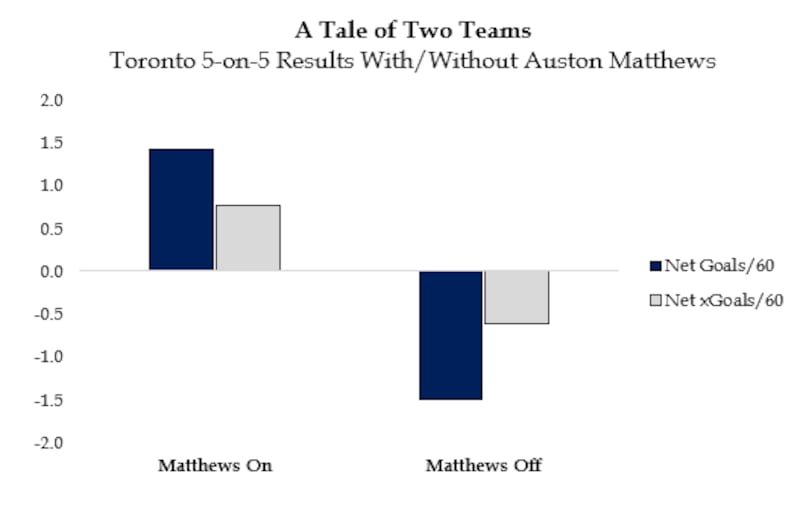
Your first line is typically going to outperform the rest of the team, but this performance gap is extreme. How extreme? With Matthews on the ice this year, the Maple Leafs look like the Minnesota Wild, a team blowing the doors off the rest of the competition in the Western Conference and playing to a 130-point pace. When Matthews comes off, the Maple Leafs results look to be a mirror image of the Vancouver Canucks.
There are several reasons for why the results are in the gutter, and I would be remiss to not acknowledge the impact goaltending has had across the board. The tandem of Sergei Bobrovsky and Anthony Stolarz has stopped just over 88 per cent of shots on the year, only a tick below the league average but a far cry from what GM John Chayka and company thought they’d be getting in the crease this season given the investment.
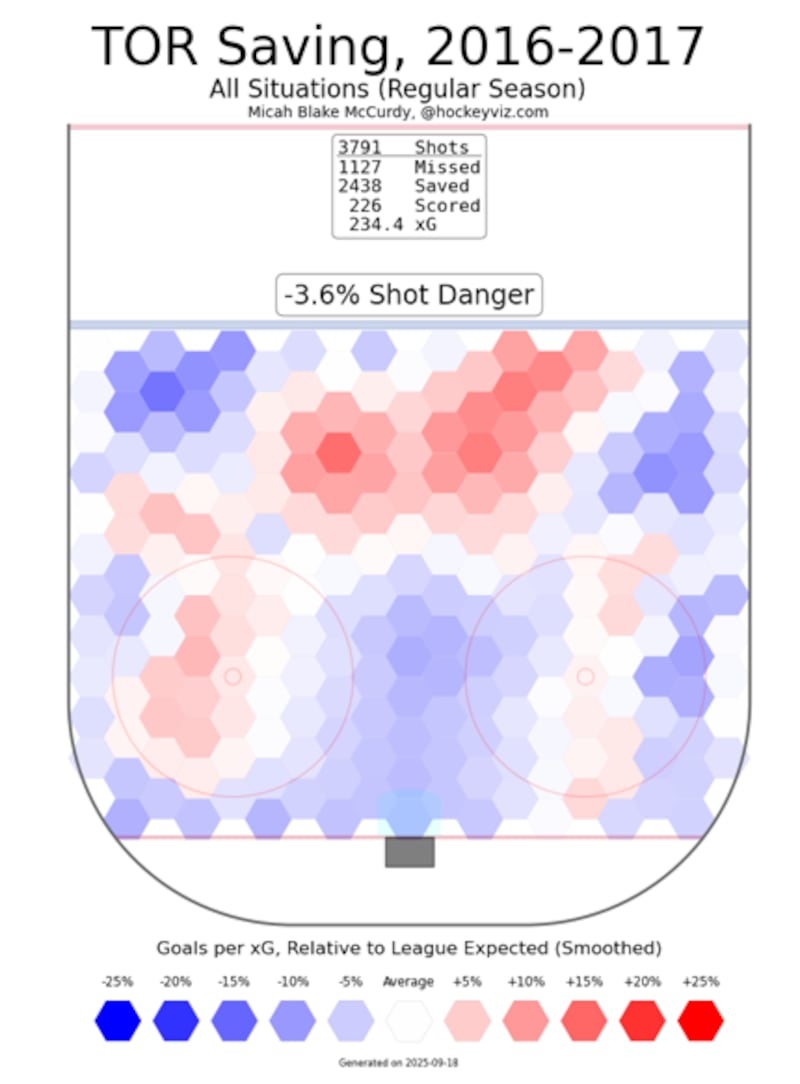
It’s not the worst goaltending room in the league, but it’s not one stealing victories for the team either. The season-to-date save chart (via HockeyViz) I think is illuminating: look at those dangerous chances between the circles and in front of the Toronto net, and notice how commonly those shots are finding the back of the net:
But the lineup in front of Bobrovsky and Stolarz is not doing a lot to help the goaltenders either. At 5-on-5, Toronto grades 24th in shot suppression (57.4 attempts against per 60 minutes) and 17th in expected goal rates against (2.6 per 60), so there’s plenty of defensive-zone pressure to deal with each night.
And unlike the Matthews line, which has been able to reliably outscore this defensive pressure, the rest of the team is underwater. The second- and third-line results are undoubtedly the most concerning: Toronto has a lot of money invested in the likes of John Tavares and William Nylander, to say nothing of the expectations of new blood like Gavin McKenna and Kirill Marchenko:
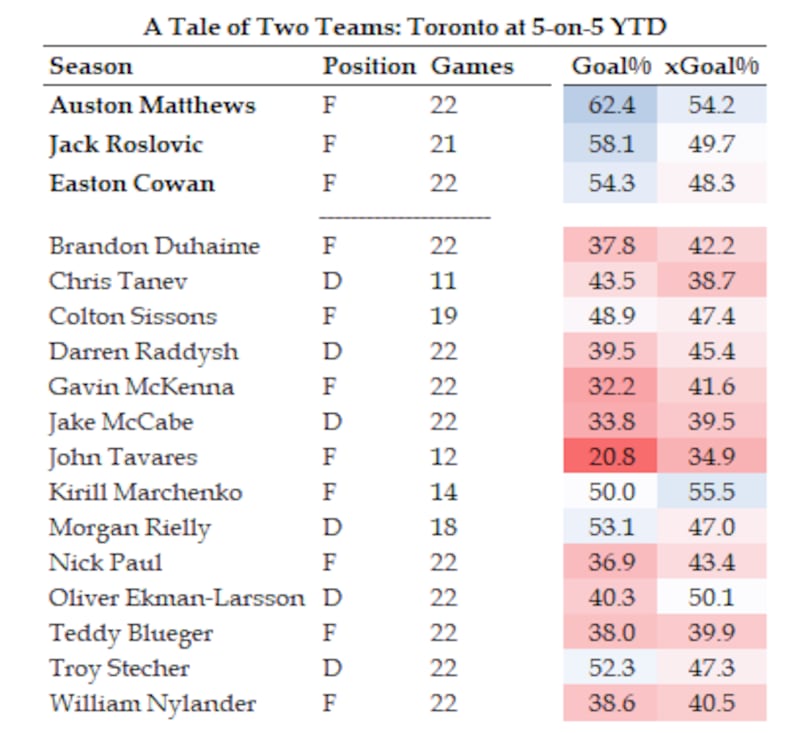
I think there’s a reasonable debate about the talent of the Toronto blueline, but this forward group should be giving you much more than what we are seeing this season. Right now, this team looks like a reincarnated version of last year’s group led by Craig Berube, which finished 28th in the NHL.
Is this team better? I still believe the answer to that question is yes. But it’s time this team started showing us because skepticism is mounting around the league. And given the results, rightfully so.
Data via Natural Stat Trick, NHL.com, Evolving Hockey, Hockey Reference