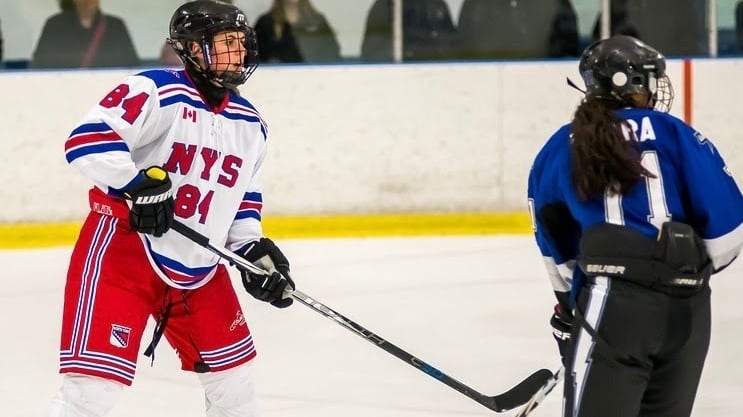
The Ontario Hockey Federation (OHF) has ruled that two members of a U-13 AAA boy’s hockey team in Toronto violated the organization’s code of conduct in March by repeatedly entering a dressing room being used by a women’s team while some of the players were changing and showering.
Neither player on the U-13 Toronto Young Nationals team was sanctioned by the OHF’s discipline panel, according to a July 27 written decision. Nationals head coach Paul Tamburro and three other members of the Greater Toronto Hockey League team’s coaching staff were suspended for 10 regular-season games each and ordered to complete two online courses about gender-based violence in sport and proper supervision of players before returning, a discipline decision that was kept secret from the public.
Unlike a number of national and provincial sport organizations, the OHF does not make public its sanction decisions for off-ice misconduct.
Toronto Cyclones players Katie Armstrong and Sarah Emara said in interviews with TSN that they believe the public should be aware of the March 1 incident at Scotiabank Pond Arena in Toronto and of its aftermath – not to shame the boys or have them removed from hockey, but rather because they believed the response of parents, coaches, and officials on the boys’ team illustrates how hockey allows violations of women’s privacy and boundaries to be dismissed without accountability.
“I think being conditioned as a woman in the culture of sports, you’re taught to say, ‘Oh no, it’s fine, it’s fine,’” Armstrong said. “But it should be taken seriously, even small instances like this. Women are taught to almost feel shame over bringing something like this up. It’s important that you see how things like this start, and that there are different levels.”
A three-person OHF discipline panel wrote in a July 27 decision obtained by TSN that panel members were concerned that there had been no meaningful team-level follow-up or educational response to the incident by the time of the OHF hearing, held virtually on June 30, and that Nationals team officials repeatedly characterizing the matter during an investigation and the hearing as merely an “unfortunate incident” risked minimizing the seriousness of the conduct and the impact on the Cyclones players, who play in the Ontario Women’s Hockey Association.
“The incident affected the privacy, dignity, and sense of safety of the Cyclones players,” the panel wrote. “The panel is also concerned by any suggestion [by at least one Nationals team official] that the Cyclones players bore any responsibility for the incident because their locker-room door was not locked. Such a suggestion risks shifting responsibility away from those whose conduct and supervision gave rise to the incident and may compound the harm experienced by the affected players.”
The panel wrote in its decision that it would not impose individual suspensions on Nationals players who entered the Cyclones locker room.
“Their actions were inappropriate and caused harm,” the panel wrote. “The panel also recognizes that both players apologized, expressed remorse, and accepted responsibility for their conduct… The panel instead considers a broader educational and restorative response to be more appropriate.”
Tamburro did not respond to a request for comment. Nationals acting general manager Lucy Carvalho wrote in a statement that the organization would not comment on the OHF’s discipline committee’s findings or the disciplinary outcomes.
“As a minor hockey organization, we recognize our ongoing responsibility to provide a safe and respectful environment for all participants,” Carvalho wrote. “Expectations regarding player conduct and responsibilities of team officials are reinforced regularly throughout the organization.”
Armstrong and Emara said that about a dozen Cyclones players were in various stages of undress following a March 1 game when the door to their locker room opened repeatedly, each time accompanied by laughter.
“After the third time, I made eye contact with the boys who entered and I got dressed and went out to ask where their coach was,” Emara said.
“It was not an accident. They came into the room three or four times. When I was looking for their coaches or parents, a man walked over and told me, ‘It’s OK. They’re 12 years old. They don’t know any better.’ I said that was unacceptable. The kids are standing there just giggling and laughing and by that time, some of their parents were also there saying, ‘This is OK. Boys will be boys.’ That’s what they said, literally word for word: boys will be boys. That just baffled me.”
Emera said she wasn’t upset with the boys as much as with their parents.
“How are they ever going to learn when they see the adults saying, ‘It’s fine for boys to be boys, it’s the girls’ fault the boys went in the change room again and again because the girls didn’t lock the door,’” Emera said. “It just made no sense to me.”
Emera said she, Armstrong, and a third Cyclones player decided immediately to move forward as witnesses to a complaint.
“Everything is always brushed under the rug,” Emara said. “If we had seen a different reaction from the coaches – genuine remorse, instead of dismissing this as a case of ‘boys will be boys’ I don’t think it would have gotten anywhere near this far.”
The OHF discipline panel identified similar concerns in its decision.
It found that the Nationals coaching staff failed to adequately supervise the players at the rink. According to the decision, the Nationals team coaches acknowledged that, even by the June 30 hearing, they had not addressed the incident directly with the players or the broader team. They said the incident occurred near the end of the season, and the players had since dispersed to other teams and activities.
The panel’s members wrote they were also troubled that members of the Nationals coaching staff repeatedly described what happened during a discipline hearing merely as an “unfortunate incident” and emphasized that they did not believe the conduct was malicious. The panel wrote that characterization risked minimizing both the seriousness of the intrusion and its effect on the Cyclones players.
During the hearing, a Nationals team official questioned why the Cyclones had not locked their dressing-room door and asked where their coaches had been. The panel rejected any suggestion that the women were at fault.
“The Cyclones players were not responsible for the unauthorized entry into their dressing room,” the panel wrote.
In the moments after the March 1 incident, Armstrong’s father confronted Tamburro to say how inappropriate his players had acted. But three months later, during the June 1 OHF discipline hearing, Tamburro said he had no memory of speaking to anyone at the time about the dressing room violation. Armstrong provided the discipline hearing with a photo she took in the hockey arena parking lot showing her father speaking with Tamburro.
“The Nationals coach said he had never spoken with anyone about this the night of the incident,” Emara said. “But then Katie provided the hearing with the photo of her dad speaking to the him and he claims, ‘Oh, I don’t remember that. I talk to a lot of people at the rink.’ I feel like you would remember a conversation like that, if you’re being told that players on your team are multiple times going into a women’s change room. I think that’s a conversation you should remember. And if you don’t remember it, then that’s a problem, too.”
Armstrong said she wished the Nationals organization had used the incident as a teaching opportunity.
“I’m not trying to bring shame to anyone or vilify these kids,” Armstrong said. “But the Nationals organization officials are making us bring it to the public because they’re showing they don’t care enough to take it seriously. If these kids are taught this is OK and ‘boys will be boys’ then they are not being taught to be better. And then how can we expect them to treat women with respect when they are young men?”