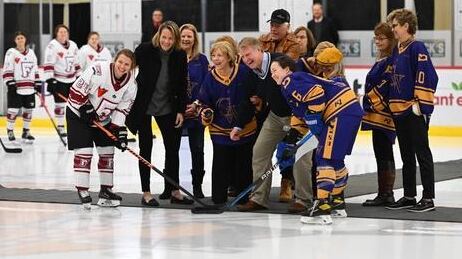
Last Wednesday in New York City the temperature hit 60 degrees Fahrenheit, but that did not stop, or even cool down, the PHF’s Metropolitan Riveters as they took to the outdoor ice at Central Park’s Wollman Rink for a clinic with kids not from elite prep schools, but from Ice Hockey in Harlem, one of the oldest programs in the country designed to bring education, community involvement, and the game of hockey to young people in need.
It may have been an unusual locale for the Rivs' staff and athletes, but there was nothing unusual at all about the goal well beyond the net…supporting communities across the country and causes far and wide through the lens of the impact that the only women’s professional hockey league in North America can have. In fact, the Rivs' efforts away from their home at the Rink at American Dream were only the latest in a list of season-long proactive outreach programs every team undertakes.
“While our primary goal is to grow our league and the opportunities for our players, we fully realize there is a higher goal here as well, and that’s to use our league and the platform we have as a tool for change in the communities we play in, and for those who are disadvantaged or struggling, and that’s where our players really shine,” PHF commissioner Reagan Carey said recently. “We are true members of the communities we play in, and we only really succeed if all around us do as well.”
The Riveters' clinic is the latest example of the PHF’s expansive outreach to identify and work with new communities in and around hockey. Last Saturday night in Boston, the Pride hosted Hockey Fights Cancer while on Sunday they celebrated Black History Month, supporting Black Girl Hockey Club. In Connecticut, the Whale will be hosting their annual Alzheimer’s Awareness game in partnership with the Alzheimer’s Association of Connecticut with specialty jerseys, while the Minnesota Whitecaps recently highlighted two local organizations during their Hockey is for Everyone Night, including Minnesota Special Hockey and Play For Patrick. The Patrick Schoonover Heart Foundation was started by Michael and Gayle Schoonover after their son Patrick passed away at the age of 14 due to sudden cardiac arrest that was caused by undetected heart defects. Minnesota Special Hockey was founded in 2006 and started at Richfield Ice Arena, providing a place for everyone, regardless of physical impairment or developmental disorder, to play hockey. Sunday’s contest will be Youth Hockey Day.
Then you went further north, where earlier in the month the Montreal Force unveiled specially designed jerseys by artist Ganadiyoh Jada Hopper that were auctioned with proceeds to support the local Indigenous not-for-profit – Iakwahwatsiratátie – which means ‘our families are continuing’. The organization is a language nest located in Kahnawá:ke Mohawk Territory, home of Force forward Brooke Stacey.
The Toronto Six also celebrated Pride with rainbow socks and ‘Sport a Rainbow’ stickers on their helmets earlier this month, while the Buffalo Beauts' Autism Acceptance game this season raised awareness and funds for another key cause.
Last but not least, we circle back to the Riveters, who hosted Mental Health Awareness weekend to start the year with Baker Street Health and Human whose mission is to help provide the Riveters with medical support, behavioral health services, and mental skills training. The Rivs wore special ‘Let’s Talk About Mental Health’ themed jerseys for games that weekend as well.
“If we can show future generations of athletes they can do it and we make ourselves accessible to the kids who are looking to one day be like us, it can change the entire trajectory of their sports journey,” added Riveters captain Madison Packer after one of the team’s most recent events as well.
While the growth of the league using business metrics in just the past 18 months has been astounding, that fan engagement, where a connection is made to someone struggling, or a young person looking for an identity, is still second to none in terms of impact.
“If we continue to do all the right things on and off the ice, especially in the cities where we play now and will in the future, the opportunities are brighter than ever,” Carey said. “It takes a village to achieve wide-ranging success and we are still very early on in the process, but if we keep amplifying engagement our value grows, and so does our community. That translates into success for all.”