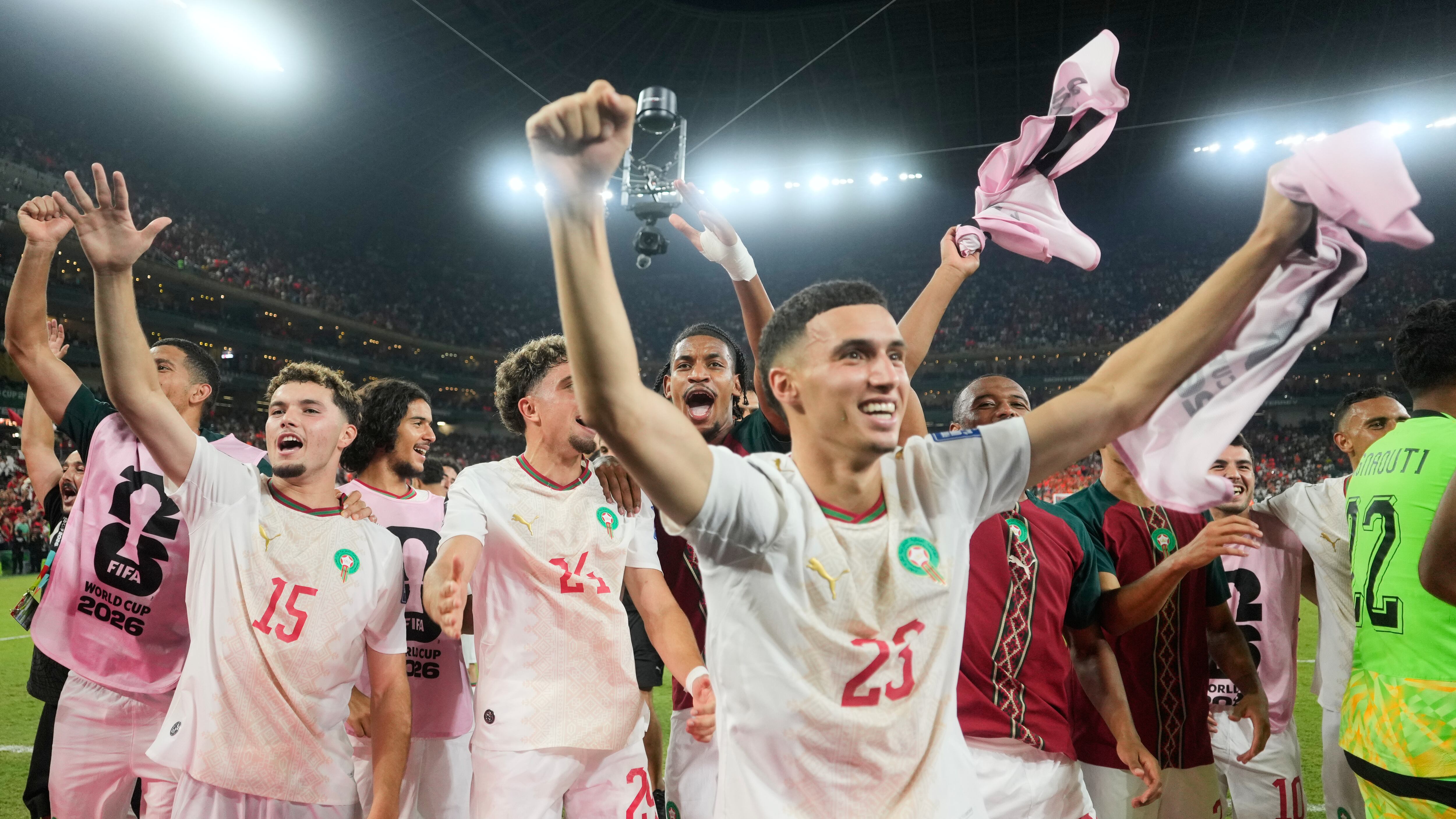
Canada faces the most daunting challenge to its unprecedented FIFA World Cup run on Saturday when it meets Africa Cup of Nations holders Morocco in Houston in the Round of 16.
In the Atlas Lions, Canada takes on its highest-ranked opponent (currently No. 6) since a game with then-No. 2 Belgium to open the 2022 World Cup in Qatar. The CanMNT, of course, also played Morocco in that tournament.
Drawn into Group C, the Atlas Lions finished as runners-up, level on seven points with Brazil, but in second thanks to an inferior goal difference. They opened their tournament with a 1-1 draw with the Selecao before a 1-0 win over Scotland a 4-2 defeat of a plucky Haiti side in their group-stage finale. Newly signed Bayern Munich midfielder Ismael Saibari, who spent the past six seasons with PSV, scored in all three matches for Morocco.
In charge of the Atlas Lions for the first time at a major tournament is Mohamed Ouahbi. The Brussels-area native never played football at any kind of high level and began his coaching career in 1997 at the age of 21. His big break came six years later when he was hired as the youth coach at Pro League giants Anderlecht.
Ouahbi would spend nearly two decades at the club before joining the Atlas Lions program in 2022 as the U20 manager. After moving up to the U23 squad in 2025, he was named manager of the senior side in March following the resignation of Walid Regragui.
A former national team right-back who was capped 44 times and played at the likes of Toulouse, Racing Santander and Dijon, Regragui had famously taken the reins of the Atlas Lions only months before the World Cup in 2022. The infamously temperamental Vahid Halilhodzic, who had previously led Japan and Cote d’Ivoire to World Cup qualification before being fired ahead of the tournament, made it a hat trick of such scenarios when he was sacked over disagreements with the federation. Prior to his appointment, Regragui had only managed at Moroccan club teams.
But the Atlas Lions became the surprise package of the 2022 World Cup, finishing atop a group that also contained UEFA heavyweights Croatia and Belgium – more on Group F later – and going on a Cinderella run. In the Round of 16, Morocco stunned 2010 champions Spain on penalties. Then in the quarters, the Atlas Lions eliminated the other Iberian squad with a 1-0 win over Portugal. Their run came to an end with a 2-0 loss to France in the semis.
Still, history had been made. By reaching the final four, Regragui’s Atlas Lions became the first African and/or Arab squad to make it to the World Cup semis. The performance turned Morocco from an unheralded team to a legitimate global power.
Regragui’s final tournament with the team would be this past December’s Africa Cup of Nations, one that ended in triumph for the Atlas Lions, but not without major controversy. Hosting the event for the first time since 1988, an undefeated Morocco topped their group before dispatching Tanzania in the Round of 16, Cameroon in the quarters and Nigeria (on penalties) in the semis. They would meet Senegal in the final.
The 2025 AFCON Final was a cagey affair and level at 90 minutes. In the third minute of stoppage, the Lions of Teranga were awarded a corner. The delivery was whipped towards the far post where Abdoulaye Seck, who had just had a coming together with Achram Hakimi that saw him go to ground, headed off of the crossbar. The rebound came to Ismaila Sarr on the doorstep and his header made it 1-0. The goal would not stand, though, with VAR waving the goal off due to Seck fouling Hakimi.
If that weren’t enough intrigue for one match, in the eighth minute of stoppage, Morocco was awarded a penalty following a VAR review that adjudged Brahim Diaz to have been pulled back in the area by El Hadji Malick Diouf. Incensed, Senegal left the pitch and headed to the lockers. The decision spurred unrest in the stands among Senegalese supporters with some attempting to storm the pitch, others throwing things on the field and one group fighting with stewards and security.
Order was restored after a nearly 15-minute disruption, and the Senegal players would eventually return to the pitch. While Youssef En-Nesyri is Morocco’s normal penalty taker, he ceded duties to Diaz to take his own. Following several further minutes of delay, the Real Madrid man stepped up to the spot and delivered a stinker. His Panenka attempt was as tame as could be and harmlessly floated into the waiting arms of Edouard Mendy.
In extra time, Senegal finally found a breakthrough. Played forward by Sadio Mane, Pape Guaye streaked into the box and let fly with a sensational left-footed volley to beat Bono and give the Lions of Teranga a 1-0 lead in the 94th minute. They would hold onto the lead and win their second AFCON title…or so it would seem.
In mid-March, exactly two months after the Jan. 18 AFCON Final, Senegal’s victory was declared invalid and Morocco were awarded the title with a 3-0 forfeit victory. The Confederation of African Football overturned the result as punishment for Senegal’s walk-off from the pitch following the awarding of the penalty to Diaz. The ruling cited Article 82 of the tournament’s regulations – should a team refuse to play or leave the pitch without authorization before the final whistle, it will be considered the loser of the match. Furthermore, Article 84 states that a violation of Article 82 results in permanent expulsion from the tournament and a 3-0 forfeit defeat.
So the Atlas Lions were champions, but it certainly didn’t feel like that after a loss on the pitch. Regragui received a deluge of criticism directly after the tournament for not winning it on home soil and, by the beginning of March, he was gone. He was out before the CAF ruling.
“The team needs a fresh face, a different energy, and a new perspective with a new coach,” Regragui said at his farewell press conference. “I think the team needs a new lease of life before the World Cup, a new vision to continue progressing. My decision to leave is part of this team’s evolution.”
Regragui’s reign was a transformative one. Morocco will not sneak up on anybody anymore. They are a known commodity and the squad that Ouahbi shepherds now is filled with trophy-winning players from across Europe. Along with established veterans like Bono, Noussair Mazraoui and Sofyan Amrabat, there are exciting young stars such as Saibari, Ayyoub Bouaddi and Chemsdine Talbi.
The Atlas Lions are now battle-tested and their mettle was proven in their Round of 16 penalties triumph over the Netherlands. After over an hour of the two teams unafraid to engage in hard, physical play, the Oranje found an opener through Cody Gakpo, completing a nice team move with input from Wout Weghorst and Crysencio Summerville. The goal came against the run of play with the Atlas Lions having looked ascendent just beforehand.
What would happen next cost Ronald Koeman his job. It would be one thing to park the bus with a one-goal lead, but the Oranje went beyond just that, employing negative tactics and almost refusing to chase a second goal to put the match out of reach.
They would be punished for it in stoppage when Issa Diop levelled with a header. Morocco probably should have won the match before penalties had it not been for a sensational save by Bart Verbruggen on Soufiane Rahimi.
Neither team was particularly sharp on spot kicks, but the Atlas Lions missed fewer. Misses from Justin Kluivert, Quentin Timber and Summerville put the Oranje on the brink. It was Saibari who secured the victory for Morocco when he wrong-wayed Verbruggen, taking the match 1-1 (3-2 on penalties).
In Canada, Morocco meets a familiar foe. Saturday’s match will mark the first time in three World Cups that Canada will play a repeat opponent. The two sides met in Qatar on the final matchday of group-stage play. While the game was a big one for Morocco, Canada was playing for pride, having already been eliminated from the competition.
The Atlas Lions didn’t take long to take control of the match. In just the fourth minute, miscommunication between Steven Vitoria and Milan Borjan led to disaster for Canada. With Vitoria being closed in on in a hurry by En-Nesyri, the veteran defender attempted to play a ball back to his keeper, but it wasn’t heavy enough. Borjan had to come off of his line to get there before En-Nesyri to make a desperate clearance. Instead of hammering the ball, though, his effort had nothing on it and landed right at the feet of Hakim Ziyech, who calmly chipped over Borjan and into the empty net to make it 1-0.
Less than 20 minutes later, the Atlas Lions would be two up to the good. A long ball over the top for En-Nesyri split Vitoria and Kamal Miller. With a step on both defenders, En-Nesyri’s low drive beat Borjan at his near post in the 23rd to make it 2-0. Just as Morocco’s first goal had an odor to it, so did the second one. Borjan could have been much better there.
Before the end of the half, Canada would pull one back with an own goal. Sam Adekugbe’s ball across the face of goal was turned into his own net by Nayef Aguerd. While Canada captain Atiba Hutchinson would hit the crossbar with a header from a set piece in the second half, it was as close as Canada would come to an equalizer. The match finished at 2-1 with Canada going home on the back of three losses.
Saturday’s match will be the fifth contested between the two sides and first since Qatar. Canada is still looking for its first victory. Canada is 0-1-3 against the Atlas Lions and has been outscored 10-4 over the four games. Only one of the previous four matches was played in Canada.
As has been mentioned multiple times over the course of the tournament, this is a much-changed Canada squad since Qatar. Six of Canada’s starting XI in the loss to Morocco (Borjan, Vitoria, Miller, Adekugbe, Junior Hoilett and Mark-Anthony Kaye) did not make the current World Cup squad and neither did two of the substitutes (Hutchinson and David Wotherspoon). But Canada’s opponents are quite different, as well.
Five of the 11 men who started for the Atlas Lions four years ago (Aguerd, Ziyech, Romain Saiss, Abdelhamid Sabiri and Soufiane Boufal) are not in North America right now. Not one of Regrarui’s five substitutes (Zakarai Aboukhlal, Selim Amallah, Abderrazak Hamdallah, Jawad El Yamiq and Yahya Jabrane) made this 26-man roster. While there are obviously players returning for both sides, there is a freshness to this matchup.
What’s also different is the perception of the two teams. When Morocco and Canada met in Qatar, the Atlas Lions had made it out of the group stage just once in five previous tournaments and that was in 1986. Canada, of course, was playing in just its second World Cup and first since 1986.
Where both programs have been in the days since has certainly disabused anybody of the notion that these teams are simply here to make up numbers.
While neither side is overlooking the other heading into Saturday’s match, it’s only natural to see what path lies ahead with a victory. The winner of the match in Houston earns a date with the winner of Saturday’s other game – France vs. Paraguay – on Thursday in Boston. Needless to say, with both Canada and Morocco having been French colonies, one of the two potential matchups contains significantly more cultural relevance than the other.