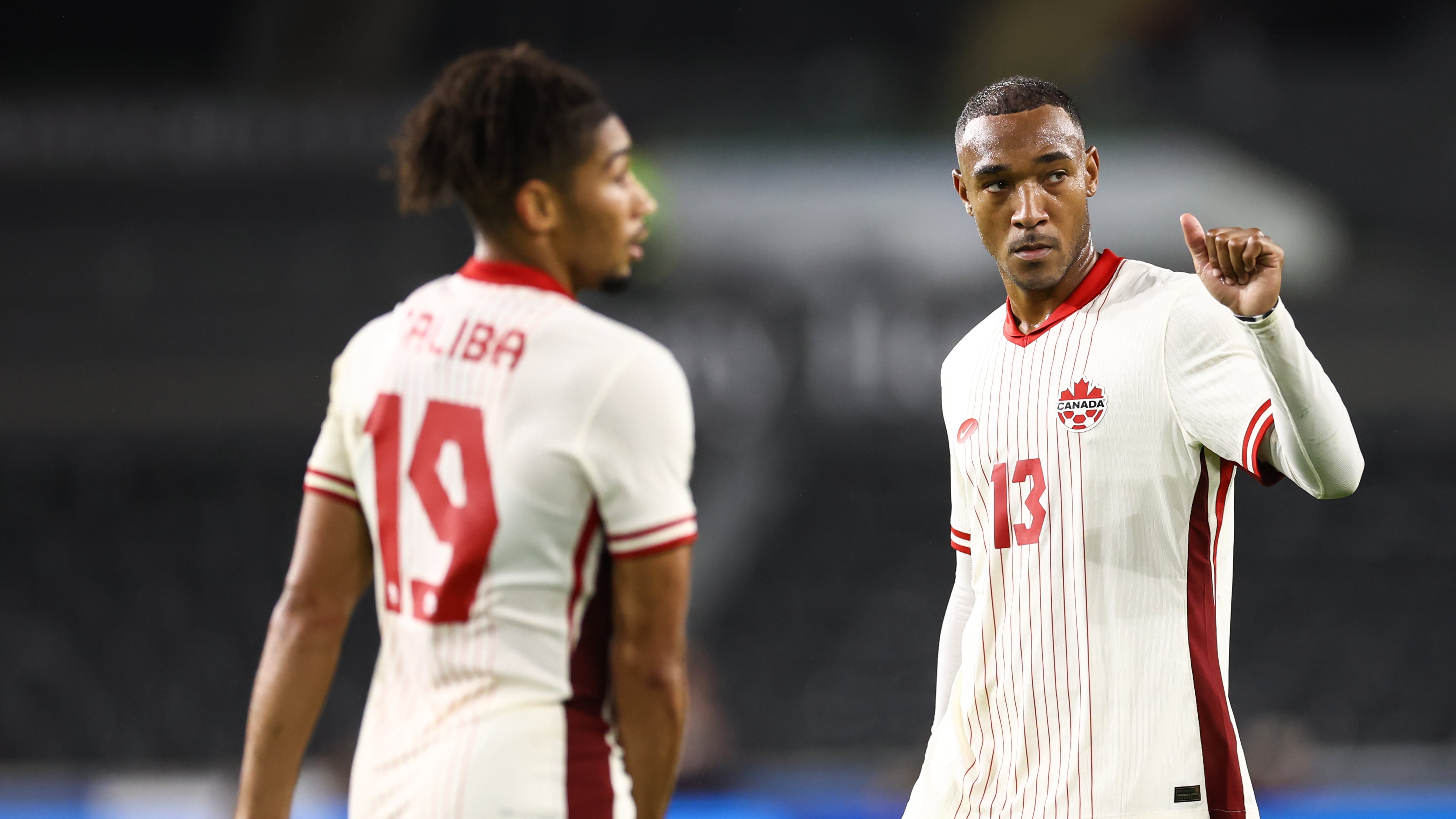
Canadian defender Derek Cornelius believes he was unfairly labelled as a player who chose country over club during his final months at Rangers.
In a recent interview with TSN, Cornelius explained that, as he rehabbed from a hamstring injury incurred while playing for Canada last November, his focus was earning his roster spot back with Rangers and helping his team win a Scottish title.
But the 28-year-old from Ajax, Ont., sat on the sidelines for seven months, and now says the entire situation made him feel disrespected.
“I felt very disrespected,” Cornelius said. “I said [to Rangers], ‘I can help this team.’ In some way, whether that’s starting, whether it’s five minutes to hold on to a lead, whether that’s having a conversation with a guy - a younger player - saying, ‘Don’t worry about the pressure, just focus on your job.’ Whatever [role].
“I wasn’t given a solid reason as to why I was not able to be considered [to play].”
Cornelius moved to Rangers on loan from Olympique Marseille last summer. He made 12 appearances for the club across all competitions, scoring one goal and adding an assist. His last game in Scotland came in November against Dundee FC. Cornelius then injured his hamstring in the 33rd minute of Canada’s 2-0 win over Venezuela on Nov. 18.
Initially, when doctors gave him a recovery timeline of four months, Cornelius didn’t think his injury would leave him out that long.
“I started laughing [about the prognosis],” Cornelius said. “[The doctor responded], ‘There’s no joke here.’ That was a tough one to hear, you know? It was the biggest injury I’ve had in my career, and possibly the most important year in my career, before a World Cup.
“To hear you’re going be sidelined for so long, it was, it was hard, but I can only deal with what was in front of me.”
Cornelius said his only focus was maintaining his mental approach to rehab. Then, as he got back to fitness in February, Canada coach Jesse Marsch revealed to the media Cornelius was training with Rangers’ academy players. Rangers manager Danny Röhl then confirmed Cornelius was training away from the first team.
“I was out for an extended period of time, excited to come back, looking forward to it, no conversations [between Cornelius and Röhl] were had during that time, which was fine,” Cornelius said. “I think I came back into team training maybe twice or so, and then after the second training, I was called to [Röhl’s] office, and he basically just told me, ‘From now until the end of the season, you’re not going to be part of the squad.’ And I just felt that was really unfair. I felt like I deserved the opportunity to work my way back into the team.”
Rangers allowed Cornelius to meet up with Canada early before the March window, and Röhl stressed then that he and Cornelius would have a conversation after the spring friendlies.
“I had two conversations in the last couple of days with Derek. I will have a conversation when he comes back from the national team again,” Röhl said on March 20. “All these things between Derek and me, it’s between us, this is crucial. I have my principles; this is very important.”
Marsch also said publicly that he attempted to act as a mediator between Cornelius and Röhl.
Cornelius played 15 minutes against Iceland and 32 minutes against Tunisia during the international window. He then returned to Scotland and didn’t play for Rangers again.
The club released Cornelius in mid-May to link up with Canada’s staff in Charlotte for the team’s pre-World Cup camp. TSN reached out to Rangers at that point, but the team declined to comment.
Cornelius also wouldn’t go into detail about any of his discussions with Röhl.
“I wasn’t given a solid reason,” Cornelius said of what the manager told him about not playing.
But the defender did say the interactions he had at Rangers and the atmosphere he felt around him at the club made him feel as if he was being labelled as a player who was choosing his World Cup ambitions over Rangers.
“It was tough. It was really tough. I was hoping the situation would change. Maybe if [Röhl] sees the way I’ve been training for the last two, three weeks, he could have changed his mind, but it wasn’t the case, and it’s honestly disappointing. I honestly feel like we had enough talent and enough ability to go on and win a title.”
Ultimately, Rangers finished third in the Scottish title race behind Hearts and champions Celtic.
As his club situation played out, Cornelius said his inner circle of relationships and past club experiences helped him find stability. Over the past decade, Cornelius’s career has taken him from Germany to Serbia to the Vancouver Whitecaps then Greece, Sweden, France, and Scotland, and all those experiences shaped his emotional perspective.
“Whether it’s racism you’re facing in Serbia, or in Vancouver, [where I was] maybe not getting as many consistent minutes that I was wanting to, or playing in an environment like Marseille with such incredible pressure, [or] my time in Sweden we’re fighting for titles, and what it means to be in a title hunt, and winning - I think they all came with their different challenges,” Cornelius said. “I look back, and I say, ‘You know, you’ve been through this, this, this, and this. You gonna get through this as well.’”
With two more years left in his Marseille contract, Cornelius will not be returning to Rangers and isn’t focusing on his club future during the World Cup.
While he wasn’t playing in Scotland, Cornelius received regular exercise plans from Canada’s head of performance and assistant coach Pierre Barrieu and isn’t worried about his sharpness ahead of Canada’s pre-World Cup friendlies against Uzbekistan in Edmonton and Ireland in Montreal.
His only focus now is proving to Marsch he is still a reliable defensive anchor alongside fellow central defender Moïse Bombito. The duo played together in 13 of Marsch’s first 15 matches as Canada’s head coach, including Canada’s run to the 2024 Copa América semifinal.
But Cornelius is also aware the expectations heading into the nation’s first group game on June 12 against Bosnia and Herzegovina in Toronto are as high as they’ve ever been.
“It’s a different kind of pressure that [Canada] have to deal with,” Cornelius said. “If we don’t get any points [in the group stage] it’s a big disappointment. And I personally like those expectations that are now being put on the team, because we’re finally getting recognized as a good team, as a solid team, and we need to perform now.”