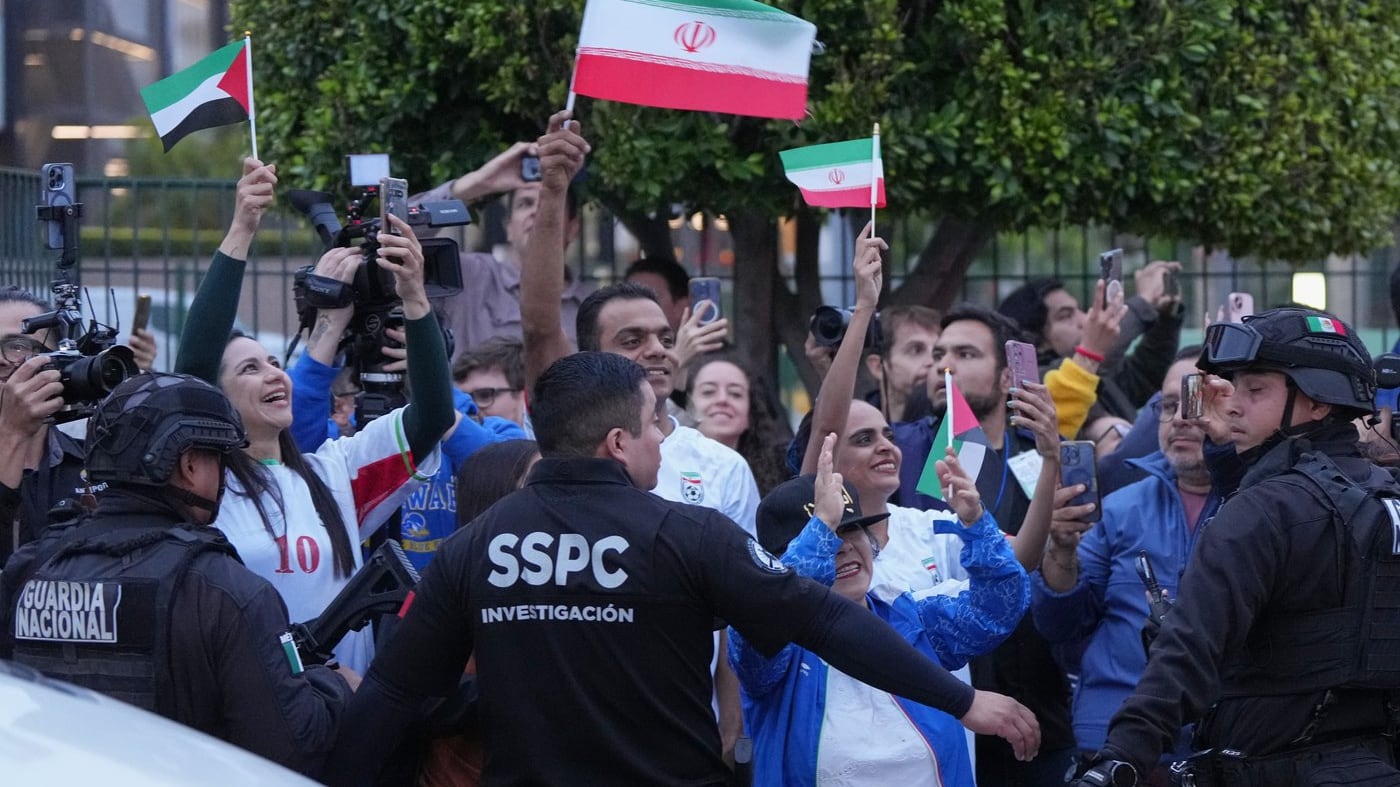
Adding more turmoil to a chaotic World Cup buildup for Iran, the national soccer federation claimed Tuesday that FIFA revoked the ticket allocation for fans at the team’s three group-stage games in the United States.
Each federation for the 48 teams taking part is entitled to receive and distribute 8% of stadium capacity for each of its games at the World Cup, adding up to several thousands of tickets per game.
Those allocations typically went on sale to each team's most loyal fans soon after the tournament draw in December, when Iranians had already for five months been subject to a travel ban by the U.S. government.
Now, just days before Iran opens its World Cup — on June 15 at the 70,000-seat Los Angeles Rams’ stadium in Inglewood against New Zealand — the federation claimed in a statement reported by semi-official state media it was now unable to provide any tickets to its supporters.
The claim adds to the tensions between Iranian soccer, FIFA and tournament co-host the U.S., which began military attacks on Iran on Feb. 28.
FIFA has total authority over ticketing operations at the World Cup, yet the Iranian soccer body suggested “the United States has now taken steps to obstruct the presence of Iranian supporters at the stadiums.”
“This incident raises serious questions about the influence of non-sporting and political considerations on the organization of the world’s biggest football event,” the Iranian soccer federation said.
FIFA said in a statement Tuesday it is "working closely with the IR Iran Football Federation to identify compliant solutions that maximize opportunities for Iranian supporters to attend matches.”
FIFA President Gianni Infantino and its CEO-like secretary general Mattias Grafström each promised logistical support in face-to-face meetings with Iranian soccer officials in Turkey in recent weeks.
Iran's bumpy ride to World Cup
Most of Iran's 26-man squad has not had a competitive game since February because they play for clubs in the domestic league that was shut down by the war.
They are now based in the Mexican border city of Tijuana instead of a pre-war plan to train in Tucson, Arizona. It is the team's seventh appearance at a men's World Cup.
Some federation officials also have been denied visas to enter the U.S., where Iran also plays Belgium in Inglewood, a suburb of Los Angeles, on June 21 and then Egypt in Seattle on June 26.
Andrew Giuliani, the executive director of the White House FIFA task force, said Tuesday that the Iranian team would be able to enter the U.S. the day before their match and emphasized that Tijuana was a short flight to Los Angeles. He confirmed that some Iranian officials were “not coming in” and while he declined to go into specifics, Giuliani added that “as you can imagine, there are some people that claim that they are coaches that may not be coaches.”
“The president has been clear on this one ... that he wants to make sure that they have every opportunity to compete on a level playing field here, while also making sure that people that are directly working, let’s say, with the IRGC have no ability to access the United States of America,” Giuliani said, referring to the Islamic Revolutionary Guard Corps.
Fans wanting to come to the U.S. to follow the team were likely to face issues obtaining visas issues and making payments while financial sanctions are in force.
“However, in an unexpected move, the allocation granted to Iran’s football federation has been withdrawn, and under the current circumstances the federation is unable to offer even a single ticket to national team supporters,” the federation said.
It was unclear Tuesday how many tickets in Iran’s allocation were sold, if they live in their home country or are part of its diaspora including about 1 million people in the U.S.
If Iranian tickets are revoked, FIFA would have just days to sell about 5,600 tickets for the Iran-New Zealand game on Monday, though Los Angeles has the largest Iranian community in the U.S.
The FIFA sales site on Tuesday showed rows of field-level seats available at $450 each though in the dozens rather than hundreds.
Still, Infantino stated in 2017 — when U.S. soccer officials were preparing a co-hosting bid with Canada and Mexico they won the following year — that fans must have access to the tournament.
“It’s obvious when it comes to FIFA competitions as well (that) any team, including the supporters and the officials of that team, who would qualify for a World Cup need to have access to the country, otherwise there is no World Cup,” Infantino said nine years ago. “That is obvious.”
Hostile welcomes
U.S. policy toward World Cup visitors is becoming a strong theme before the games begin on Thursday.
A FIFA-appointed match referee from Somalia was denied entry to the U.S. in Miami at the weekend and on Monday he was cut from the 104-game tournament that starts in Mexico City.
An Iraq player was detained for several hours on arriving in Chicago and a photographer traveling with the delegation was denied entry.
“The disruption is such that one has to ask who is running the World Cup. Is it FIFA or is it the U.S. government with its racially charged immigration policies?” Piara Powar, the head of FIFA's anti-discrimination monitoring partner, said on Tuesday in a statement.
“Before a ball has been kicked,” said Powar, executive director of the Fare Network, “the sense that this World Cup is anything but the celebration of global humanity a World Cup should be is beginning to take over.”
___
Associated Press writer Seung Min Kim contributed to this report from Washington. AP World Cup: https://apnews.com/hub/fifa-world-cup
Graham Dunbar, The Associated Press