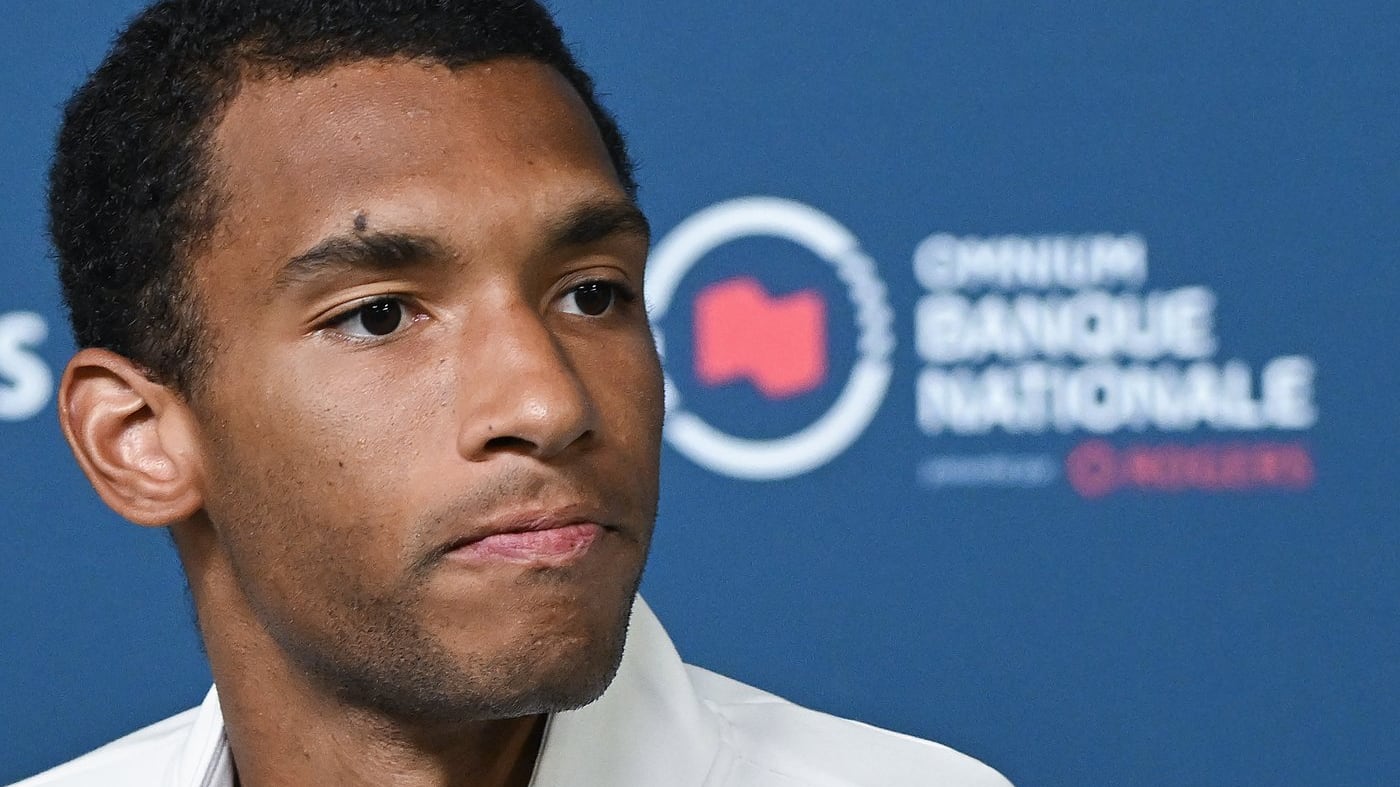
MONTREAL — High hopes for Canada's top men's tennis players at the National Bank Open have quickly given way to injuries, with Félix Auger-Aliassime, Gabriel Diallo and Denis Shapovalov all sidelined in Montreal.
"We need our top players to be healthy, that's for sure," said Guillaume Marx, Tennis Canada's vice-president of high performance, on Thursday. "It's obviously on our minds."
Local favourite Auger-Aliassime was forced to withdraw before his opening match Wednesday after injuring his back during a practice session two days earlier. His withdrawal came on the heels of early round retirements by fellow Montrealer Diallo and Richmond Hill, Ont., native Shapovalov on Tuesday.
While Marx said the timing was disappointing, he doesn't expect Auger-Aliassime's injury to linger.
"I'm not too worried about Félix," he said. "Like he said, it's an injury that he knows a little bit, one that has occurred already. Usually, it doesn't take too long.
"It's just Wednesday he couldn't play. We're pretty positive."
Auger-Aliassime entered the tournament as the second seed after spending two weeks training in Montreal. Tournament organizers sold out Wednesday night's Centre Court session with Auger-Aliassime as the main attraction.
Diallo's outlook was less certain after the 24-year-old retired from his opening-round match with an apparent leg injury.
Marx confirmed Diallo will miss next week's ATP Masters 1000 event in Cincinnati but would not speculate on a timeline for his return. The U.S. Open, the year's final Grand Slam, begins main draw play on Aug. 30.
"For Gabriel, we'll see now how long it's going to take," Marx said. "We'll have to monitor that, for sure."
Shapovalov also retired Tuesday after suffering an ankle injury. The world No. 43 had returned to competition only last week, reaching the final of an ATP 250 tournament in Los Cabos, Mexico, after missing a month with various injuries.
Marx said this point in the ATP calendar presents unique physical challenges as players transition from grass and clay surfaces to the North American hard-court swing.
"The transition of surfaces are critical moments for the players," he said. "They are oftentimes periods of the season where players are most susceptible to injuries. The hard courts can bring back old injuries to the surface."
He added the demanding schedule leaves little margin for players who are less than fully healthy.
"The calendar is intense," Marx said. "Perhaps that, too, is contributing to player fatigue. The injuries that were sustained by the players are each a unique case, but they are symptomatic of the challenges we face.
"Today, the big problem, too, is that the margins are thin. Someone who is not at 100 per cent, they basically have no chance."
The Canadians' injuries have been just one part of a chaotic week in Montreal.
Twelve seeded players, including top seed Alexander Zverev and fourth seed Daniil Medvedev, were eliminated Wednesday, leaving the tournament without a player ranked in the world's top five in the round of 32 for the first time at an ATP Masters 1000 event since 1991.
Six of the top eight seeds had been eliminated from the singles draw by Thursday, with Australia’s Alex de Minaur the latest to bow out.
The tournament’s No. 3 was bounced by unseeded Cameron Norrie of Great Britain 5-7, 7-6 (5), 6-1 in a back-and-forth third-round matchup.
"I thought I gave myself chances early in the third set and then I just played some bad points in a row," said de Minaur. "I got behind quickly and it all just went very quickly."
Norrie advanced to the fourth round of the National Bank Open for the first time in six appearances at the tournament.
"I'm really happy,” Norrie said. “It was a crazy match. It's been a while since I won by saving a match point. It was going to be a battle from the beginning, but I'm really proud of my attitude."
His next opponent in the round of 16 is No. 18 seed Arthur Fils of France. The Frenchman defeated Argentina’s Mariano Navone 6-3, 6-2 earlier Thursday to advance to the fourth round for the first time in Canada.
"He's such a good player," Norrie said of Fils. "He's a complete player with a huge serve. He’s got a forehand, a backhand, is athletic and moves well. When he’s been healthy, he’s probably one of the best players in the world and most confident.
"He won easy today, so I’m going to have to definitely play my best to have a chance with him.”
Nineteen-year-old Rafael Jodar of Spain beat the No. 11 seed Lorenzo Musetti of Italy 6-4, 6-3 to open Thursday’s night session on Centre Court.
Jodar will face a tough test in eighth-seed Jiri Lehecka of Czechia, who also moved on with a tidy 6-3, 6-4 win over Belgian Alexander Blockx.
Italy's Luciano Darderi, the 19th seed, came back from a set down to beat China’s Juncheng Shang 4-6, 6-1, 6-4.
Darderi advanced to face Portugal's Nuno Borges, who topped Germany's Yannick Hanfmann 6-4, 6-2.
Meanwhile, in first-round doubles action, the all-Canadian team of Duncan Chan and Alexis Galarneau eliminated Zverev and Brazilian Marcelo Melo 6-3, 7-6 (5).
Liam Draxl of Newmarket, Ont., and Calgary's Cleeve Harper fell to Fabian Maroszan and Medvedev 4-6, 6-4, 10-6.
This report by The Canadian Press was first published Aug. 6, 2026.
Jordan Stoopler, The Canadian Press