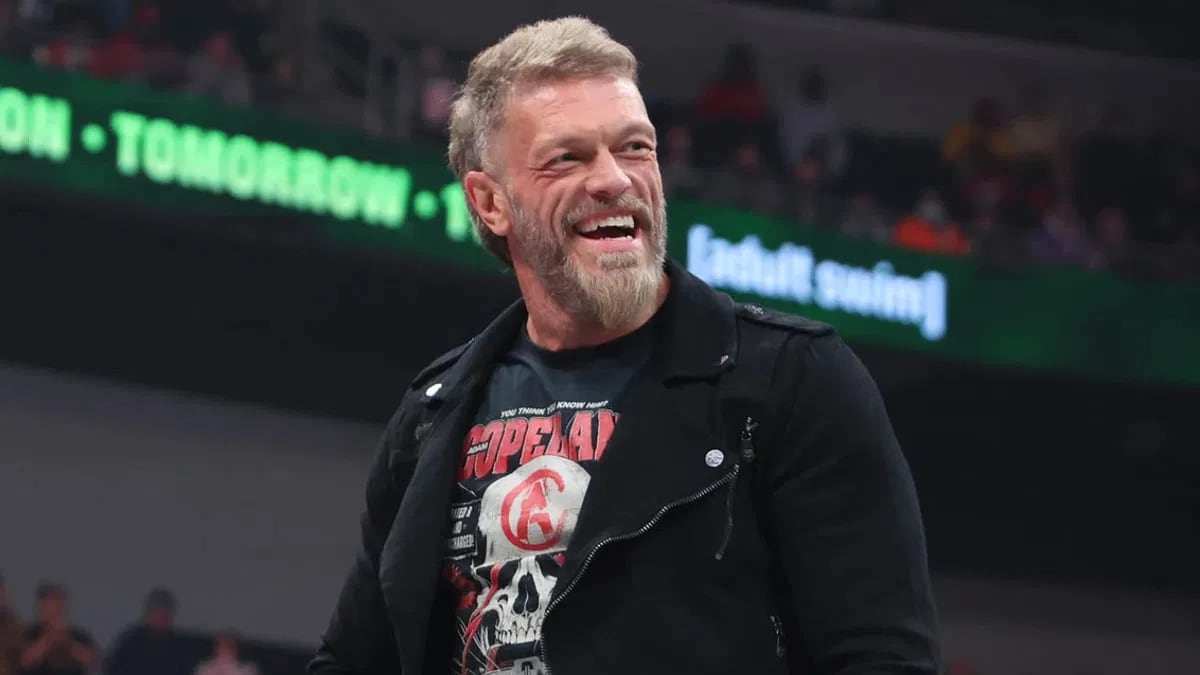
For the first time ever, Adam Copeland and Jay Reso, aka Christian Cage, will team together on pay-per-view in Toronto at All Elite Wrestling’s All Out at Scotiabank Arena on Saturday afternoon when they take on FTR of David “Dax” Harwood and Daniel “Cash” Wheeler.
It seems hard to believe that the best friends, from Orangeville, Ont. and Kitchener, Ont., respectively, and long-time tag-team partners would never have teamed on a PPV in their billed hometown, but that’s the case. The match will be the first time the two have wrestled as a team in Toronto in nearly 25 years.
“We knew we were going to get here, we just didn’t know when or necessarily how,” Copeland said of the program with FTR, “but we knew this was one of the matches we wanted to get to and kind of be the first real [match] that solidifies our team going forward and it’s more than just a one-off. [Jay and I] wanted to work those guys. We often would sit there when we were both retired – and between the two of us, we were retired for 16 years. I was gone nine and he was gone seven. This was done. But we thought if we ever could [come back], FTR and the Young Bucks (Nick Jackson and Matt Jackson). Those were the two teams we really wanted to get in there with.”
That this match is even happening at all is a wild improbability.
Copeland and Reso were, of course, Edge and Christian in World Wrestling Entertainment, where the high school buddies would team from 1998 to 2001, winning seven WWE Tag Team Championships, before going on to successful solo careers that saw each man claim multiple world titles. But neither Copeland nor Reso was able to end his career on his own terms, or so they thought.
In 2011, Copeland announced his retirement from wrestling after a series of neck injuries. Reso would then end his career due to concussions by the end of 2013. While both remained on the periphery of the business in the ensuing years, believing that part of their lives was over – until it wasn’t.
After a pair of neck surgeries and a nine-year absence, Copeland was medically cleared to make a return to wrestling and did so at the 2020 Royal Rumble. The following year, Reso also received medical clearance and made a surprise return at the 2021 Royal Rumble. A seemingly impossible second act had come to pass for both men.
While Reso jumped to AEW in 2021, Copeland remained with WWE for two more years before coming over himself in 2023. Expectations of a reunion between the two were quickly subverted when Copeland’s first major feud in the company was with Reso over the latter’s TNT Championship. At the conclusion of the feud that saw Copeland ultimately triumph and take the title, each man largely stayed out of the other’s orbit for the next 18 months until circumstances called for the old friends-turned-foes to reunite.
Returning from a leg injury that saw him miss the second half of 2024, Copeland spent the beginning of this year aligned with real-life close friends and fellow Asheville, N.C. residents, FTR as a trio. At April’s Dynasty, the three men challenged the Death Riders (Claudio Castagnoli, PAC and Wheeler YUTA) for the AEW World Trios Championships and came up short. Frustrations boiled over in the aftermath of the loss and Wheeler and Harwood turned on Copeland, viciously attacking him and punctuating the assault with a “Conchairto,” an Edge and Christian signature, to write Copeland off of television.
Elsewhere, Reso was having problems of his own. In late 2022, Cage became “The Patriarch,” a preening, but truly loathsome heel who was always clad in a signature turtleneck and safari jacket. Beginning with the late Luke Perry, the dad of AEW wrestler Jack Perry, Cage would mock and belittle the fathers – dead or alive – of allies and opponents alike, self-styling himself as the paternal figure they never had. Surrounding him was his Patriarchy: the hulking Luchasaurus, whom he rechristened as “Killswitch,” Kip Sabian, and 20-year-old wrestling prodigy Nick Wayne, along with his widowed mother, Shayna Wayne.
Sick of the constant abuse and self-serving ways, the Patriarchy turned on Cage at All In at Globe Life Field this past July after Cage inadvertently cost Wayne and Sabian in their AEW World Tag Team Championship match. Urged on by FTR, who were on commentary for the match, Sabian and Wayne put the boots to Cage. Just as they were to deliver a Conchairto to his prone body, the returning Copeland intervened, saving Cage and sending his assailants packing.
For the first time in over a decade, Copeland and Cage, however uneasily, were once again on the same page, back together to combat a mutual threat. The duo teamed to defeat Sabian and Killswitch at last month’s Forbidden Door in London in their first match together in 14 years. The match served as an aperitif for the feud with FTR, a match all four men are relishing.
For Copeland, the matchup offers a rarity in pro wrestling – a bout between top teams of two different eras.
“I don’t think it’s arguable that FTR is one of the best teams ever,” Copeland said. “I love the idea of having these two teams that were both high-level in their eras now facing off. And the other team, being Jay and I, can still hold up our end of the bargain. It’s not too often that you can get that. Maybe Rock and [Hulk] Hogan [at WrestleMania 18 in 2002], but there’s not a lot of other instances of that. And I don’t know what we are now compared to what we were, but I’d like to think we can still go in there and go. That’s really cool and a really fun place to be coming from heading into it. It’s a match that all four of us have always wanted to do and I think the fan base is wanting to see it, too.”
But both Copeland and Reso were insistent this wasn’t going to be a hollow reunion to chase a quick buck or pop a buyrate. They wanted to approach reteaming from a new perspective because both men were a long way away from Edge and Christian.
Copeland says they were very cognizant of not abandoning who Reso was over the past several years. The Patriarch version of Cage was widely considered to be some of the very best work of Reso’s career, and his sometimes uncomfortably slimy heel shouldn’t be offered redemption overnight. Even after reuniting with Copeland, Cage hasn’t really turned face.
“The biggest thing we both wanted going into it was to maintain his character, rather than all of a sudden, he’s this good guy who’s been a horrible human being for the last three years,” Copeland explained. “We have to lean into that, and I think that’s what’s making our reunion different. We’re not just coming to play the greatest hits. We’re actually coming in with different incarnations of our characters.”
The 51-year-old Copeland is enjoying this face-heel dynamic with the two partners but understands the difficulty of getting fans to get behind a truly repellent Cage.
“These are two completely different people and the reason we had to [reunite] sooner than later is the audience was going to keep booing him,” Copeland said. “They needed me out there to say, ‘It’s okay to cheer him.’ So that’s why we had to get there because otherwise, [a reunion is] way too far off. Like how do we team if we can’t even get along? So we have to at least show that. And I knew with both of us out there doing a promo, he can do his a------ thing and I can say, ‘Yeah, we just gotta deal with it, folks. We’re in this together’ and that’s the way it can work and move forward.
“My job is to be the straight man and set it up and get the humour out of reacting. We were a very humourous act before, so we were like ‘Okay, how do we find humour in this?’ and it was pretty easy. Within, like, two seconds out there, we found it.”
Humour has also come from FTR’s manager, Stokely Hathaway. The short-statured, but quick-witted Hathaway is always willing to make himself the butt of a joke and Copeland has nothing but praise for his work.
“He’s throwback in terms of a manager in that he can do things,” Copeland said. “You can count on him and depend on him to take a good spear or a good Killswitch. But his facials – I don’t think he’s ever not playing to the camera, even if it’s not getting picked up. He knows at some point they’re going to pick him up. And his eyes, man. They’re just so damn expressive. It’s been fun to watch.”
Now in his fourth decade of competition, Copeland finds himself in a very different industry than the one he entered in 1992. Styles, tastes and philosophies have changed over the years, as to be expected, but so have entire aspects of the business.
Gone are the days of a wrestler working 200 to 300 shows a year and travelling to multiple cities over the course of a week. With house shows largely a thing of the past after the pandemic, TV matches are frequently the only work a performer will do on any given week. With this massive shift in lessening of workloads, there was the belief that fewer matches would result in fewer injuries, but that hasn’t really been the case.
Copeland has a theory as to why that is.
“Because there’s less pain involved now and because you’re not doing it every night, you take bigger risks,” Copeland explained. “With bigger risks, come bigger injuries. There are pros and cons, right? When we had over 200 house shows a year, that’s where you learned. That’s where you got better. You weren’t doing your reps live on TV and being picked apart under a microscope by people who are experts but have never stepped foot in a ring. So, there’s that, but with that being said, it’s much healthier for the performer in terms of home life, emotional [health] and all of those things. And that’s better. That’s absolutely better. But I feel like there’s been a little bit of ‘Well, we’re doing it less, so maybe we can do more’ and there’s still going to be some fallout from that.”
Copeland says there’s no substitution for ring time and it’s imperative that younger performers get that somewhere.
“I think you need to get experience wherever you can and, preferably, it’s not on TV, so you can try stuff to see if it works,” Copeland said. “It’s an interesting position for new talent coming in because it’s completely changed. By working 200 [dates a year], you have to work smarter in order to be able to do it. Now that can be thrown out the window because you figure, ‘Well, at least I have a week to recover.’ When it moved from a live-event industry to a television industry, it changed more than just how you consumed your pro wrestling.”
As for where he is in the ring right now, Copeland believes he’s found an approach that serves him in 2025 but acknowledges that the recuperation takes longer.
“I made the switch to my style back in ’06. I feel like that’s where I tweaked my style to take it from a guy who can have good matches to a main-event talent,” he said. “And I realized the tweaks in style I had to make in order to do that because if you look, historically, at top guys, they’re not really concerned about five stars or any of that stuff. They’re just concerned about, ‘Hey, can we bring in money?’ That’s the gauge, not how many spots we do or how many moves we do.”
Copeland says a stylistic change as a performer ages is necessary if you want any kind of longevity in your career. Chasing a killer match at the cost of your health can only get you so far, and that’s something everybody discovers at some point.
“Those guys’ careers are not going to last as long because it’s just not sustainable,” Copeland said of performers who don’t make adjustments. “You can’t land on your head repeatedly and not expect there to be some fallout from that. But I also get it, having competed in TLCs and a lot of crazy matches. I get it. You’re trying to get noticed, you’re trying to put your stamp on what it is that you do and get noticed. So, I totally understand it, but I also understand that it’s not sustainable for a long career.”
Wrestling in Toronto for just the fourth time in 15 years, Copeland is relishing the opportunity to perform in front of a hometown crowd, not knowing how many more opportunities he will have to do so in what has already been the most unpredictable of careers.
All Elite Wrestling’s All Out is LIVE from Toronto’s Scotiabank Arena on Saturday at 3pm ET/Noon PT