In Part 2 of our look at CFL Record Chasers from this season we look at running back and receiver records that could be vulnerable if offences continue to produce at the aggressive pace we’ve seen so far this season.
Wednesday in Part One, we looked at two Doug Flutie single-season records – for passing yardage and touchdown throws – that could be under attack.
Today we look at four more records in danger, two rushing and two receiving, that are each held by Hall of Famers.
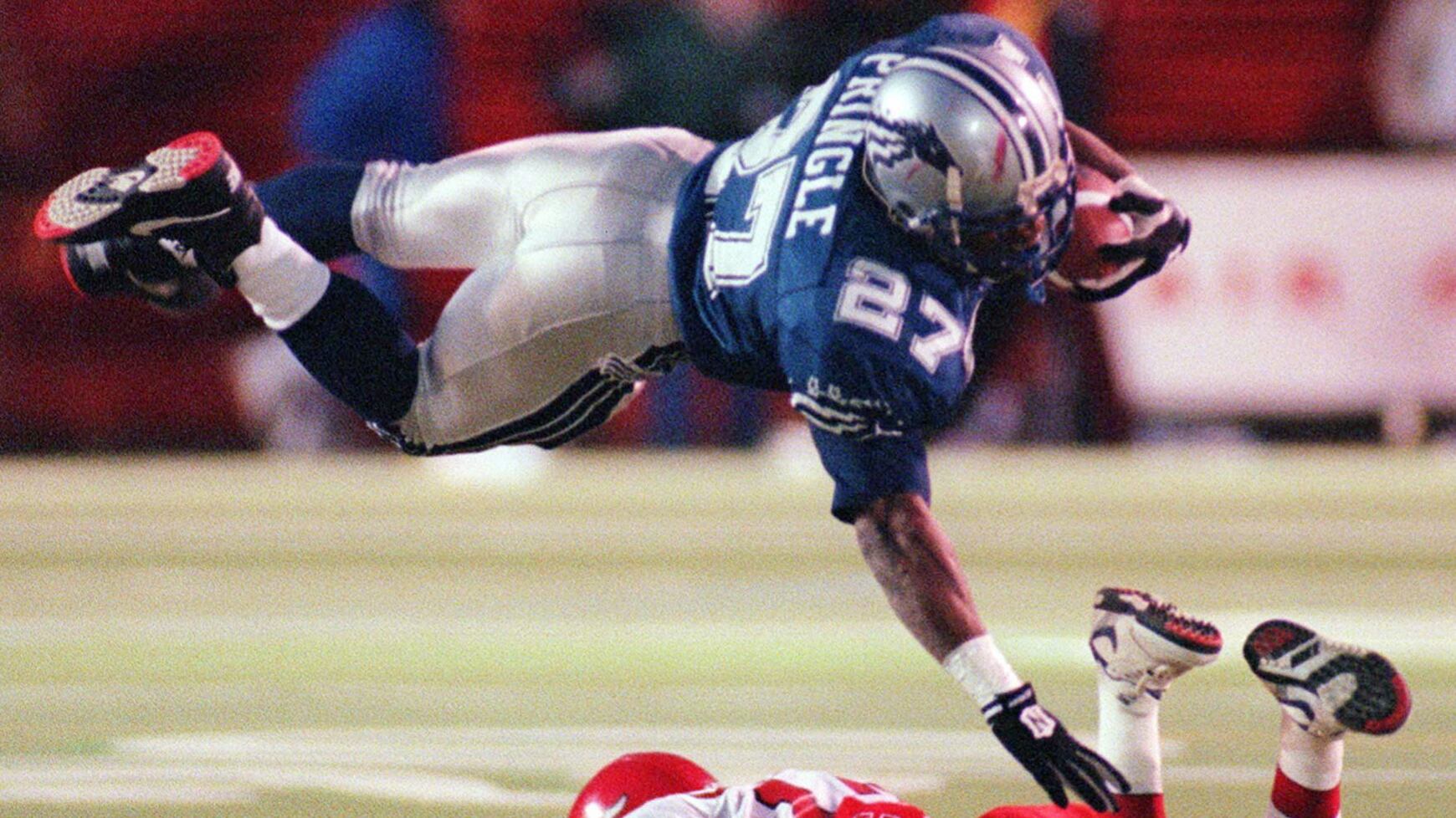
1. Most rushing touchdowns in a season – Mike Pringle’s 19 TDs with Montreal in 2000
Mike Pringle played 17 games in 2000, carrying the ball 326 times and averaging more than 100 yards per game, despite turning 33 during the season. (By comparison last season’s CFL rushing leader, Dedrick Mills of Calgary, carried the ball 250 times in 18 games.)
Montreal was the second highest-scoring team in the CFL that season, so there were lots of opportunities for Pringle to convert red-zone visits into touchdowns.
It should be noted that Pringle’s accomplishment came before teams started using short-yardage quarterbacks at the goal line, which undoubtedly gave him a significant advantage over today’s backs.
Who could break it?
Averaging a touchdown a game for a running back in Canadian football has proved an extremely challenging task.
One reason is the introduction, roughly 15 years ago, of short-yardage quarterbacks at the goal line, taking scoring opportunities away from running backs. (For example, in Pringle’s 19-touchdown season, the Alouettes had only four other rushing touchdowns – two for starting QB Anthony Calvillo, one to a receiver and one to a fullback.)
In addition, in today’s game some teams split carries among more than one back, thus limiting the opportunity to challenge for the single-season touchdown record. And then there are injuries – running back comes with one of the highest rates of missed games in football.
So, this is probably one of the safest records there is in the CFL. In fact, over the past four seasons, the average figure for a running back touchdown leader is 9.25 per season, less than half of Pringle’s mark.
With all due respect to Edmonton’s Justin Rankin and B.C.’s James Butler, who each have four touchdowns in four games so far this season, Pringle’s touchdown record is safe.
2. Most yards rushing in a season – Pringle’s 2,065 yards with Montreal in 1998
By the late 1990s, Pringle had established himself as the CFL’s premier back, rushing for more than 1,650 yards in six of seven seasons between 1994 and 2000. The only exception was the 1996 season, when missed half the year while he was with the NFL’s Denver Broncos.
In 1998 he had a career-high 347 carries, averaging six yards a touch and breaking the 100-yard mark in 14 of 18 games that season. The 347 carries weren’t just a career high for Pringle, it was a CFL record that hasn’t been sniffed recently, with only Hamilton’s Troy Davis (324) and Winnipeg’s Charlie Robers (302) breaking the 300-carry barrier in the past quarter century.
It’s worth noting that Montreal’s starting centre, left guard and left tackle in 1998 were three future Hall of Famers in Bryan Chiu, Pierre Vercheval and Uzooma Okeke.
Who could break it?
Rankin began the year at a record-setting pace with 387 rushing yards in Edmonton’s first three games before being held to just 19 along the ground in the Elks most recent game. He now projects to finish with 1,827 yards this season, which would be the third-best total in league history.
While Pringle averaged almost 20 carries a game in 1998, Rankin is averaging just over 13. Getting just two-thirds the number of carries Pringle did in his record-setting season would be a near insurmountable challenge to beating his mark. Rankin does have more big-play ability than Pringle did, however, as reflected in him already having runs of 61, 47 and 33 yards this season.
Rankin also has the benefit of playing for a team where he is the near sole focus of the rushing offence, with 53 of 59 attempts so far this season going his way.
Rankin’s receiving ability gives him a better shot at taking down Pringle’s record of 2,414 yards from scrimmage in a season, which he did twice – once in 1994 with Baltimore and once with Montreal in 1998.
With 254 receiving yards to complement his 406 along the ground through four games, Rankin is on pace for an astounding total of 2,970 yards from scrimmage. The fact me managed a 100-yard receiving game while being held to just 19 yards along the ground in Edmonton’s last outing indicates how difficult he is to contain.
Setting the all-time record for yards from scrimmage could very mean Rankin achieving 1,000 yards on both the ground and through the air, something no CFL player has ever done in a single season.
3. Most Yards Receiving In a Season – Allen Pitts’ 2,036 yards with Calgary in 1994
Allen Pitts had the luxury of being thrown to by perhaps the greatest CFL quarterback of all-time in Doug Flutie.
Like most single-season record holders, Pitts benefited from playing all 18 regular-season games, averaging 113.1 receiving yards per contest – including 11 games in which he broke the 100-yard mark.
Pitts average of 16.2 yard per catch wasn’t historic, but he was able to combine a high volume of receptions with consistency throughout his 1994 season, setting a then-CFL record with 126 receptions.
Pitts averaged seven catches a game but, as for the volume of throws going his way, CFL stats of the day didn’t track how many times a player was targeted.
Who could break it?
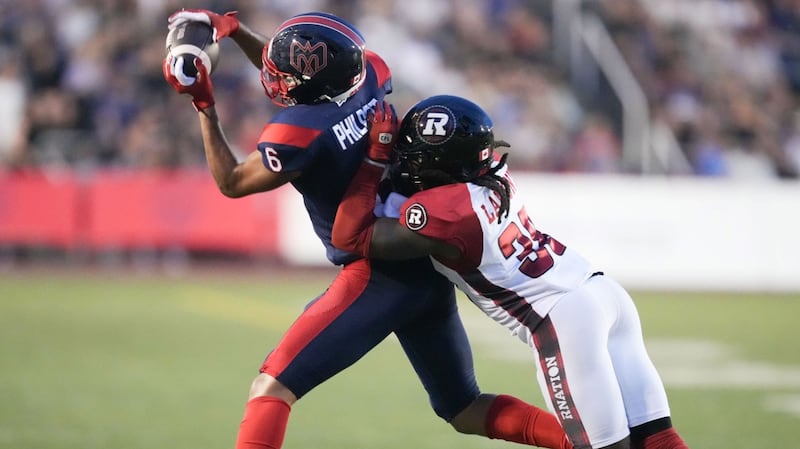
There are currently a pair of CFL receivers who right now are on pace to challenge Pitts’ mark: Montreal’s Tyson Philpot (2,641) and Saskatchewan’s KeeSean Johnson (1,971).
Philpot’s 587 yards receiving through four games puts him on pace to shatter Pitts’ record by more than 600 yards during the 2026 season.
Philpot has had three 100-yard receiving games so far this season, narrowly missing the 200-yard mark in two of them. He’s also averaging nine catches per game, which is two more per game than Pitts did during his record-setting season.
While Pitts had 29.3 per cent of all Calgary receptions during the 1994 season, Philpot thus far has had 33.6 per cent of all Montreal receptions and has been the league’s most targeted player (46) through the first five weeks of the season.
His 587 receiving yards represent 39.7 per cent of all Montreal’s receiving yards, a significantly higher figure than Pitts’ 32.8 per cent in 1994. His five catches of 30 or more yards rank tops in the CFL, as does his 211 yards after catch, demonstrating the ability to grow his receiving totals with the ball in his hands.
For a player with his volume of catches, 16.3 yards per grab is impressive and slightly better than that of Pitts in ’94.
The greatest challenge to Philpot breaking Pitts’ record may be staying healthy for all 18 games. He has not played more than 13 at any point in his previous four CFL seasons.
Similar to Philpot, Johnson has been a high-volume receiver so far this season, with his 43 targets and 32 receptions each ranking second only to Philpot. His yards per catch average of 13.7 yards is 2.6 yards fewer than Philpot and 2.5 behind Pitts, meaning he may need a higher volume of catches than either of them to challenge the record.
With 30.88 per cent of all Saskatchewan receiving yards so far this season his percentage of his team’s overall receiving yards lags behind both those of Pitts and Philpot.
Johnson’s yards-after-catch total of 106 is less than half of what Philpot has so far this season.
Johnson would have to remain a high-volume target throughout the season to challenge Pitts, which could be difficult on a team with two other strong options in Kian Schaffer-Baker and Samuel Emilus.
4. Most receptions in a single season – Derrell (Mookie) Mitchell’s 160 catches with Toronto in 1998
The most amazing thing about Derrell Mitchell’s 160-reception season with Toronto in 1998 is that he did it with the league’s lowest-scoring team during a 9-9 season, catching passes primarily from a quarterback who had a very modest CFL career.
Kerwin Bell spent only two CFL seasons as a full-time starter but in 1998 he led the CFL with 4,991 yards and a completion percentage of 67.3, finishing ahead of future Hall of Famers Damon Allen, Danny McManus and Anthony Calvillo, and future NFL starter Jeff Garcia.
Mitchell averaged 12.5 yards per catch, a modest number, but his 2,000 yards represented more than 40 per cent of Bell’s passing yardage that season as he hauled in 41.8 per cent of all of Bell’s passes.
Mitchell averaged 8.9 catches per game with a season high of 16, tying a CFL record that still stands today.
He also benefitted from playing mostly in the slot, giving him the closest proximity to the quarterback for most of his receptions.
Who could break it?
If Philpot can maintain his current pace of nine receptions per game over an 18-game season he would finish with 162 catches, bettering Mitchell’s mark by two.
But there are some true challenges for him to overcome, starting with the fact he doesn’t line up often in the slot, where throws are shorter and more direct. While Mitchell averaged 12.5 yards per catch, Philpot is averaging 16.3, making it more difficult to keep up his pace of receptions per game.
Philpot has 33.6 per cent of all Montreal receptions so far, slightly more than the 32.3 per cent Mitchell was receiving from Toronto quarterbacks in 1998.
Mitchell benefited from having 67 catches more than any other player on the Argos and 94 more than any other receiver, while Philpot shares the No. 1 role with Tyler Snead, who has been targeted just six times fewer (40) so far.