The oldest championship in golf has become the last major on the calendar.
The British Open has 166 years of history behind it, so it doesn’t need a catchy slogan — the PGA Championship was “Glory's Last Shot” when it was last in the lineup — for Scottie Scheffler and everyone else to know it will be eight months before the next major.
“We look forward to them so much, we build our schedules and the year around them, and then they're over like that,” Justin Thomas said. “It sucks when they're done.”
And for the 153 players who have their last chance at winning a major this year? The pressure is not necessarily any greater, nor is there greater urgency to win one before the season is done.
“But every year you don't is another year you haven't,” Thomas said.
The 154th edition of The Open Championship returns to Royal Birkdale on July 16-19 along the Lancashire Coast in northwest England, an area rich with links golf — three British Open venues are about 60 miles (96 kilometers) apart. The Royal & Ancient is expecting upward of 300,000 fans.
It will be the last chance for Scheffler to make it three years in a row winning a major. In the modern era of majors that dates to 1934, only eight other players have done that — Ralph Guldahl, Peter Thomson, Arnold Palmer, Jack Nicklaus, Tom Watson, Tiger Woods, Phil Mickelson and Brooks Koepka.
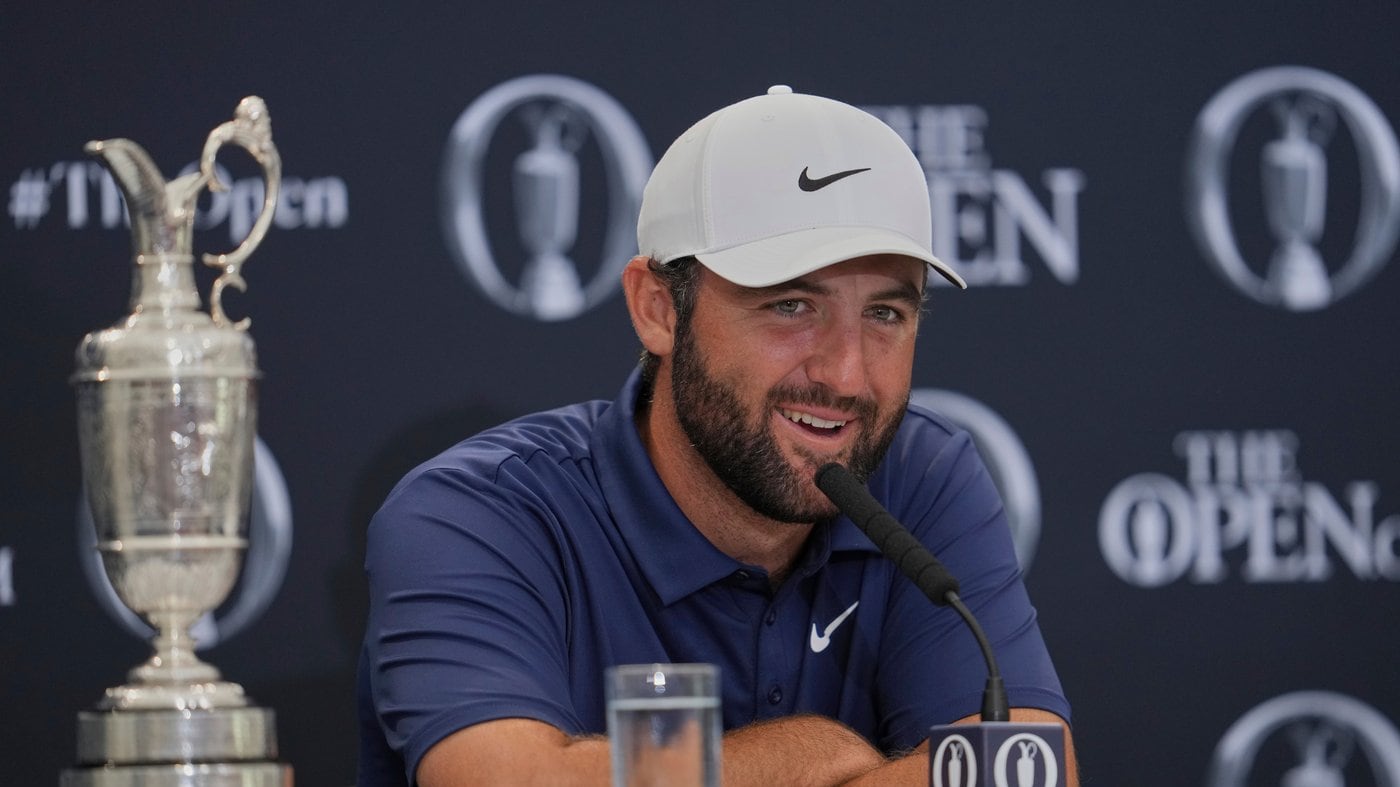
Scheffler became the “Champion of the Year” at Royal Portrush last summer with another command performance on golf’s biggest stage. He is not one to look back on all the trophies he has won in the last five years, but the 30-year-old Texan has caught himself glancing at all the names engraved into the base of that silver claret jug.
“The perfect size trophy — not too big, not too small and you get to drink out of it,” Scheffler said. “It will be very tough to hand it back on Tuesday, but I’ll be fighting like heck to get it back on Sunday.”
Scheffler is the last of 10 names added to the base of golf's oldest trophy since Rory McIlroy last took possession in 2014. McIlroy, the back-to-back Masters champion, is keen to get a seventh major and join Harry Vardon with the most majors by anyone from the Old World.
English hopes lie with Tommy Fleetwood, who grew up a short walk from Birkdale, and Matt Fitzpatrick, whose three wins this year are more than Scheffler's and McIlroy's combined.
McIlroy hasn't seriously contended for the British Open since 2022 in St. Andrews. His lone appearance at Royal Birkdale was a tie for fourth in 2017, though he finished seven shots behind. But he loves the course and the challenge off the tee it presents, which typically is his strength.
“The one thing that I like about Birkdale is there’s usually sets of bunkers on both sides of the fairway. So you’re always having to challenge one set of bunkers to get to where you want your ball to finish,” he said.
McIlroy cited the 10th hole to illustrate. To play it safe and stay short of the bunkers doesn't leave a good view of the green with a mid-iron. To challenge the bunker on the left, and stay short of the bunker on the right, allows for a good chance at birdie with a wedge in hand.
“So there’s a lot of holes like that where ... I know I’m hitting a club that could get me into trouble,” McIlroy said. “But to be in the best possible position for my second shot, that’s the shot that I need to play."
This is not exactly the same Royal Birkdale that last hosted the British Open in 2017 because of changes to some five holes. The most noticeable might be the par-4 fifth, shortened to 321 yards with more bunkers and the green shifted to the left to tempt players to drive the green.
The most significant change is eliminating the par-3 14th hole where Jordan Spieth began his remarkable rally in 2017. Now the 14th is a par 5 that used to be No. 15, only it's 60 yards longer (602 yards), has been shifted to the right and now has 12 bunkers.
The 15th is a newly created hole that measures 241 yards. Adam Scott was asked to give a short assessment and replied, “too long.” McIlroy said he was “undecided,” which didn't sound all that encouraging when he added, “I think it's going to be a big talking point during the week.”
It's a beautiful links course set among dunes off the Irish Sea, one of only two on the British Open rotation where the ninth and 18th holes return to the clubhouse.
And it has a rich heritage despite not hosting the Open until 1954. Of the nine previous champions (Thomson won twice) all but one are in the World Golf Hall of Fame or certain to be there when eligible. Those nine champions have combined to win 37 majors.
Links golf on any course can produce some quirky bounces, when seemingly good shots turn bad and sometimes — though not as often — the other way around.
“You can tell why golf was invented here,” Scheffler said. "You can hit a lot of clubs from off the green. It’s not the same club every time, and it gives you an option. You can get some funny bounces sometimes. But it’s also a pure and raw way to play golf.
“The conditions change pretty quickly, and that could have an effect on tournament. But when you have similar conditions over four days, it’s a pretty true test of golf.”
Harris English was the runner-up to Scheffler last year at Royal Portrush. He was asked what trait an Open champion needs to conquer links golf. “Super gritty,” he replied.
“You've got to deal with playing in any weather, any conditions. You get some crap lies and bad breaks. You're going to have a lot of stuff go against you in links golf,” English said. “You've got to figure it out. It's pure golf.
“Yeah, there's luck involved,” he said. "But if you keep hitting good shots, luck will be in your favor.”
And when it's over, another name will be added to the base of the claret jug. And then golf's best players will have to wait 263 days until the next major.
___
AP golf: https://apnews.com/hub/golf
Doug Ferguson, The Associated Press