Major League Baseball’s owners convened this week at the league’s headquarters in New York with plenty to discuss.
Last week, the owners and the MLB Players Association exchanged opening proposals for a new collective bargaining agreement. The plans highlighted fundamentally different visions for the sport’s economic future and underlined the potential for a long work stoppage.
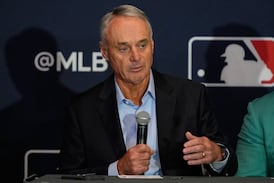
Speaking to reporters Wednesday, MLB commissioner Rob Manfred defended the league’s push for a hard salary cap, arguing that the league’s current system is inadequate.
“We have tried mightily over several rounds of bargaining to use a competitive balance tax to address competitive concerns,” Manfred said. “And sometimes you’ve got to admit you failed.”
With the next owners meetings scheduled for November, just days before the current CBA is set to expire on Dec. 1, here are four takeaways from this week’s edition.
Manfred says all 30 teams are on board to split TV revenue -- yes, even the Dodgers
The Los Angeles Dodgers -- and other high-revenue teams -- would surrender a competitive advantage under MLB’s proposal, which would require them to share all of their local television revenue (they currently share 48%).
The Dodgers’ local media arrangement has been valued at roughly $8.35 billion over 25 years, making it one of the most lucrative deals in professional sports. The figure dwarfs the local media revenue generated by clubs that have been hit hard by the deterioration of the regional sports network model. And yet Manfred said he believes “there is unanimous support” from all 30 teams.
“I think that the Dodgers understand there is a need to update the overall economic model in the industry and that the upside associated with that, in terms of growing the industry, growing the popularity of the sport, is big for large markets, small markets, owners and players in every way,” Manfred said. “That upside is bigger than any issue that separates us in the bargaining table.”
MLB needs only 23 votes to ratify a CBA. But Manfred’s assertion that all 30 clubs support the proposal suggests ownership believes the potential benefits of a revamped economic system outweigh the concerns of even the clubs with the most to lose.
What do the owners have to say? They’re not talking -- they’re letting Manfred be their voice
Several owners and team presidents declined to comment on labor negotiations, or avoided reporters altogether, at this week’s owners meetings. It’s the continuation of a recent pattern of having Manfred speak for them at the meetings, which are held three times a year.
For decades, owners held court with reporters there on a variety of topics. The number dwindled over the years, but it continued as recently as November 2024, with New York Yankees owner Hal Steinbrenner taking questions from media members. Since then, with both sides bracing for a labor showdown, owners have largely ceded their public defense to Manfred, making the commissioner the face of ownership’s campaign for a salary cap.
Manfred was involved in labor negotiations the last time MLB proposed a salary cap in 1994 as a junior lawyer on the owners’ bargaining team. That stalemate led to a players’ strike that lasted nearly eight months and forced the cancellation of the 1994 World Series. Manfred acknowledged he worries about a similar outcome in 2027, but he declined to say whether owners believe another work stoppage would be worth securing a salary cap system.
“I’m not going to speculate about work stoppages,” Manfred said. “I think that the proposal we’ve made is grounds for constructive dialogue back and forth through the MLBPA about how we can address the No. 1 concern of our fans, and that is like a competitive balance in the game,” Manfred said.
It’s early, but the owners and players are speaking a different language
Both sides seemingly agree that the disparity between high-revenue and low-revenue teams is worth addressing. Beyond that, they appear light years apart.
The union’s initial proposal was expansive, with revised definitions for revenue sharing within the current competitive balance tax system. It included not only the parameters for a hard top and floor, but it also addressed minimum salaries, free agency eligibility, the qualifying offer, the pre-arbitration bonus pool, the draft lottery and more.
The owners’ first offer called for a fundamental change to the sport’s financial structure. But it covered little else besides a hard cap and floor with a 50/50 revenue split and the centralization of all television revenue. That was by design. MLB views overhauling the system as imperative moving forward.
“We never thought about the CBT as a revenue-generating device,” Manfred said. “And when you see more and more tax getting paid, you realize that it is not the kind of speed bump that would help on the issue of competitive balance.”
A record nine clubs were penalized for exceeding CBT thresholds in 2024 and 2025. Taxes totaled $78.5 million in 2022, $222.8 million in 2023, $311.3 million in 2024 and $402.6 million in 2025. The Dodgers paid $169.4 million in luxury tax last season.
On Monday, two days before Manfred addressed reporters, MLBPA interim executive director Bruce Meyer described MLB’s proposal as “the worst system for any players in any major sport, and not even close.”
He argued contracts would no longer be fully guaranteed under MLB’s proposal because it would include an escrow system, whereby player salaries would lose money if the league does not meet revenue projections in a given year. MLB officials countered by pointing out that, such as the NBA and NHL, players would receive more money should the league exceed revenue projections.
Meyer also contended that players’ overall compensation would drop by $500 million because amateur signing bonuses would be counted as part of the players’ cut in the league’s proposal. In response, Manfred said Wednesday that the owners haven’t yet made a proposal on amateur bonuses and insisted that major leaguers would make more money in 2027 under the proposed system than they’re making this season. Clubs spend nearly $600 million a year on domestic and international players under the current system.
“Well, all I can tell you about our initial proposal is it was specifically constructed to ensure that, in the first year of the contract, major league players would make more money than they made in 2026,” Manfred said. “To the extent that anybody is suggesting something other than that, it’s just not accurate.”
The two sides are in the first inning of negotiations, but the gap between them is not merely about money. At least at the outset, the sides are negotiating entirely different visions for how the sport should operate.
The next move in negotiations? There’s nothing on the calendar
The back-and-forth between the two parties is unusual compared to recent rounds of negotiations. In 2021, the union made its first proposal in May and MLB waited to counter until August. This time, the league responded in about 24 hours.
What’s next is unknown. The sides have not yet scheduled their next meeting.
“Look, every deal that gets made has to achieve some of the things that we’re looking to achieve, and some of the things that the union’s looking to achieve,” Manfred said. “There’s proposals and there’s goals behind proposals, right? We’re looking at their proposals, trying to figure out what they’re trying to achieve, and whether we can meet some of those goals and still achieve the things that we’re looking at.”