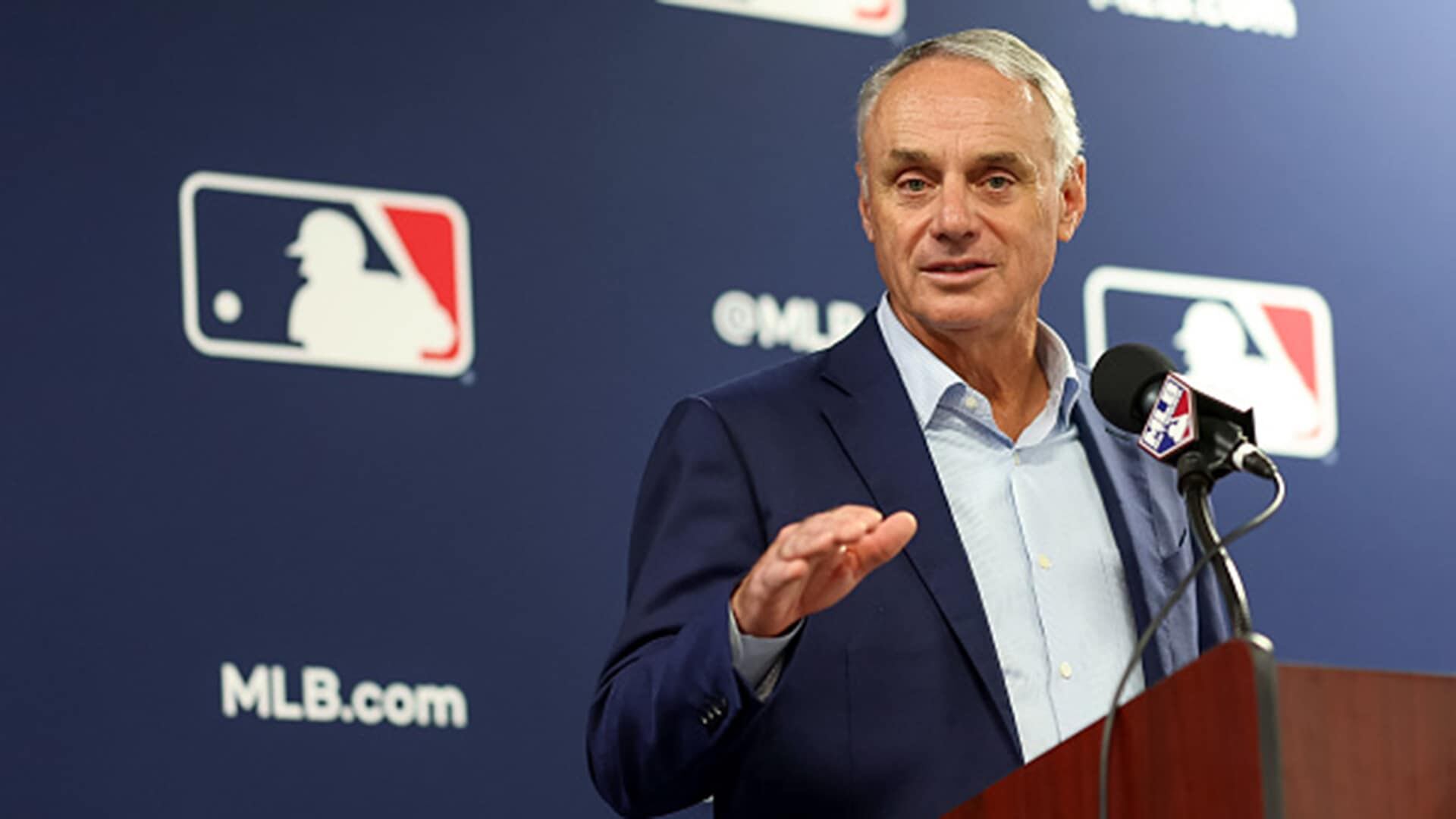
PHILADELPHIA -- MLB commissioner Rob Manfred and MLBPA interim executive director Bruce Meyer shared differing views on the "Level the Field" advertising campaign expressing the league's desire for a salary cap within the next collective bargaining agreement.
The ads have been airing this season in an attempt to sway public support for MLB's proposed economic system, and they come as the league boasts increased attendance and a general positive vibe about the product on the field.
"I think when you have a difficult public issue, particularly when the other side of the issue is being very public about what their views are on the negotiation, I think it's incumbent on us to keep our fans informed of our view of the world," Manfred said Tuesday morning from the All-Star Game. "Particularly given sometimes the other side may not be completely accurate or fair in terms of their recitation of what's going on."
Meyer fired back, insisting the league can't have it both ways, and declared the sport is in a good place but that it also needs more fixing.
"I have watched over the last two years [how] the owners, the commissioner's office, try to convince fans, the consumers of their product, that the product is broken," Meyer said. "I think it's perverse. Case in point is leading up to this All-Star Game, any of us who watch baseball ... are seeing ads not so much for the All-Star Game, not promoting the game, not promoting the players, [but] promoting the league's desire for a salary cap."
The acrimony over the ads highlights the early, bumpy stages of labor negotiations that could extend into next season. The current CBA expires Dec. 1, and all signs point to an extended lockout before any agreement on a new one can be reached. The league has offered a first-ever salary cap and floor as part of its next CBA, while the union responded with a mechanism to increase spending at the bottom but without a hard limit at the top.
Despite the popularity of the sport and increased attendance that the league likes to highlight, MLB insists a salary cap is needed in order to maintain "momentum."
"We've got that momentum by listening to our fans and making changes that candidly the MLBPA was not interested in," Manfred said in regard to the pitch clock and other rule changes. "Those changes have paid off in terms of creating that momentum. And the best way to lose momentum is to stand still."
Meyer views it the other way around. He said the league is "putting on the table" an issue that the union has never warmed to, which in its own way will lead to a loss of momentum. It's at least likely to lead to a work stoppage.
"If they do a lockout, that'll be a choice," Meyer said. "That'll be an owners' choice."
Manfred cites public polling as a key talking point for a salary cap, insisting it's what fans of teams in smaller markets want. His argument comes down to a simple observation: Current payroll disparity is not conducive to a competitive league.
"The gap is $441 million," Manfred said. "It defies human experience to ask a fan to think that the bottom end of that gap has the same opportunity to win as the top end."
The union has never viewed that gap as a roadblock to winning, citing competitive teams in smaller markets such as Tampa Bay and Cleveland. The union also believes a cap does the opposite of its desired intent.
"The owners want a system that not only guarantees their profits, not only increases their franchise values, but essentially is a form of subsidized mediocrity," Meyer said. "A salary cap is the ultimate excuse not to compete."
Manfred was asked whether smaller-market teams being competitive hurt his argument for a salary cap.
"It gives Bruce talking points," Manfred said. "We know that. But I think from our perspective, the more important issue is what is the aggregate data over time? I think our view of the world is that over a very long period of time, there's a very strong relationship between who gets into playoffs and who proceeds."
In other words, only the high spenders tend to win it all. A smaller-market team hasn't won a World Series since the Kansas City Royals in 2015.
Manfred was also asked about potential input on labor negotiations from President Donald Trump, who has already stated that he thinks a salary cap would be good for the sport.
"I think it would be wildly, wildly inappropriate for me to speculate about what the President of the United States might do or not do in a hypothetical situation," Manfred said. "We know this. He is a great sports fan and he is really knowledgeable about the business of sports, so it doesn't surprise me he's interested. But beyond that, I'm going to pass."
Manfred: Harper didn't break any rules
A day after Bryce Harper said he did not consent to FanDuel using a personalized video for a customer diagnosed with a gambling addiction, Manfred said the Philadelphia Phillies first baseman did not break any rules with the activity.
"We made sure about that," Manfred said. "Ad we'll continue to try to figure out exactly how we ended up where we ended up on that."
Harper said he received a request on Cameo in November 2024 to record a video using a script given to him for a personal holiday video. He said he didn't know that FanDuel, an official partner of MLB, would use it as part of a VIP promotion.
'Early stages' of LA Olympics discussions
One of the hurdles in early discussions between MLB and the MLBPA about major leaguers' participation in the 2028 Olympics is the league's insistence on players being required to take part in the tournament if asked. Manfred on Tuesday reasoned that, unlike the World Baseball Classic, the Olympics would cover days that players otherwise would be playing in major league games.
The WBC is played in March during spring training. To accommodate the Olympics into its regular-season schedule, MLB would end its first half July 9, stage the Home Run Derby on July 10 and the All-Star Game on July 11. The six-team Olympic tournament would run from July 13 through July 19 at Dodger Stadium. The MLB regular season would resume July 21.
To make traveling easier, MLB would likely hold the All-Star Game in San Francisco if MLB players do participate in the Olympics.
"We went down the road on LA 2028 because we saw it as a unique opportunity to market the sport with our very, very best players," Manfred said. "It is a disruptive undertaking for us. Put money to one side; you're disrupting your entire season and if we're going to undertake that effort, we want our very best out there so that people see how great our game really is."
Meyer countered that the union found the discipline for declining to participate in the league's first proposal was "extreme."
"In general, our players want to play in the Olympics," Meyer said. "They're patriotic and for them it's a special opportunity and we want them to have that opportunity. Having said that, we want to make sure that they have things like travel and accommodations and things that they deserve based on who they are. We are in a very early stage in discussions over the Olympics. I want to make that clear. Very early stage."
Federal probe into MLBPA ongoing
A federal probe into the MLBPA's financial operations of its business ventures remains ongoing, but Meyer said the union and its current staff "have never been targets" of the investigation.
A whistleblower complaint in Nov. 2024 triggered the probe from the Eastern District of New York, which centered on a youth baseball company owned by the MLBPA that spent at least $3.9 million while staging few sparsely attended live events for children.
Players Way, a Florida-based business, was shut down earlier this year. In April, Xavier James, the union's chief operating officer, and Michael O'Neill, the head of human resources, were fired with cause in the wake of an internal investigation conducted in response to the federal probe. Meyer said the union has cooperated with the investigation over the past year.
Reevaluating All-Star pitcher participation rules
Manfred said the league will look into ways to generate greater participation, with several top pitchers declining to take the mound or unavailable to pitch in the All-Star Game.
"It's clear to me that teams are managing their pitching in a way to take advantage of the Sunday pitcher rule," Manfred said. "I do think it's really important that we always reevaluate our approach to the All-Star Game in order to get the very, very best players actually participating in the game."
Cam Schlittler, Paul Skenes, Logan Webb and Yoshinobu Yamamoto are among the pitchers who either declined to pitch in the game for rest purposes or are ineligible to pitch after starting for their respective teams Sunday.