Editor's note: This story originally ran on June 3, 2026. The sale of the Padres was unanimously approved by MLB team owners on Aug. 17, 2026.
In his time as owner of the San Diego Padres, the late Peter Seidler spoke frequently with his general manager, A.J. Preller, about the repeated cycle of frustration the city's sports fans had experienced. "All the time," Preller said recently.
Often, the Padres developed or collected stars, and with the notable exception of eight-time batting champion Tony Gwynn, they would trade players when they became more expensive or stand down as they departed as free agents. The team would sink back to mediocrity -- or worse. It was like the fans were Charlie Brown and the Padres were Lucy, snatching the football away and yanking hope when it seemed there was a chance for glory. And for San Diegans, the roots of resentment weren't tied to just the baseball team. The city's NBA franchise, the Clippers, moved to Los Angeles in 1984, and then in 2017, the Chargers chose a new stadium deal over a fanbase that had supported them for more than five decades and jumped to L.A.
But Seidler, Preller and others in the organization changed the trajectory of the Padres, constructing a new perception of the team, even while absorbing waves of industry criticism and skepticism about San Diego's spending. And soon, Seidler's bold choices will be handsomely rewarded. The Padres -- the team that occupies a relatively tiny corner of the California media market -- will be officially sold to Jose Feliciano and Kwanza Jones for a stunning $3.9 billion, by far the largest value for an MLB team in history (the New York Mets sold to Steve Cohen for $2.4 billion in 2020). The Padres' valuation is about five times greater than the franchise's sale price in 2012, for $800 million. (The Padres sale was discussed at this week's owners' meetings in New York but not yet finalized; commissioner Rob Manfred said he expected a vote later this summer.)
"It's a lot, it's a lot," Padres third baseman Manny Machado said. "It's a tribute to him, and what he did for that city and that organization. He not only put the players first, but the fans. He put that organization at the highest level.
"At one point, nobody wanted to be a Padre. Now, the players are lining up to come. Fans are lining up and the seats are being sold out. And it all started with his new dream."
Feliciano and Jones are buying a perennial playoff contender, a team with stars and star power, performing in what is widely considered to be one of the best venues in Major League Baseball -- because of the consistently large and enthusiastic crowds that fill Petco Park. Not only with a hope of success, but an earned trust that the team's ownership is trying to win.
"I never would have guessed they could do this," said one long-serving executive with another team. "I don't think anybody in baseball thought they could."
Seidler, who passed in November 2023, was well aware of the concerns of his peers -- that the Padres were spending recklessly and perhaps jeopardizing the long-term health of the franchise. But he assured a reporter at the outset of the 2022 season that the Padres would be fine.
Seidler, the executive concluded, "was right."
In the first 53 seasons of the Padres' franchise, the team never came close to drawing 3 million fans. But with Seidler and the team's leadership paying for stars, the Padres flirted with 3 million for the first time in 2022 -- drawing 2,987,470 -- and have gone well over that number in each of the past three seasons. Through the first two months of the 2026 season, the Padres are averaging 41,557 fans per game, ranking behind only the Los Angeles Dodgers in attendance among the 30 teams.
In 2017, the Padres had one of the lowest payrolls in baseball at $70 million. This year, San Diego's payroll is $202 million; the team carried a franchise-high $249 million roster in 2023. As the Padres ascended in spending -- and success -- Seidler never set a specific budget for the front office, Preller said. Rather, Seidler would ask what was possible and allow Preller and his staff to present options. "He was great to work for in that way," Preller said. "He hired people [to run baseball operations] and then he listened to them."
After the 2017 season, first baseman Eric Hosmer lingered in the free agent market well into February, and the Padres signed him to a franchise record eight-year, $144 million deal. Within the context of the team's history, the deal seemed wildly out of place -- but it was only the beginning.
The next winter, Machado and Bryce Harper were free agents, and like Hosmer, they were unsigned in late January. Preller made a case for Machado to Seidler and fellow Padres owner Ron Fowler -- and he went through a similar exercise with Harper. At one point, Preller recalled with a laugh, he raised the idea of signing Harper and Machado.
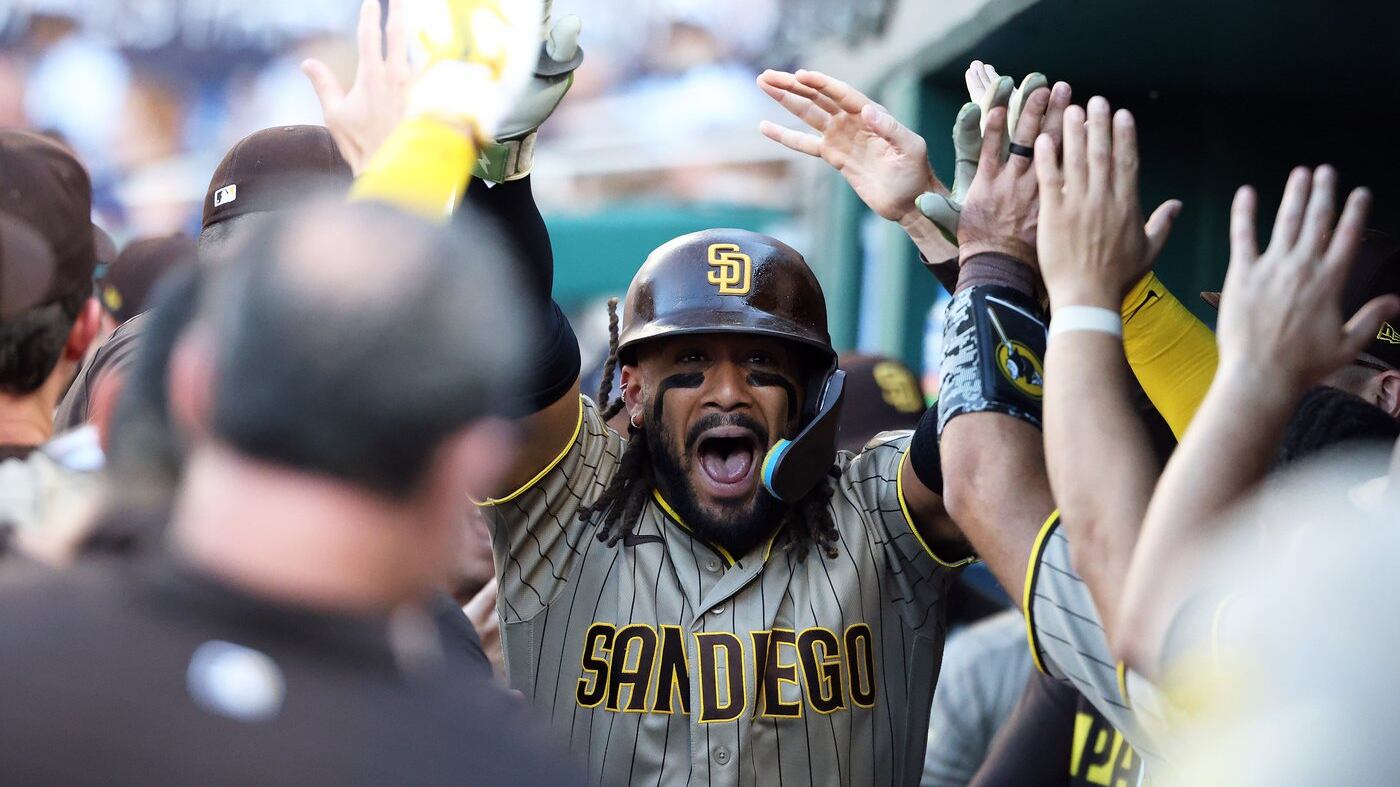
Seidler and Fowler quickly nixed that plan, but Seidler followed Preller's advice that the Padres needed foundational stars. Machado signed a $300 million contract with San Diego in 2019, a deal that shocked a lot of rival executives. Two years later, the team locked up young star Fernando Tatis Jr. to a 14-year, $340 million deal. "A word that we heard a lot was 'unsustainable,'" one Padres source said. "'The Padres can't sustain that kind of spending.'"
"He wanted to win," Preller said of Seidler, "and he wanted to win in an entertaining way."
The Padres made the playoffs for the first time in 14 seasons in the COVID-19-shortened 2020 season and then qualified again in 2022; the Padres have reached the postseason in four of the past six years. There are Dodgers players who will tell you that on their journey to the World Series in 2024, San Diego was the best team they faced and the most significant threat to their title, pushing Los Angeles to within a game of elimination in the National League Division Series.
Some officials in the industry believe Seidler -- who twice fought off non-Hodgkin's lymphoma and underwent treatment for an unspecified illness in the months before he passed -- pushed the spending of the Padres in the knowledge that he was ailing. Preller says that all along, Seidler's goal was simple: He wanted to build a championship club for the city of San Diego.
Preller might have been the perfect general manager for Seidler, due to his aggressiveness and imagination for big deals -- and willingness to bear the inherent risk. When the Washington Nationals dangled Juan Soto in the trade market during the summer of 2022, Preller swapped prospects Mackenzie Gore, James Wood and CJ Abrams, among others, for the best young hitter of the generation. After the Padres had a disappointing season in 2023, Preller flipped Soto to the New York Yankees and recouped some value, with Michael King as the headliner.
After the 2022 season, the Padres offered more money to Trea Turner than the Philadelphia Phillies, but Turner accepted the Philly offer for family reasons. The Padres met with Aaron Judge in December 2022 and discussed a deal that would've been north of $400 million. Yankees owner Hal Steinbrenner pushed his offer to Judge by $40 million -- by then, everyone had started to take Seidler, Preller & Co. very seriously -- and Judge returned to New York.
The Padres pivoted and signed All-Star Xander Bogaerts. They made deals for hometown kid Joe Musgrove and Yu Darvish, and they also drafted and signed center fielder Jackson Merrill to a nine-year, $135 million contract. Last summer, Preller traded for baseball's best reliever, Mason Miller, surprising his peers by agreeing to give up top shortstop prospect Leo De Vries.
This is all an extraordinary departure for a franchise that had failed to retain stars for so many years. Ozzie Smith, Dave Winfield and Roberto Alomar all started their careers with the Padres, but their Hall of Fame plaques are adorned with the caps of other teams. In 1992, San Diego had an exceptional quartet of hitters -- All-Stars Gwynn, Gary Sheffield, Fred McGriff and Tony Fernandez -- and when a reporter marveled to a Padres owner about the group's production, the owner privately complained about what the future cost would be. Sheffield and McGriff were traded the following season, as part of what became known in San Diego as a fire sale. The team played in the World Series in 1998, and the Padres subsequently slashed payroll. In 2010, Adrian Gonzalez -- born and raised in San Diego -- finished fourth in the NL MVP race, but in classic Padres' style, he was traded to the Boston Red Sox.
This has all been so different in the past decade. There have been times when the Padres bumped against MLB's debt rules, with a need for more cash from ownership to cover expenses. As the new owners come on board, they assume the big money owed to Machado, Bogaerts, Musgrove, Jake Cronenworth and others. There might be regression soon for some of those players, and a need for Preller to manage payroll, pick and choose future investments.
But there is a new expectation for what the Padres can do. And in the fans' eyes, there is hope.