Editor’s note: This story is condensed from an interview between Bob Kendrick, president of the Negro Leagues Baseball Museum in Kansas City, Missouri, and Buster Olney for Jackie Robinson Day.
I will speak to the Los Angeles Dodgers and the New York Mets today, on Jackie Robinson Day, around the statue of Jackie at Dodger Stadium. Most of them will be familiar with his story and have a general understanding of why this day is so significant.
But what surprises a lot of players who come to the museum is that baseball was his weakest sport. He was a much better basketball, football and track athlete than he was a baseball player -- and some say an even better tennis player. He was one of the greatest athletes in American sports history. Were there better baseball players in the Negro Leagues than Jackie? Absolutely.
When Branch Rickey, the president and general manager of the Brooklyn Dodgers, was looking for a Negro Leagues player to sign, Jackie Robinson was not his first choice. Rickey preferred the great Monte Irvin, a five-tool superstar with movie star good looks playing with the Newark Eagles. Irvin had just gotten back from World War II.
But when Eagles owner Effa Manley balked, Rickey backs off Monte Irvin, and he turned his attention to Jackie Roosevelt Robinson, who had just joined the Kansas City Monarchs after his own military service.
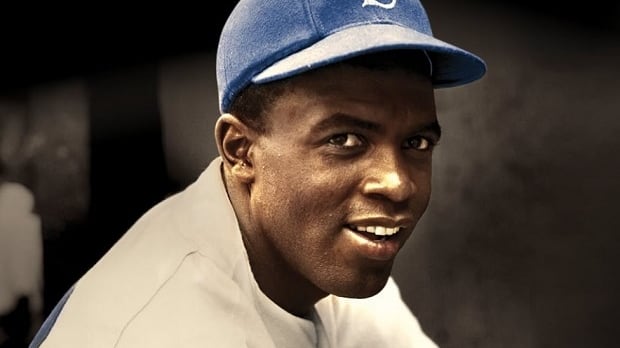
Rickey signed Robinson on Oct. 23, 1945, and Robinson became the first Black player in Major League Baseball. And wherever he ranked among the Negro League’s best, he was absolutely the right man to be the first to break the color line.
He had the intangibles that better prepared him to be able to deal with the immense racial hatred that the first player was going to have to endure. He had already been a celebrated collegian, an All-America football player at UCLA. He had served in the military. And, of course, he was about to get married to the beautiful Rachel Robinson. He had stability. All of those attributes would help him as he dealt with racial discrimination.
When Robinson walked out on that field for the first time with the Dodgers on April 15, 1947, he was called everything other than what my late mother would say -- a child of God. When he came to the plate, they knocked him down continuously. Sometimes opposing pitchers would get fined if they didn’t knock him down. When he would slide into second base, he would oftentimes come up wet, from where the opposition had spit on him; when opponents came into second base, they’d do so spikes high, trying to cut him. They did everything imaginable to break Jackie, but Jackie would not break.
If Jackie hadn’t played well, the naysayers would’ve said, “See I told you he couldn’t play in our league.” But in his rookie season with the Dodgers, he hit .297, scored 125 runs and led the National League with 29 stolen bases. He won the National League Rookie of the Year.
Rickey picked the right guy, because failure was not an option -- on either side of the situation. How much longer would it have been for another Black man to get the opportunity to play in the major leagues? It could’ve been five, 10, 15, 20 years or more for that to happen again. If that had happened, think about the stars we would’ve missed -- Willie Mays, Henry Aaron, Ernie Banks, Monte Irvin, Bob Gibson, Roberto Clemente. Can you imagine our sport without those great stars?
Jackie wasn’t playing only for Jackie. He was carrying the weight of 21 million Black folks when he walked across those lines, and if he failed -- in a game that is predicated on failure -- then an entire race of people would’ve failed. We were counting on him, and he couldn’t fail. I tell people all the time that the level of euphoria in the Black community was like when Neil Armstrong walked on the moon. Robinson was our Neil Armstrong.
I once asked Sharon, Jackie’s daughter, “Do you think your father really realized what he was signing up for?” Because it’s inconceivable to me that someone would knowingly, willingly take on that level of responsibility. Sharon said she felt it was his calling.
This was so much bigger than the game of baseball. The social advancement of America can be tied directly to Jackie’s breaking of baseball’s color barrier. We make the case here at the Negro Leagues Museum that it wasn’t just a part of the Civil Rights Movement, but the beginning of the Civil Rights Movement.
This was before Brown v. Board of Education. This is before Rosa Parks’ refusal to move to the back of the bus. Martin Luther King Jr. was a sophomore at Morehouse College when Jackie signed his contract to play with the Brooklyn Dodgers. This is what got the ball rolling on social progress in our country -- baseball. Our country rode the coattails of what happened in baseball, because of the reverence for baseball; it was our national pastime. It essentially triggered integration in this country.
He didn’t change just the game; he changed the country.
Many subscribe to the belief that one individual cannot make change. Well, Jackie Robinson is the classic example of how one individual can invoke change. When he walked out on that field as a member of the Brooklyn Dodgers, he was carrying the hope of an entire race of people.
Jackie played while bearing this immense weight, and to me that’s the message: Each of us, in our own way, can be a change agent. Jackie was indeed a change agent. And perhaps this country’s greatest change agent.