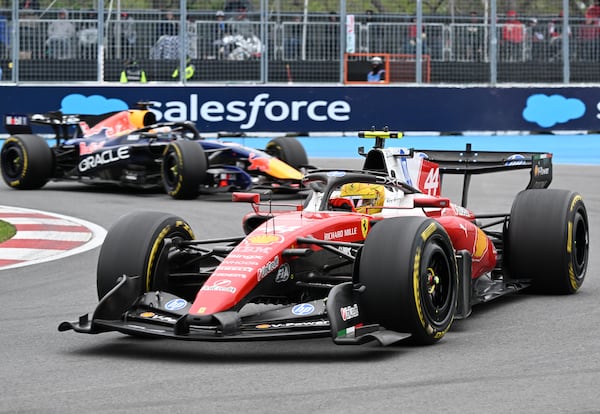
Could this weekend’s Monaco Grand Prix be Ferrari’s chance to get its first win on the board since Mexico in 2024?
With hype growing around the team heading into this weekend’s street race, we look at what to expect from Ferrari in Monaco.
Why is there so much hype around Ferrari for this race?
From what we’ve seen of the 2026 cars so far, Monaco’s unique layout is expected to suit the strengths of the Ferrari and mask some of its weaknesses.
Ferrari’s drivers have been keen to point out how good their car is in corners and that it loses most of its lap time on the straights. That combination has seen the Italian team struggle to remain at the front this year when it has led races early on, but in Monaco, where there are so few straights and so many low and medium-speed corners, the Ferrari could be better placed to fight for victory or retain the lead should one of its drivers get out in front.
“I mean, it’s the one track that power is not king,” Lewis Hamilton said of Monaco following his podium finish at the last round in Canada. “I think it’s definitely car performance [that is rewarded] and I think our car could be really strong there. If you take away the power deficit, we’re in the fight with these guys [Mercedes].”
Ferrari’s routinely fast starts could also provide an advantage if Hamilton or teammate Charles Leclerc qualify at the front of the grid. The rapid getaways have been attributed to the team’s decision to opt for a smaller turbocharger than its rivals, which could also provide an advantage all the way around the lap in Monaco. While a smaller turbocharger comes with some inherent disadvantages on high-speed circuits, it should help the drivers keep it spooled up for maximum power out of Monaco’s slow-speed corners.
Combined with two drivers with strong track records at Monaco, there are good reasons for Ferrari fans to approach this weekend with some cautious optimism. Just don’t rule out Mercedes, McLaren and Red Bull.
Is this Hamilton’s best chance to win a grand prix since joining Ferrari?
If the above theory proves correct, then the answer is another cautious yes. Of course, Hamilton won the Chinese Grand Prix sprint race last year in just his second race in red, but the 2025 Ferrari failed to win a full-length grand prix all season and has been a few critical tenths of a second shy of Mercedes so far this year. Perhaps the biggest obstacle for Hamilton in Monaco, if the Ferrari is competitive, will be his teammate.
Although Hamilton has won three Monaco Grands Prix to Leclerc’s single victory in 2024, the Monegasque has consistently been rapid at his home track. Hamilton has two pole positions at Monaco in his 19-year career, whereas Leclerc already has three from his seven F1 appearances on the street track to date. So much about being fast in Monaco is linked to confidence in the car and taking risks, and while Hamilton has looked happier in his Ferrari at recent races, you’d still put money on Leclerc finding every last thousandth of a second around the unforgiving circuit.
Of course, Mercedes, McLaren and Red Bull will all be competitive too, meaning a small mistake in Q3 could be the difference between the front row of the grid and starting seventh or eighth.
Why is Leclerc so quick in Monaco, and why has he only got one win to show for it?
As soon as he was tall enough to peer over the balcony of a friend’s apartment and see Formula 1 cars whizzing past on the streets below, Leclerc has been obsessed with the idea of winning the Monaco Grand Prix.
That dream finally came true in 2024, but only after several years of near misses and bad luck on the famous street circuit. The idea of a “Leclerc curse” gained traction on social media in 2021 when he qualified on pole but only after colliding with the barrier on his second attempt in Q3. Despite the substantial hit to the car’s transmission, Ferrari opted against a precautionary gearbox change overnight, and as he completed his laps to the grid on Sunday, a driveshaft failed and forced him to miss the start.
If the 2021 incident stood alone, it could be dismissed, but there were multiple incidents of bad luck and driver error prior to and after that.
Even before he started in F1, the home hero suffered a double DNF in his only Formula 2 weekend at the circuit despite taking pole position and leading the feature race early on. A front-left brake failure on his Alfa Romeo-Sauber in 2018 saw him retire from his F1 debut at the circuit, and a Ferrari decision not to send him out for a second attempt in Q1 saw him knocked out of qualifying early in 2019, leaving him 16th on the grid.
Leclerc took pole position again in 2022, only for Ferrari to mistime the switch from intermediate tyres to slicks during the race and cost him the lead. By 2023, the Leclerc curse was considered F1 lore and gained extra credence when he qualified third but received a grid penalty for blocking Lando Norris in qualifying, dropping him down the grid.
While Leclerc refused to acknowledge any mention of a curse, he admitted after his victory in 2024 that a layer of tension had built up during his race weekends at Monaco as a result of his bad luck in previous years. Regardless of the disappointing track record over the years, he has always been remarkably quick in Monaco and will likely be among the favourites for pole position this weekend.
OK, so there are reasons for hope for Ferrari fans, but how will the 2026 regulations impact racing overall in Monaco?
In many ways, the tight and twisty Monaco Grand Prix circuit should be perfect for the latest generation of F1 cars.
The fundamental issue drivers have reported this year is the need to manage battery power around the lap. But in Monaco, with so few straights and so many braking zones for corners, that shouldn’t be a problem. The exact opposite -- having an abundance of electrical power -- has led the FIA to decide against designating any straight-line mode areas on pre-event track maps, which have been used at every other circuit so far this year to allow drivers to make use of active aerodynamics to reduce drag. That reduction in drag helps save battery power and limit unusual driving tactics such as lift and coast and superclipping -- but the layout in Monaco means it simply isn’t needed.
The FIA has also restricted the deployment of electrical energy over certain speeds to limit how fast the cars go on the few flat-out sections of track that exist around Monaco. However, overtake mode, which allows a chasing driver access to more power for longer when within a second of the car in front, remains in place, albeit slightly trimmed compared to other races this year.
Whether any overtaking will actually be possible this year remains to be seen. The Monaco Grand Prix has long been processional because the layout is too tight and the cars are too big. This year, the cars are 10cm narrower and overtake mode will provide some extra punch for the attacking driver at the end of straights, but don’t expect any miracles: this is still Monaco, and it will still be very tricky to pass.
Lastly, the FIA has ditched the mandatory two-stop rule that turned midfield battles at last year’s Monaco Grand Prix into something of a farce. The normal one-stop rule, whereby drivers have to use two compounds of slick tyres, applies.