SPA-FRANCORCHAMPS, Belgium -- In some ways, the Belgian Grand Prix seemed like a microcosm for the 2026 season. During a race that promised a lot but never really gained steam, four familiar themes were present that could end up defining F1 in 2026 over the remainder of the year.
With next weekend’s Hungarian Grand Prix representing the midway point of the season, let’s take a closer look at what all four themes mean for the rest of the season.
Is Antonelli on track to becoming F1’s youngest champion?
Antonelli has won six of the year’s 10 races so far, with Sunday’s victory giving him a 45-point lead over the next driver in the standings -- now Ferrari’s Hamilton. Even when reliability issues left Antonelli without points in Spain and at Silverstone, his underlying performance has not wavered. This weekend, his level could not be matched by any of his rivals.
For the rest of us, it feels like he is firmly on track to win the championship. Does he?
“The momentum has always been there despite what happened in the previous races,” Antonelli said Sunday after the race. “That’s why I just need to take it one weekend at a time, because you never know what can happen.
“I just need to maximize the performance every time and try to do my best whenever I get in the car. Then you see what the balance is at the end of the year.”
Antonelli’s focus has impressed team principal Toto Wolff the most, especially for a 19-year-old in just his second season in F1.
“What was not expected is the serenity and structure that he brought into his game this year,” Wolff said Sunday. “With Kimi, whether the session was good or bad, you wouldn’t see a difference in emotions in the debrief. It is absolutely transactional: What is the problem? How do we solve it? How do we move on from it? And that is new.
“That’s why, when he wins, you can’t see this absolute excitement that a 19-year-old would always have. At the same time, if he fails to deliver results -- in Barcelona, when we had the car stoppage, or even in Silverstone -- he comes back in, and he was the one saying to the team, ‘This is a mechanical sport, this is going to happen’.
Of course, a lot can still change in the second half of the season. After Monaco, Antonelli held a 66-point lead and just three races later it was reduced to 25 points.
Yet, everything we’ve seen from Antonelli in 2026 -- not least his prodigious pace -- suggests the title is very much his to lose.
Can Russell catch a break?
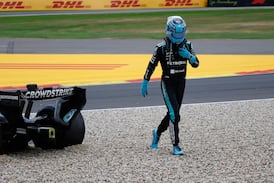
As Russell crested the hill at Raidillon on the opening lap of Sunday’s race, the readout for his battery pack was displaying at 0%. An unexplained failure of the power unit to recover energy under braking for Turn 1 meant he was roughly 35% down on the energy level he should have had at that part of the circuit. This allowed the two Ferraris to deploy their own battery packs to stream past him on the Kemmel Straight.
As Russell reached the braking point for the Les Combes chicane, he attempted to repass Hamilton around the outside -- only for his former teammate to briefly lose grip and clip the Mercedes. The contact pitched Russell into a spin that ultimately left him beached in the gravel and out of the race.
“I shouldn’t have been in that position in the first place, that’s why I’m most angry,” Russell said when asked about the incident. “The contact with Lewis, honestly, I think was a racing incident.”
Wolff confirmed Russell wasn’t the only driver with a Mercedes engine to experience a loss of power -- including Antonelli -- but confirmed his senior driver experienced the worst of it and was not to blame.
“That bit him badly, it 100% goes on us,” Wolff said. “But, you know, we’re trying our best as a team.”
Sunday’s issue followed three practice sessions and a qualifying session in which Russell seemed to have a lack of electric power compared with teammate Antonelli. The team believes the two issues are not linked, but, like the lack of power on the opening lap, the root cause of the qualifying mismatch isn’t fully understood.
Wolff did acknowledge that Russell’s power loss Saturday accounted for just over half of the 0.367-second gap between the two Mercedes drivers.
“There was definitely something on the engine that we have identified that meant he had less energy to deploy up to Turn 18,” Wolff said. “It’s good that we spotted it here because in Budapest, which is not an energy-starved circuit, it would have been more difficult to identify.
“But it still doesn’t make it better for him.”
Russell has felt like he has been missing something compared with Antonelli for a series of races. He has accepted that some of the gap is down to Antonelli getting more out of this year’s car but is clearly frustrated that things have been exacerbated by technical issues.
Antonelli has, it should be noted, also had reliability at recent races, and said he experienced a similar lack of power at the opening round in Australia. However, such arguments are unlikely to offer Russell much solace.
“I’m numb to the disappointment now,” Russell said Sunday. “When it happens so often, you just get used to it.”
Can Ferrari mount a sustained threat?
Two weeks earlier at Silverstone, an issue with one of Antonelli’s brake ducts had brought a battle between him and Leclerc to an early end -- and a Ferrari victory. This time, the race started taking shape after the virtual safety car gave Leclerc the lead.
Perhaps with the knowledge he still had about 24 laps to find a way past the Ferrari, Antonelli took his time. Over the course of the next 14 laps, he slowly and methodically reeled in Leclerc, before making a move stick with relative ease on the run to Le Combes on Lap 34.
“It looked like we were lacking the pace, actually, to catch up [with Leclerc],” Wolff said. “But, you know, the VSC was an unfortunate situation, maybe he just needed to kind of settle down, assess and say, ‘OK, this is the reality now, what am I doing to catch up?’
“And then it was actually spectacular. James [Allison, Mercedes’ technical director] ... said, ‘We’re coming, we’re chipping away one-tenth a lap’. I mean, the preciseness, it was one-tenth [on one lap], one-tenth [on the next], two-tenths, one-tenth, two-tenths. Driving the car and the tires just in the way to make sure that they won’t go off at the end.”
Despite the air of inevitability around Antonelli’s win, Ferrari’s pace in Belgium was promising.
“We kind of expected to be very far back [at Spa], maybe to the extent of four- or five-tenths,” Leclerc said. “In qualifying, that was true, but in the race we were a bit closer than we thought.
Silverstone and Spa-Francorchamps were always going to be circuits at which the Italian team’s inherent power deficit was going to make life difficult. And yet, the team came away from both with 25 more points than Mercedes.
Looking forward, Ferrari should be much better suited, on paper, to the venue of next weekend’s Hungarian Grand Prix at the Hungaroring, too.
A different Spa
Not for the first time this year, talk of energy deployment dominated qualifying. Saturday’s fastest lap times hinged on the effectiveness of battery usage on the straights rather than virtues traditionally associated with a circuit with extensive high-speed sections and limited braking zones, such as bravery through the corners.
The emphasis on energy management was always going to be more pronounced here. But it didn’t make the experience any less underwhelming for those behind the wheel.
“It’s a different Spa,” Verstappen said Saturday after qualifying in second place.
“For most of sector two you run just on the engine [without battery power],” he explained. “So what is that? 450 or 500 bhp -- something like that? Which is, I guess, more or less what a Formula 3 car has, but with F1 downforce.
“So you can imagine, of course, that is not very exciting to drive.”
Verstappen was, in fact, 35 kph (21 mph) slower through the high-speed Pouhon corner and 3.775 seconds slower over the entire lap compared to last year’s qualifying session. Such stats make difficult reading for long-term fans of the sport but come as no surprise to those working in it, who have long warned about the impact the 2026 regulations would have on circuits such as Spa.
“It’s a fact that in 2026, because of the energy starvation, some of the circuits which are particularly long and very demanding in terms of electrical energy, do change their character,” McLaren team principal Andrea Stella said Saturday after qualifying. “I think this is something we have to acknowledge. We knew already before 2026 that this would have been the case because it’s been apparent in the simulations.”
Stella holds some hope over changes to the regulations for 2027, but suspects that tracks like Spa will not return to their former glory in the near future and that everyone will “have to kind of get used to it.”
He added: “And on the other side, we’ll have to see what incrementally we can keep improving in these power unit regulations such that we can retain the character of some challenging corners, where if you don’t approach fast then the corner is no longer a corner. Pouhon can be a corner at 280, 290 kph, but if you approach it at 270 kph, it’s a flat-out corner and relatively easy.”
With Spa due to take a rotational position on the calendar from 2027 onward, we might have to wait until 2029 or perhaps even 2031 -- when the next generation of V8 engines are scheduled to be introduced -- to see F1 cars back at their best at this remarkable track.