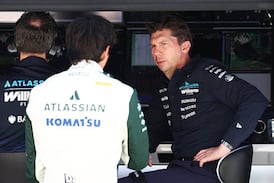
Formula 1's cost cap has inadvertently created a "two-tier" championship, according to Williams boss James Vowles.
F1 introduced the cap in 2021 in a bid to curtail spiralling costs and to level the competitive field, with several teams only narrowly scraping through the Covid-19 pandemic without going out of business.
Like other teams in the midfield, Vowles' Williams outfit have languished a long way behind the lead group of Mercedes, Ferrari, Red Bull and McLaren.
Vowles said the cost cap has failed in two of the three objectives it was created to achieve and laid out why he thinks the rules need reconsidering.
"First and foremost, I own the mistakes that we made this winter, and we need to detach that from that question. We have gone backwards -- we had a car that was overweight," Vowles said in response to a question about the cost cap and how realistic it was to expect teams like Williams to cut the gap to the front.
He then gave a detailed explanation of where he thinks the mechanism has fallen short.
"But actually, when we did the cost cap, this is way back in Covid, when we had a phone call about it, there were three key tasks that we wanted out of it," he added.
"We wanted long-term financial sustainability, and I think in that goal, not just have we achieved it, but we've exceeded it. This business now has good investment that allows us to go on, and they're businesses. They weren't businesses before 2021 at all.
"The two others that went with it were sporting equity and, effectively, compression of the field, so effectively competitiveness that compressed together. Those are the three goals of cost cap, and those two have failed."
Vowles quoted data to back up his viewpoint, saying the competitiveness of F1 has worsened across the grid.
Citing statistics he had seen, Vowles said that in the cost cap era, the top four teams are scoring 83% of the points, whereas the number before the cost cap was in the 70's, and said the other teams now make the podium just 5% of the time, down from 10 before.
"In other words," he said. "We have made the situation worse ... I can give you a whole bunch of statistics, but the cost cap has made it worse, not better."
- Bahrain GP in Malaysia: Max Verstappen leads first practice from George Russell
- Why is the Bahrain Grand Prix taking place in Malaysia, 4,000 miles away? F1's unusual race explained
- Charles Leclerc tops second practice, Mercedes off the pace
Vowles has spoken often about how surprised he was when he left the all-conquering Mercedes outfit to take the top job at Williams, finding the famous old team significantly behind in resources.
He said just bringing Williams close to the level the top teams are at operationally is money that should be going into the car to bridge the performance difference.
Vowles explained what he dubbed the "cost cap trap" smaller teams have found themselves in.
"I'm probably unique because I went from the best team to the worst team. I think that's fairly clear. What I hadn't appreciated or realised when you do that jump is just how little exists.
"When you're in a cost cap, I'm not spending money on the car. I'm spending millions, tens of millions actually, just on basic systems, so you just know where a part is in the factory.
"So that's not going to the car, it's not going to a front wing, it's not going to an upgrade. It's going on systems that I need to do just to do the very basics. So, we're caught in a cost cap trap, because if I do anything short-term, and I always talk about investing in the future, now you understand why. If I do anything that's about this year, I will slow myself down in the future, and I can't do that. We have a two-tier championship. That's not me telling you that.
"That is just what is on the table right now in terms of points score. And I think, and this is where we have to come together as a business, that's not right in terms of what we want for the future. We do want the ability for, if we do a good job, we should have the ability to fight for that. Even last year, which was a great year, the gap on points between us and P4, between us and Ferrari, was 238 points. It's not a small amount. It's an absolute gulf, and we were on the podium three times.
"In cost cap, and I didn't appreciate it until I came into Williams, it really penalises you in terms of what you're doing."
Vowles said he still agrees with the concept of the cost cap but thinks it needs a radical rethink to include the gulf which historically has existed between the top and bottom teams.
"The solution isn't to take cost cap away," he added. "As I said before, we have a brilliantly financially stable sport now as a result of it, but we do need to think about what mechanisms we have in there to make sure we're all playing with the same tools and the same mechanisms, because today we're not. That's a bit lengthy, but that's my thoughts on it."
Vowles was speaking at the news conference ahead of this weekend's Bahrain Grand Prix in Malaysia.
Sat next to him was Ferrari boss Fred Vasseur, who offered a counter point in reply on a clear benefit of the cap.
Ferrari had famously been long-time opponents of the cost cap, but were brought around to the idea by F1 owners Liberty Media, who have guided F1 into an unprecedented commercial boom.
"What we have to keep in mind is that before the cost cap, 2018, 2017, 2016, for sure the business in general was much worse, but we had also five or six teams in bankruptcy or almost in bankruptcy," Vasseur said. "And it's not just the fact that the business is going well, it's the fact that we are sending the message that everybody can compete, right or wrong, but this is the message. And this is also attracting new investors and new OEMs (Original Equipment Manufacturer) in the business."
All of F1 teams are now considered to be valued well north of £1 billion -- for example, Forbes last year valued the Williams team at $2.5 billion for 2025.
Claire Williams, daughter of team founder Frank, had sold the team to Dorilton Capital for less than $200 million just five years earlier, in August 2020, the middle of the pandemic.
The numbers at the end of the grid are even more eye-watering.
Mercedes were valued at a record $6 billion last November after a deal which saw CrowdStrike CEO George Kurtz buy a 5% stake at $300 million.