SEPANG, Malaysia -- The Bahrain Grand Prix in Malaysia already had a farcical name. Formula 1’s unnecessarily complicated hybrid engines ensured the race will be remembered as one of the biggest farces in the sport’s recent history.
F1’s current engines, which feature a near 50-50 split between internal combustion energy and electrical battery elements, are already considered the biggest mistake the sport has made in recent times. Whenever they are consigned to the scrapheap, the foremost memories will be of Sunday’s two formation laps in the rain.
“Lol, look at this,” was all a laughing Max Verstappen could say over the radio as his Red Bull approached a handful of cars whose engines had simply shut down. His car had already done the same at the front of the pack a couple of minutes earlier.
It was an apt use of modern day slang: Laugh out loud was all you could really do. Collectively, and due to a perfect storm of circumstances, F1’s cars had all ground to a walking speed, one after the other. The first attempt at starting the race -- already delayed 40 minutes, because these F1 cars cannot race in extremely wet conditions -- was aborted, with another wait to allow the 11 teams to download and implement a software update from the governing FIA.
“Horrible,” said reigning world champion Lando Norris after the race. “It just proves that we shouldn’t have any of that stuff on the electronic side”.
George Russell, who also dealt with a heartbreaking late engine failure which has all but handed Mercedes teammate Kimi Antonelli the 2026 championship, said, “The whole day was a bit of a faff. It didn’t feel very F1 today”.
Carlos Sainz summed up the situation best of all: “I think F1 needs to have a hard look at themselves and see how we ended up in this situation.”
There’s a lot to still love about F1 in 2026, and some of it was on show towards the end of Sunday’s chaotic race. But the absolute worst of the sport was also showcased in brutal fashion before a competitive lap had even been completed.
What exactly happened?
As well as new-look cars and new V6 turbo hybrid engines, this year introduced a new set of Pirelli tyres. The Italian company’s wet-weather tyres have been a question-mark all season, however: bar a February test behind closed doors in Spain and wet-weather tests for Red Bull, Racing Bulls and Ferrari earlier in the year, no teams had done any meaningful runs on the intermediate or full wets prior to this weekend.
The FIA immediately delayed the start as the weather intensified, with a nearby thunderstorm also complicating things. Several teams briefly lost their weather radars on the pit wall, while some of the marshal panels lining the circuit briefly stopped working.
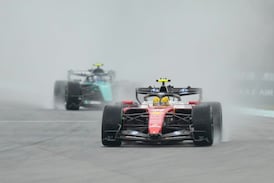
At 3:40pm local time, 40 minutes after the race was supposed to start, the FIA attempted to get things underway with two formation laps behind the safety car, followed by a standing start from the grid. The rain had started easing off and the track was wet, but it looked as though race control was going to make a go of it. But those formation laps were always going to be an exercise in extreme caution.
Several corners into the first formation lap is where things started going wrong, when the cars encountered a software bug baked into the algorithms that dictate F1’s new complicated engines. During rain, for safety reasons, engine modes run at a maximum deployment of 250 killowatts of deployment in certain sectors, down from 350kW in dry conditions. Once Verstappen, leading the pack but tiptoeing around on the cold intermediates, dropped below a speed of 50 km/h, the algorithms dictating the behaviour of his engine started having problems: essentially, the MGU-K no longer kicked in to feed power into his low-revving engine. The restriction on the car’s hybrid-electric component is meant to prevent teams from effectively using it as a traction control device at the start of a race; this time, however, the combination of not running on wet tires with an extremely wet tarmac meant drivers were applying much less throttle than normal.
The algorithm did not spot the difference, so kicked in. With the additional power boost locked out, the internal combustion engine was effectively dying without a surge of recovery power from the electrical side.
You wouldn’t be the only one confused by this: F1 drivers have said this year’s debriefs with engineers are longer and more complicated than ever. Many have spoken about their engines behaving in radically different ways lap to lap, as self-learning algorithms kick in power at different points.
In the moment, what was happening was unclear: Some thought Verstappen simply had an engine issue.
“There was nothing going on,” he said later. “That was the problem. It was just like driving at, what, 35 km/h, going uphill, actually losing speed. So, yeah, I don’t know exactly, because when you go too low in speed and too low RPM, for whatever reason, then it just bogs down. Normally it takes one or two seconds and it comes back.”
But this time, the power did not come back. Verstappen’s car was slowing so dramatically, which meant the cars behind him bunched up. But the rules state you cannot overtake the car in front on a formation lap.
“I triggered it first and then I look in my mirror, I just see... I was like, “Wait, are they waiting for me or what’s going on...?” Verstappen said.
Those behind were, in fact, waiting. The same thing happened to Lewis Hamilton’s Ferrari, in second position, shortly after his car also dropped below the all-important 50 km/h benchmark.
“It was like the Lego race,” Hamilton joked later, referring to the viral pre-race spectacle during the Miami Grand Prix in May.
While Verstappen somehow managed to avoid coming to a complete standstill, Hamilton’s ground to a halt. The seven-time world champion had to restart his Ferrari’s power unit on the pit straight. But unlike with Verstappen, cars slowly started passing Hamilton as he plummeted down the order.
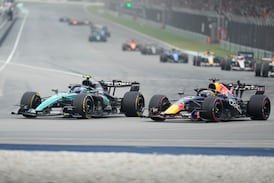
“It was insane,” said current championship leader Antonelli. “At some point we were five-wide in the straight, because we couldn’t understand what was going on.”
Hamilton’s Ferrari seemed to suffer the most extreme version of the engine issue: By the time he did stop completely, he was half way down the order, and Audi, Williams, Racing Bulls and other teams’ cars were facing similar issues around him. It was this scene a laughing Verstappen would later drive past. The start procedure was canceled, effectively a red flag.
And here is where the lack of wet tire usage this year had caught the FIA out.
“We didn’t manage to test the software as extensively as we would have liked, because there’s been very little wet running this year,” the governing body’s single seater chief Nikolas Tombazis explained in a rare trip to the media pen after the race.
“There was a bit of a combination of circumstances which caused this bug to kick in. Basically, [on] the formation lap, some cars went very slowly, almost came to a standstill. There was a bit of a concertina effect between cars, and some cars almost stopped completely. That bug prevented the power from being redeployed, and for the cars to start again. I think if we had had a bit more testing, we probably would have managed to catch it in time, and not have such a situation.
“Once the problem happened, our guys realised very quickly what was happening, and had to work under a lot of time pressure for an update to the software, which was issued to the teams, and the teams had to install it on their cars.
The FIA later gave a simpler statement on what had happened, blaming a perfect storm of various factors. The governing body said “an unprecedented combination of low engine speed, low-grip conditions, wet-weather energy management settings and the Sepang circuit’s sector configuration led to an unintended loss of power for a number of cars”.
The remedy was a software update -- code Tombazis admitted was a “cobbled up, hurried solution.” Rewriting and sending the new code to the teams to install in their systems led to another delay. It meant the worst of the rain also disappeared, we got only a handful of laps on the intermediates and the prospect of a genuine wet-weather classic disappeared.
If you still need another way to think about it: The 11 teams competing in the pinnacle of motorsport hit Ctrl+Alt+Delete and installed a software update to race safely again.
The fallout
The FIA did apologize afterward for the chaos.
“All of that took about 20 minutes,” Tombazis said. “It may have felt like five hours for spectators waiting in a race and for everybody else, which is understandable. And we are sorry about that. But I think it was quite a fast reaction given the problem.”
The sport’s governing body could easily direct critics toward a race ultimately full of incidents and overtaking. And, fair enough: Sepang was an entertaining spectacle.
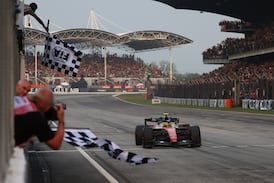
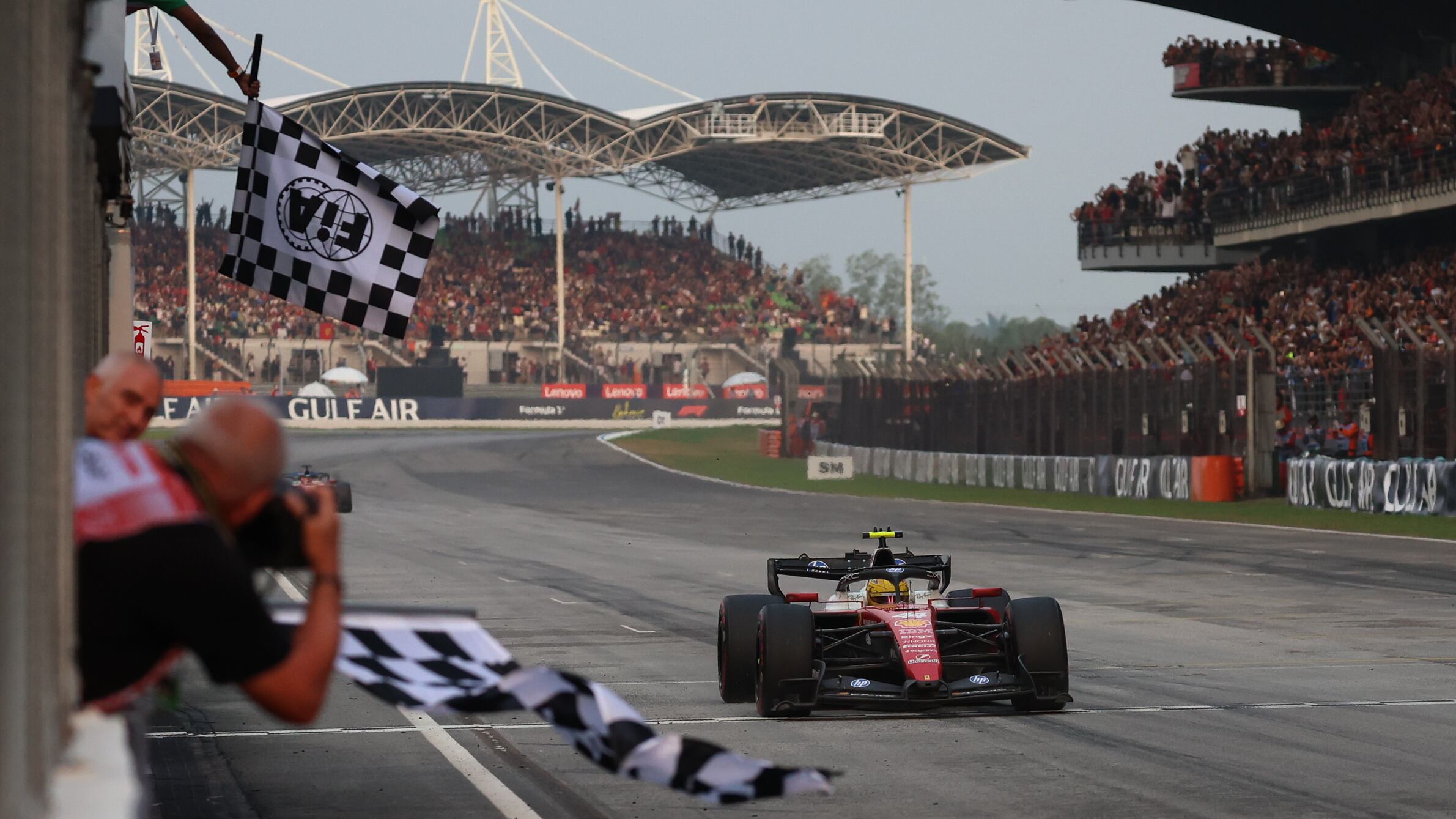
Verstappen returned to the top step for the first time this season. Hamilton turned in a supreme drive for third after gambling incorrectly on slick tires over intermediates, which had him over a minute down on the lead early. Antonelli now looks certain to become the sport’s youngest ever champion after Russell’s late DNF (and the engine penalties likely to come with it).
It was a fitting return for the brilliant Sepang circuit, too. Yet, the engines are such a step in the wrong direction it’s hard to look past it.
“That’s what happens when you have these engines,” Verstappen said. He’s been outspoken about the regs since the first time he drove a 2026 car, so it’s perhaps not a surprise what he said next.
“With a V8 you don’t have these problems”.
F1’s current rules were drawn up over a period of years, and the promise of the V6 turbo hybrid engines was making the sport more appealing to new manufacturers -- Audi this year, General Motors by the end of the decade. But the price to lure two new manufacturers to the sport does not seem worth it so far.
F1 will make small tweaks to the engines over the next two years, shifting the 50-50 split closer towards a 60-40 split in favor of conventional combustion power over the electrical elements by 2028. But many in the paddock believe it will not be enough to make racing feel normal again.
Sainz, who has been vocal about the situation, believes the sport has to learn from Sepang. “It is clear the regs are extremely complicated for the drivers, for the teams, for the PUs, for the manufacturers,” he said after the race. “Again, my only question mark is: Who, five years ago, decided that this was the direction to go?
“The FIA and F1 are doing the best they can with what was decided four or five years ago, but clearly what was decided four or five years ago is wrong.”
A silver lining to end on: Sunday’s engine farce may end up accelerating the push to drop V6s in favour of V8s at the earliest possible opportunity.
Whenever that day is, it cannot be soon enough.