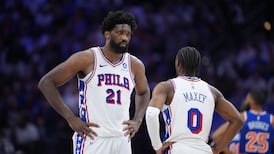
When the Philadelphia 76ers traded for Jaylen Brown this offseason, questions swirled about how the shots will be distributed among the forward and incumbent stars Joel Embiid and Tyrese Maxey. Three weeks later, they landed LeBron James in free agency -- and those question marks gained exclamation points.
Those blockbuster moves mean the Sixers will enter the 2026-27 season with four “super-users,” players loosely defined as those with career usage rates over 25%.
Despite four superstar scorers on the roster, oddsmakers didn’t instantly place Philadelphia atop the Eastern Conference standings. The 76ers’ 2027 championship odds improved from +2000 to +900 with the acquisition of James, but Philadelphia’s projected win total jumped only from 48.5 to 50.5.
That’s partially due to the assumption that Embiid will be heavily load-managed during the regular season, but part of it is the question facing the 76ers every time Maxey -- or James, or Brown, or Embiid -- brings the ball up the court.
How quickly can four super-users figure this out?
Using 30 previous NBA teams with a collection of high-usage stars, let’s examine where this 76ers squad would land. And, more importantly, whether Philadelphia can avoid the typical super-user pitfalls and capture a title.
Luckily for the Sixers, James has done it three times.
Top 30 ‘good’ teams, ranked by star usage
The following teams -- all of which were expected to win at least 47 games that season -- are ranked by the aggregate career usage rates of their top-five players. The 2021-22 Los Angeles Lakers check in at No. 1, thanks to Russell Westbrook (career usage rate of 34%), James (32%), Carmelo Anthony (29%), Anthony Davis (27%) and Malik Monk (23%).
That adds up to the mathematically impossible 146% shown below.
Obviously, the usage of those players would become 100% when on the floor together. For every team on this list, stars needed to make major sacrifices.
That Lakers lineup played just 31 minutes together for the season, scoring and allowing 75 points, with James being the usage leader at 31% and Westbrook next at 21%. Los Angeles stumbled to a 33-49 record, largely due to injuries and poor fit.
And though 10 of the 30 teams reached the Finals, four of which won the title, plenty of other super-user teams suffered a similar fate as the 2021-22 Lakers. Of the 30 teams, four won a title and 16 reached at least the second round. Simply put, teams full of super-users have roughly a 50-50 chance to crash out by late April.
The 76ers’ super-users -- and the LeBron factor
Philadelphia’s top five -- James, Maxey, Brown, Embiid and second-year guard VJ Edgecombe -- combine for only a 134% career usage rate, tied with two previous LeBron teams -- the 2010-11 Miami Heat, who lost in the Finals to the Dallas Mavericks, and the 2012-13 squad that edged the San Antonio Spurs.
Assembling super-users has been LeBron’s formula for two decades. Of the 30 teams on this list, LeBron has been on 13 of them. And of the four teams to win a title with a roster of super-users, James has been on three.
Of the 10 LeBron-led teams that didn’t win the title:
- 2021-22: The worst-performing team was the aforementioned 2022 Lakers team, winning just 33 games.
- 2009-10: James, Shaquille O’Neal and the Cleveland Cavaliers won 61 games but lost to the Celtics in the second round.
- 2010-11: James’ first Heat team had the highest expected win percentage on the list; Vegas set Miami’s win total at 64.5.
- 2005-06: LeBron’s first team to qualify for super-user status featured Larry Hughes as its biggest offseason addition. (Hughes had scored 22 points per game during the prior season for the Washington Wizards.)
James has played well with good players, though it hasn’t always been the case. For example, he wasn’t particularly good alongside Westbrook or Luka Doncic in L.A. One potential reason is that neither of those guards is particularly fond of setting screens, in part because screeners get beat up by defenders. James’ new teammates are all below their position average for screens set, per Genius IQ.
There are more concerns for this Philadelphia team. For a lone super-user, average shooting splits on high volume are fine. But for a collection of super-users to succeed, players’ individual efficiency must improve. Among the 150 listed players on these 30 teams, nearly 80% boosted their shooting efficiency. (Even that 33-win 2021-22 Lakers team had all five of its listed players shoot better.)
The NBA’s average effective field goal percentage off potential half-court assists is 57%, per GeniusIQ tracking data. Only Maxey (59%) checked in above that mark last season, while James (55%), Embiid (55%), Edgecombe (54%) and Brown (53%) all fell short. For comparison, when Kevin Durant joined Stephen Curry and Klay Thompson with the Golden State Warriors, all three stars shot better than 58% off potential assists the season before.
That’s not this Sixers team, and coach Nick Nurse likely knows that. Drawing up plays and implementing a democratic offense can be tough with a lineup full of super-users. Of the 30 teams, 12 replaced their coach during the season, after the season or soon into the subsequent season.
I worked in the front office of one of the teams on this list: the 2007-08 Denver Nuggets with Carmelo Anthony, Allen Iverson, Kenyon Martin and JR Smith that won 50 games, the most by an eight seed in NBA history. Those Nuggets lost in the first round to the top seed and eventual Western Conference champion Lakers.
But that Lakers team was not a collection of super-users. It had Kobe Bryant, then Pau Gasol as a moderate possession user, then essentially role players. One was Lamar Odom, who wasn’t always a role player but shot less than ever with the Lakers and at a higher percentage. His defense peaked that season, and the subsequent two years, the Lakers won the title.
That offseason, the Nuggets traded one super-user, Iverson, to acquire Chauncey Billups, who was a more moderate possession-user similar to Gasol. It didn’t deliver a championship, but we got a lot closer, losing in the conference finals to the Lakers in 2009.
Who will be the Sixers’ Odom, the player who will sacrifice on offense and defend consistently? Brown was in the discussion as the “best two-way player” in the league last season, but there isn’t a dramatic difference across the Sixers’ starters in terms of defending on the perimeter.
A better question heading into the season: Who will be the Sixers’ best offensive player? Embiid, Maxey, Brown and James were all clustered around plus-1.5 to plus-2.5 offensive net points per 100 possessions, which is in the “good” range, but nowhere near peak-Kobe-level (more than plus-5.0).
For the teams on this list that went to the Finals, their best players posted an average of plus-5.1 offensive net points per 100 possessions the previous season -- far beyond any of these Sixers stars.