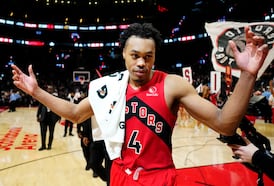
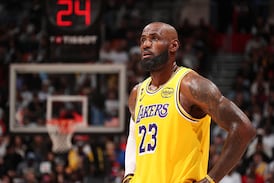
TORONTO – One way or the other, Bobby Webster’s first NBA trade deadline at the helm of the Raptors should be telling.
So far, Toronto’s general manager and head of basketball operations has approached the annual midseason inflection point in a similar manner to his long-time boss, Masai Ujiri. Two weeks out from the Feb. 5 deadline, Webster has been working the phones aggressively, doing his due diligence on just about every consequential player who could become available.
It’s inherently ingrained in his DNA as an executive. For years, the Raptors have been reported as potential suitors whenever a star has hit the trade market. Regardless of his degree of interest in the player, Ujiri would almost always make the call to check in, and after working closely with the former team president and vice chairman for more than a decade, Webster has been doing the same.
Inevitably, that exploratory interest gets leaked by an agent or the other team, is used as leverage, and then blows up on social media. It’s hard to know what’s real and what isn’t at this time of the year. Welcome to trade deadline season!
But sometimes, where there’s smoke, there’s fire. A year ago, their interest in Brandon Ingram seemed far-fetched. They were still in the early stages of a rebuild and the perennially patient Ujiri had vowed to stay the course. Even rival executives and many of the league’s most plugged-in insiders were taking the reports with a grain of salt.
However, their acquisition of and subsequent extension for the former all-star signalled that Toronto’s ever-opportunistic front office was ready to expedite the building process.
With his team ahead of schedule, off to a pleasantly surprising 27-19 start to the campaign, the spotlight shifts to Webster, who inherited Ujiri’s role as the primary decision maker over the summer.
There are multiple paths that he could take, with varying levels of risk and reward.
He could use the upcoming deadline to add depth and fortify a talented roster with some notable holes, namely shooting and size. He could make a smaller move to unload salary and duck the luxury tax, deferring any major changes to the summer. Or he could ride the momentum, push some of his chips in, and make a run at a seemingly wide-open Eastern Conference.
Put it this way: If the Raptors don’t make a big splash over the next couple weeks, it won’t be for a lack of effort or interest on their part. It will be because their hands are tied.
TSN can confirm that Toronto appears willing to part with some combination of Immanuel Quickley, Jakob Poeltl and RJ Barrett, or at least that’s the impression that rival teams have gleaned from exploratory discussions. That tracks, both because the Raptors would need to include one or two of those players to match salary in any big trade, but also because those are the contracts limiting their financial flexibility moving forward.
It’s a dilemma of their own making, to be sure – a function of handing out above-market contracts to players before they reached free agency, essentially bidding against themselves.
Even at the time, the Quickley deal – $175 million over five years – felt like a slight overpay, and with injuries and inconsistency, it hasn’t aged especially well. Maybe he can build off his career night in Golden State on Tuesday – a historically efficient 40 points on just 13 shots – but he’s still looking to establish himself as a reliable lead guard more than two years into his tenure.
Poeltl’s value isn’t in question when he’s healthy. However, the starting centre has been limited by a nagging back issue since training camp, just a few months after signing his extension. He’s logged just seven minutes over the past 19 games and has had multiple return attempts derailed by lingering discomfort. It’s not an injury that tends to age well in seven footers, and he’ll be making just shy of $30 million annually into his mid-30s.
Barrett was viewed as a one-dimensional player and negative asset when he was acquired by Toronto, and while he has grown by leaps and bounds since coming over with Quickley in the OG Anunoby deal, it’s hard to shake that label. He’s under contract through next season and will be looking for a sizeable extension over the summer.
Naturally, teams aren’t lining up to acquire those guys. Most of the clubs Toronto has spoken to or will speak to, aren’t incentivised to take on long-term salary without also getting back premium picks and prospects.
The Raptors have always been reluctant to include multiple first-rounders in a deal, and outside of Scottie Barnes, prized prospect and rookie standout Collin Murray-Boyles is the closest thing to untouchable on the roster. Their other recent first-round picks, Gradey Dick and Ja’Kobe Walter, haven’t shown enough to be more than neutral assets.
And so, with the deadline approaching, the Raptors have reached an impasse. It seems unlikely that they’ll be able to turn their big contracts into a star like, say, Anthony Davis or Domantas Sabonis. And it seems just as unlikely that they’d be willing to sweeten their offer with the assets it would require to get something like that done. It’s a high-stakes game of chicken that feels destined to end in a stalemate.
According to sources, the Raptors have held internal conversations about the pros and cons of trading for Davis, an elite rim protector and perennial all-star, who turns 33 in March, comes with an extensive injury history, and is currently out with ligament damage in his hand. Mostly, though, their reported interest appears to be driven by Davis’s representation, wish casting on the part of agent Rich Paul, who is said to be working tirelessly to force a trade and get his client to greener pastures.
Davis is in line for a mega extension over the summer, one that could be worth up to $275 million, and one the Mavericks don’t seem willing to offer. Paul also represents Ingram, another often-injured star, whom the Raptors acquired and extended for $120 million – a figure that, even Paul has acknowledged, is richer than he likely would have garnered in free agency.
But when push comes to shove, is Dallas really going to take pennies on the dollar for the headliner of its Luka Doncic return? It would make far more sense to shut Davis down, maximize their first-round pick in the loaded 2026 draft – it’s the last one they control until 2031 – and shop him again over the summer, with an eye on building around Cooper Flagg.
What will the Raptors do? Their recent history offers some clues on how they might approach the deadline. You could see them jumping on an opportunity to buy low, if it presents itself. If it doesn’t, they’re generally not the team to relent and pay somebody else’s price.
All signs point to playing it relatively safe: using the expiring contract of Ochai Agbaji and a second-round pick (or, perhaps, a protected first-rounder) to avoid the tax and try to add a depth big.
They’ve already checked in on another Mavericks centre, Daniel Gafford, per a source, while Orlando’s Goga Bitadze and Brooklyn’s Day’Ron Sharpe are other names to monitor. That way, they could see how this group holds up in meaningful games during the spring before reassessing in the off-season, when it’s easier to make significant change.
But that’s the Ujiri playbook. Sources within MLSE insist that Webster has full autonomy and is under no pressure to take a big swing in his first at-bat. But in declining to elevate him to the president’s role and dangling the title over his head like a carrot, this was always going to be a make-or-break season for Toronto’s GM, as well as several others on his staff and in the organization.
So far so good. Even with some obvious deficiencies and question marks, this roster that he and Ujiri built has shown proof of concept.
This is Webster’s first chance to really put his stamp on the team. We’ll see what he does with it.