Las Vegas summer league offered the NBA world its first extended look at how this year's premier lottery class would fare against professional competition.
The top four picks -- AJ Dybantsa, Darryn Peterson, Cameron Boozer and Caleb Wilson -- all had their moments. Dybantsa led the Washington Wizards to a head-to-head victory over Peterson's Utah Jazz on opening night, though Peterson still found a way to show off his scoring savvy despite facing regular double-teams. Meanwhile, Boozer led the Memphis Grizzlies to the tournament's championship game, and the high-flying Wilson thrilled Chicago Bulls fans all week long.
The top tier of the 2026 class had plenty of competition for attention: a handful of 2025 lottery picks were back for a second run through Sin City, and Yaxel Lendeborg, this year's 11th pick, led the Golden State Warriors to the summer league title on Sunday.
Now that summer league is officially in the books, let's hand out superlatives to this year's standouts. Note: Players needed to appear in at least two games to be included, and those who stuck around for the entire event earned extra credit.
Jump to a superlative:
Most Valuable Player | Most Electric Rookie
Most Intriguing Rookie | Most Inconsistent Rookie
Most Disappointing Rookie | Best Second-Round Rookie
Best Sophomore | Most Improved Sophomore
Best Second-Round Sophomore | Best Undrafted Player
Summer league MVP: Cameron Boozer, Memphis Grizzlies
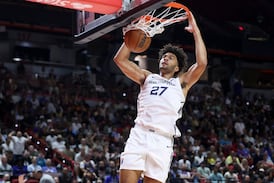
Boozer didn't play in front of as many fans as Dybantsa, draw as much defensive attention as Peterson or author as many YouTube highlights as Wilson, but the Duke product stood out by doing what he does best: produce consistently and win.
While Dybantsa's Wizards, Peterson's Jazz and Wilson's Bulls combined for a 6-9 record in Las Vegas, Boozer led the Grizzlies (4-2) to the summer league's championship game. The sturdy 6-foot-9 forward made a smooth adjustment to the professional level of competition: He averaged 18.5 points, 8.0 rebounds, and 3.7 assists per game in six games. On a per-minute basis, those numbers weren't far off his production during his sensational freshman season at Duke.
Boozer's effectiveness as an interior scorer vacillated depending on the size of his matchup: He expertly exploited mismatches against smaller defenders but found tougher sledding when he tried to operate in the trees. Because he's such a polished and intelligent player, Boozer mostly found the right in-game adjustments when stymied and moved well around the perimeter.
The young and rebuilding Grizzlies flanked Boozer with NBA players -- Cedric Coward, Olivier-Maxence Prosper, Taylor Hendricks and Javon Small -- and he struck a nice balance between scoring and moving the ball. Boozer has an uncanny ability to read defenses at his age, finding teammates with cross-court skip passes from the wing and baseline looks from the elbow.
"There's a lot we can take into the regular season," Boozer said. "[Our identity is] speed kills and outworking the opponent. I think we have a roster that can go out and compete this year."
Skeptics might view Boozer as "more boring" or "less athletic" than the other top names in his class, but his reliability, control and intelligence are all major assets. Ditto for his single-minded focus on team success.
"We lost," Boozer said Sunday, rejecting any individual acclaim. "You can't win MVP unless you win [the championship]."
Most electric rookie: Caleb Wilson, Chicago Bulls
No player generated more buzz in Las Vegas than Wilson, who poured his heart into the event after his one-and-done season at the University of North Carolina was cut short by a right thumb injury.
Wilson, 20, performed like an athlete forced to bottle up his energy and competitive juices for the past five months. In between monster two-handed slams, he blocked shots at the rim, pushed the ball in transition, threaded 40-foot bounce passes on the run and showed off his improved three-point shot. While the 6-foot-9 Wilson seems like a natural fit at power forward, it's possible that he's quick and versatile enough to also function as an oversize wing.
The most eye-popping aspect of Wilson's game is his leaping ability: He gets off the ground faster, skies higher and levitates longer than his opponents. No wonder Kevin Garnett, the former teenage sensation turned Hall of Famer, sat courtside last Thursday to get a look at Wilson.
While Dybantsa and Peterson cut short their summer league runs, Wilson compiled averages of 23.5 points, 7.3 rebounds, 1.3 steals and 2.5 blocks per game in four appearances. His competitive pride came through in his finale: He scrapped with the Lakers until blood covered his jersey, and he jawed with a defender so aggressively that the two parties eventually had to be separated.
There were downsides to Wilson's frenetic energy. He regularly committed turnovers while trying to dribble in traffic, and some of his end-to-end forays led to poor decisions. He needs to add strength to become a more reliable inside-the-arc scorer, and his high-risk, high-reward play style needs a few years of refining.
Still, Wilson looks like the most exciting Bulls player since Derrick Rose after just one week in the Nevada desert.
Most intriguing rookie: Darryn Peterson, Utah Jazz
Peterson's freshman season at Kansas left everyone wishing they had been able to see more: His best moments were splendid and prompted comparisons to Kobe Bryant, but his body of work was incomplete because of injury absences and minutes limits. That's basically the same story for Peterson coming out of summer league.
The second pick averaged 20.7 points and 4.0 assists in his three appearances, and he gave glimpses of his well-honed ability to create space off the dribble and score in a variety of ways. Even so, he was unable to put to bed some of the biggest questions about his game.
Despite describing himself as a point guard in the predraft process, Peterson registered more turnovers than assists and looked confused at times while navigating double-teams and traps. That wouldn't have been overly concerning if he was scoring with ease, but Peterson struggled to find the touch on his jumper and finished with 31/23/76 shooting splits.
While the 6-foot-5 guard has the physical tools and level-headed demeanor to become a perennial All-Star, he didn't really take Las Vegas by storm. The wait for his breakthrough continues.
Most inconsistent rookie: Morez Johnson Jr., Dallas Mavericks
Johnson's debut was a sight to behold: 27 points, eight rebounds, three assists, three steals and two blocks against the Golden State Warriors. As that line suggests, the No. 9 pick was a wrecking ball on both sides of the court. To top off an excellent showing filled with above-the-rim highlights on both ends, the 6-foot-9 forward even stepped out to hit a 3-pointer. This was everything Dallas could have wanted to see: physicality, energy, versatility and a stretch element on offense.
Unfortunately, Johnson looked like a completely different player in the Mavericks' next game, a loss to the Lakers. He committed seven fouls in 28 minutes, looked a step slow to react to the action in the paint and finished with just 10 points and five rebounds as the Mavericks were outscored by 22 points in his 28 minutes.
The truth is surely somewhere in the middle for Johnson, who will shift into a complementary offensive role once he's playing alongside Cooper Flagg and Kyrie Irving in Dallas. If he can consistently bring the type of energy he showed against Golden State, Johnson can help the Mavericks win games simply by exhausting the opposition.
Most disappointing rookie: Aday Mara, Oklahoma City Thunder
Given that summer league play is relatively unstructured and dominated by bucket-getting guards, it's no surprise that Mara didn't leave much of a mark during his minutes and sometimes struggled to keep up with the pace of play.
The 7-foot-3 center enters the NBA as a very skilled passer, and his best moments in Las Vegas involved him whipping the ball to cutters for high-percentage looks in the paint. Otherwise, Mara found his own scoring opportunities hard to come by, and he didn't command the basket area that well on either end for a player with his size and length.
Oklahoma City was the only team to go winless in Las Vegas, and Mara, the No. 11 pick, averaged just 8.7 points and 7.7 rebounds in his three appearances. Don't overreact yet: Mara excelled when surrounded by NBA-caliber players at the University of Michigan, and he is set to join the league's most talented roster in Oklahoma City.
Best second-round rookie: Meleek Thomas, Cleveland Cavaliers
Thomas, the No. 34 pick out of Arkansas, enjoyed a weeklong heater. The 6-foot-3 guard led summer league by averaging 27.3 points per game on 50/44/100 shooting splits in four games. In a competition stacked with quality bucket-getters, Thomas stood alone by averaging nearly four points per game more than anyone else who played at least three games.
Of course, it helped that Thomas enjoyed the greenest light in Las Vegas and averaged a tournament-high 20.5 shots per game. His top performance was a 35-point explosion against the Miami Heat in which he hit six 3-pointers and looked very fluid on the ball.
Whether or not the Cavaliers land LeBron James in free agency, they will gladly add Thomas' pop to a bench that ranked 25th in scoring last season.
Best sophomore: Egor Demin, Brooklyn Nets
Boy, has the switch flipped for Demin, who was a timid and largely ineffective rookie for the rebuilding Nets. The Russian guard failed to make the most of his 6-foot-8 size last season, hanging out behind the 3-point line and rarely scoring at the rim.
Demin, 20, looked like a completely different and much more complete player this summer: He attacked off the dribble with greater regularity, finished in traffic and made good, assertive decisions as a playmaker. The Nets desperately need some of their recent draft picks to emerge as difference-makers, and Demin took a nice step in that direction by averaging 21.0 points and 4.3 assists in three Las Vegas exhibitions.
Most improved sophomore: Khaman Maluach, Phoenix Suns
Maluach logged the fewest minutes among last year's top 10 picks during the 2025-26 season, setting up summer league as a pivotal chance to remind Phoenix's coaches what he can do. The 7-foot-1 South Sudanese center seized his opportunity, averaging 19.5 points, 12.8 rebounds, and 2.0 blocks per game in four appearances while looking like the best center in Las Vegas.
The Duke product was very comfortable handling all of his defensive responsibilities: blocking shots at the rim, challenging drivers in the paint and stepping out at times to defend in space. Maluach, who led summer league in rebounding, also served as a multidimensional offensive weapon. In addition to a steady stream of paint scoring, he regularly launched corner 3-pointers and finished 8-20 (40%) from beyond the arc for the tournament.
Put it all together, and Maluach made a strong case for a larger role next season.
Best second-round sophomore: Chaz Lanier, Detroit Pistons
Blink and you missed Lanier's rookie season: He played more minutes in the G League than he did for the Pistons, and he barely saw the court in the playoffs. That's often how life goes for second-round picks on aspiring contenders.
Lanier, 24, had no intention of laying low in Las Vegas. The 6-foot-3 guard averaged 17.4 points and shot 51.1% from deep in nine attempts per game in his four appearances. In his best effort, Lanier scored 17 of his game-high 24 points in the first quarter of a runaway win over the New York Knicks.
The Pistons ranked 29th in 3-point attempts last season, so Lanier's high-volume, high-efficiency shooting in Las Vegas should get their attention. Remarkably, he made more 3-pointers during summer league (23) than he did in his entire rookie season (19). All small sample size disclaimers do apply.
Best undrafted player: Arthur Kaluma, Los Angeles Lakers
Kaluma's timing for a stellar summer league couldn't be any better: The Lakers are looking for size, physicality and two-way contributors as they rebuild their frontcourt following the departures of James and Rui Hachimura.
The 24-year-old forward spent last season with the Lakers' G League affiliate, earning a reputation as a physical perimeter defender with good size at 6-foot-7. But Kaluma, who went undrafted in 2025 after a four-year college career, has been a pleasant surprise on the offensive end for a Lakers team that reached the tournament's semifinals.
Kaluma averaged 18.6 points and shot 50% on more than five three-point attempts per game in his five appearances, highlighted by a 34-point outburst against the Mavericks. All that unexpected scoring didn't impact his defensive energy, as he took pleasure in hounding Wilson in a blowout win over the Bulls.
The Lakers have also been pleased with 2025 second-round pick Adou Thiero's play in Las Vegas, and they're reportedly interested in signing Jonathan Kuminga. With athletic forwards being such a coveted position when building around Luka Doncic, perhaps Kaluma's big summer will earn him a two-way contract.