LAS VEGAS -- It wasn’t long into the first day of the July live period when phone notifications around the Las Vegas Convention Center began going off: A county judge in Ohio had granted a preliminary injunction to 24 men’s and women’s basketball players suing the NCAA for a fifth year of eligibility.
It meant the likes of Filip Borovicanin and MJ Collins Jr. -- who graduated high school in 2022 and played in college for only four years -- were eligible to suit up for one more season at Xavier and Cincinnati, respectively, pending an NCAA appeal. The lawsuit stemmed from the NCAA’s new age-based eligibility model (“five for five”), which gives athletes five years of eligibility over five seasons. It goes into effect for student-athletes graduating next spring but does not retroactively apply to student-athletes who graduated this past spring.
“What does this mean?” was the common refrain from coaches and agents watching games in the Nike Elite Youth Basketball League. “Is everyone going to be eligible?”
Suddenly, coaches of programs with roster questions had more potential options with which to fill holes. Agents immediately started working the phones. One brought up numbers for every Power 4 program on his phone and went one by one, calling to figure out who still had available spots -- and, perhaps more importantly, money to spend.
The lawsuit might have applied only to the state of Ohio -- there’s another hearing for the Borovicanin case on Tuesday, and the NCAA has also appealed the original decision. But, should Ohio’s First District Court of Appeals not side with the sport’s governing body, it will open the door for potentially hundreds of graduating four-year seniors across the country to push for another year of eligibility. Similar lawsuits have already been filed in Tennessee, North Carolina, Georgia, Colorado and California, with bigger names including former UCLA guard Donovan Dent, former Miami big man Malik Reneau, former NC State forward Darrion Williams, former Michigan State big man Jaxon Kohler, former Auburn forward Keyshawn Hall and former Minnesota guard Cade Tyson all looking for another year of eligibility.
Expect more, too, with agents currently putting out feelers to gauge the college market for players they represent. For example, sources told ESPN that multiple schools have already been contacted by intermediaries regarding two-time All-SEC forward Mark Mitchell Jr. and Ivy League Player of the Year Nick Townsend -- both of whom graduated this past spring.
All of which means, the final 100 days of this college basketball offseason could be pure chaos.
“Nobody knows what will happen,” one Big Ten coach said. “There’s no telling like, are all these guys going to get eligible? Is it going to be a select few? Is it going to be none of them? That’s the most chaotic part about it. From a coaching perspective, from a leadership perspective, a player perspective, all these different buckets, everyone is just left in the dark.”
A Big 12 staff member added: “Every day you wake up, it’s a new apocalypse in college basketball. Nobody has answers. The NCAA offers no clarity. The coaches don’t know. High school players are being asked to make commitments before college players even know if they’re going in the portal. We’re playing the record backwards.”
The lawsuits and the short-term eligibility questions for this coming season were the surprise discussion point in Las Vegas, but the recruiting trail this summer has been more focused on the larger long-term impact of all the recent NCAA legislation. Programs know they are entering an unprecedented recruiting landscape when it comes to building a team for the 2027-28 season. They’re also wondering whether they will have room for these players.
The answer is multifaceted.
Part of it is the aforementioned “five for five.” The new rule gives student-athletes up to five years of eligibility over five seasons, with the eligibility clock starting upon full-time college enrollment or at the beginning of the academic year following their 19th birthday, whichever comes first.
In general, coaches have more faith in a future fifth-year senior making an immediate impact than a non-elite high school recruit.
“The ‘five in five’ provides a whole new depth of inventory for players,” one power-conference general manager said. “Would I rather have a guy with 60 starts under his belt, at a minimum, or do I want to roll the dice on a guy that maybe has an awesome game every five games? With the freshmen, that’s the tricky thing.”
A Big Ten coach said, “Even somebody that’s played just one year of college -- it doesn’t have to be a fifth-year transfer -- they’ve been through the rigors of it. We can go and talk to their previous coaching staff. They’ve gone through some adversity. You can study them from an analytical standpoint. The 72nd-ranked high school player in the country? There are a lot more variables.”
Another part is the growing budgets for men’s basketball teams and the coinciding rising salaries of men’s college basketball players. Division I power conferences have arguably become the highest-paying basketball leagues in the world outside of the NBA.
“I’ll go a step further,” one coach said. “There are high-level mid-major teams that can pay just as much or more than teams from top European leagues.”
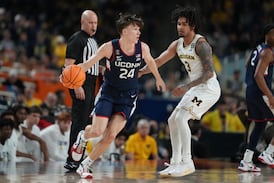
As a result, players are returning to college instead of entering the NBA draft unless they’re surefire lottery picks. Florida’s Thomas Haugh and UConn’s Braylon Mullins were projected top-20 picks in this year’s draft, but both opted to return to school. In fact, the Gators were able to keep their national championship-winning frontcourt together in each of the past two offseasons, even though Haugh, Alex Condon and Rueben Chinyelu would all have been drafted.
The trend is expected to continue. Lottery picks will leave, as usual, and there will obviously be hundreds of players entering the transfer portal. But the vast majority of players in the latter category will be replaced by, well, other players in the portal -- not incoming freshmen.
“It’s just a numbers crunch,” one ACC assistant coach said. “If you have 5% leaving, but 20% coming in, someone’s getting left out.”
Then there’s the influx of international players. This past spring saw the largest Europe-to-NCAA movement we’ve ever seen, with dozens and dozens of high-level overseas prospects making the jump to college basketball. But weeks after the majority of these players committed to college programs, the NCAA issued new guidance regarding eligibility for this group, which included updated requirements regarding compensation they might have received while playing in Europe.
An NCAA spokesperson told Sports Illustrated that the organization “identified several international leagues in which participation by a prospect is likely to result in violations of NCAA rules and a loss of eligibility.”
It creates more uncertainty for coaches this late into the offseason.
“A lot of teams are quietly preparing for these guys not to be eligible,” one Big Ten coach said. “We’ve axed four or five of our European targets because they played at a high level. We’re looking at kids that might not be as good, but they’ll have eligibility. Schools will still recruit the market, they’ll have to adapt and adjust as these rules are put into place. But if there’s a wave of high-level European kids that don’t get eligible this year, it’s going to completely change how we go about things."
The clearance process over the next few months will be a test for programs, and determine when they start targeting international prospects moving forward.
“European agents and European players, they don’t have their heads in the sand,” one power-conference general manager said. “They’re going to adjust and take less money and play in certain leagues and then come over earlier. You’ll have to recruit Europeans, instead of at 21 or 22, they’ll be 17 or 18. Why get paid 250K [from a European club team] when you’re 17, when you can get $3 million [from a college] when you’re 18 or 19? So, short term, there will be fewer Europeans coming over. Long term, I think it will be younger Europeans.”
Another factor in the complex roster-building landscape is that this next generation of high school prospects isn’t considered nearly as impactful or deep as previous groups: The 2025 class had Cooper Flagg and his historic season at Duke, followed by arguably the most impactful freshman class in years, from which Cameron Boozer, AJ Dybantsa, Darius Acuff Jr., Kingston Flemings, Keaton Wagler and Caleb Wilson each received All-American nods.
“As a whole, in the last five years, it’s my least favorite,” one Big 12 coach said of the class of 2027. “The other thing with the 2025 class and 2026 class is the [money] those guys got. The 2027 class is going to ask for those same numbers, and they’re just not worth the investment.”
At least, not all of them are worth the investment.
“If you were a top-50 kid in the past, you’d have all these options,” one power-conference coach said. “Top-25 kids now, they still have the bluebloods. But those kids in the back end of the top 50 all the way to 100-120, their recruitments are all over the place. From 120 to 150, though, the top schools are getting back involved because they’re looking at them as guys 13-14-15 on their roster. It’s a strange class.”
Affecting the depth of this 2027 class is also the growing number of reclassifications: Marcus Spears Jr. (Texas), Joaquim Boumtje Boumtje (Duke), Bruce Branch III (BYU), Obinna Ekezie (Louisville), Gabe Nesmith (Vanderbilt), L.J. Smith (Ohio State), Anderson Diaz (Alabama), Davion Thompson (Arkansas) and Caleb Ourigou (Arkansas) were all top-50 prospects in the SC Next class of 2027 who chose to move up a year and enroll in college for this upcoming season.
It remains to be seen if the class could get a boost later, with the top two prospects in the 2028 class, No. 1 A.J. Williams and No. 2 Yann Kamagate, prime candidates to move up. But where does that leave the 2027 class right now, when the majority of prospects begin to whittle down lists and start announcing commitments?
Thus far, target boards have been slow to develop, with schools far less active in extending scholarship offers than in the past. Staffs are trying to not only figure out how many roster spots will be available, but also make sure they have enough money to retain current players for 2027-28 and add reinforcements via the portal next spring.
“I’m really curious to see how many programs are trying to get kids to commit,” a power-conference general manager said. “I’m fascinated to see how actionable some of these offers are.”
“Unless there’s a star in your [incoming freshman] class, you have to go after top-level transfer portal guys,” one Big Ten coach said. “From now until November, everyone is infatuated with high school recruiting. But once November hits, how many schools are going to be sitting there thinking, now let’s focus on transfer guys? These high-level schools, once they get who they get in November, are they still going to recruit these guys well into the spring? You have to be strategic about it.”
There is one potential group benefitting among all of this: Mid-majors. More ranked prospects are opting to play immediately at a competitive mid-major program, versus facing an uphill battle for playing time at a power-five program. Instead of being an end-of-bench option and eventually transferring down a level, getting consistent minutes for a year or two could turn into a lucrative transfer up to a high-major school -- or skipping the transfer route entirely and going straight to the NBA, à la Santa Clara’s Allen Graves this past season.
Saint Louis landed its first SC Next 100 recruit in nearly a decade in Jimmy McKinney; top-25 shooting guard Mekhi Robertson committed to Merrimack, top-50 shooting guard Tony Cornett III picked Toledo and top-50 point guard Kirby Duran pledged to Towson. SC Next 100 guard Lyris Robinson meanwhile has set five official visits, none of them with a power-conference program.
One power-conference player personnel director said more patience and trust on both sides of the equation -- college coaches and high school recruits -- would allow “five for five” to be a net positive for an increasingly uncertain high school recruiting landscape.
“Teams have to evaluate high schoolers correctly and have the courage to act on their evaluations,” he said. “It might be the course correction that we really need, honestly. Now, you allow guys not to be rushed. Guys can go to a mid-major or have a plan of development at a high-major, they don’t need to be counted on right away. That could be good for the game.”