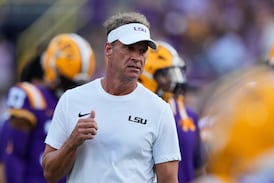
BATON ROUGE, La. -- As LSU and the SEC found themselves locked in an unprecedented game of legal chicken over coach Lane Kiffin’s plan to roster two former NFL players this season, Kiffin routinely reached out to his friend, attorney Tom Mars, for legal advice.
When Mars urged Kiffin to back down, the LSU coach texted him screenshots of legal opinions from an unlikely source.
ChatGPT.
“Usually, when I would express an opinion about what LSU was doing, Lane would reply with a screenshot from ChatGPT that supported LSU’s position, which was almost always wrong,” Mars said. “Lane ignored most of my unsolicited advice, but I don’t think he’ll be using ChatGPT anymore for legal advice.”
Even though former Ole Miss players Dae’Quan Wright and Zxavian Harris prevailed in Louisiana state court and obtained a preliminary injunction that prevented the SEC and NCAA from keeping them off the field this season, LSU ultimately chose to not add them to its roster.
The SEC had threatened to impose stiff penalties to any school that rostered former NFL, NBA or WNBA players, including a fine that equaled 50% of the sport’s annual operating budget and a half-season suspension for the head coach.
The SEC also filed a federal lawsuit against LSU in Alabama -- on the same day commissioner Greg Sankey was testifying in state court in Baton Rouge -- and later scheduled a vote of its member university presidents to consider booting the Tigers out of the league.
If Kiffin hadn’t backed down, LSU might have been punished severely, perhaps even kicked out of the league, if the SEC prevailed in federal court or a state appeals court.
“Eventually, I told him that a guy with a $91 million contract ought to have a top-notch lawyer on speed dial and not be using ChatGPT for legal advice,” Mars said.
It was another bizarre turn of events in a legal showdown that pitted one of the most powerful conferences in college sports against one of its most storied and successful programs on the eve of the 2026 season.
With dueling district attorneys, grandstanding politicians and a cast of characters as colorful as anything simmering in a Louisiana gumbo pot, the LSU-SEC faceoff was an unexpected plot twist even at a time when anything seems possible in college athletics.
The fact that Kiffin, a polarizing head coach who seems to pitch a tent and build a campfire in the gray area of the NCAA rulebook, was at the center of the dispute made it even more dramatic.
The drama goes from the courtroom to the football field Saturday night when Kiffin returns to Ole Miss, the school he left for LSU as the Rebels were preparing for last year’s College Football Playoff, in one of the most anticipated games of the season (7:30 p.m., ABC).
“One reason I like Lane so much is that neither of us are risk averse, and we’re both willing to take chances others might not take,” Mars said. “But Lane takes it to the next level. Borrowing a line from ‘Star Trek,’ you might say Lane is willing to go where no man has gone before.”
Mars has never represented Kiffin in a legal case. In February, Mars helped Ole Miss quarterback Trinidad Chambliss obtain an injunction from a state court judge in Mississippi, which allowed Chambliss to return to school for a sixth season.
Mars describes Kiffin as “just different.”
“I think his IQ is probably off the charts, and head coaches have told me that Lane is a savant on game day with the ability to see things during games that no one else sees,” Mars said. “That said, I think most people would agree that Sunday through Friday is what makes Lane both interesting and newsworthy.”
Take, for instance, Kiffin’s reaction to excerpts of John Talty’s book, “Lane Being Lane: The Story of Lane Kiffin, College Football’s Agent of Chaos,” that were released Sept. 2. An excerpt in Vanity Fair detailed the alleged off-field behavior that led former Alabama coach Nick Saban to fire Kiffin as the team’s offensive coordinator a week before the Crimson Tide played Clemson in the CFP National Championship in January 2017.
“I can save you $33 and lots of reading time by summing up the book this way,” Kiffin wrote to Mars in a text message, which was shared with ESPN. “Old unnamed sources say Lane used to argue with Saban, drink alcohol and hang out with hot women. New unnamed sources say Lane gets along with Saban, doesn’t drink alcohol, but still hangs out with hot women.”
KIFFIN HAS BEEN public enemy No. 1 in Oxford, Mississippi, ever since he left for LSU two days after the Rebels’ 38-19 victory over rival Mississippi State in the Egg Bowl. Defensive coordinator Pete Golding was promoted to replace Kiffin, and Golding guided the Rebels to their first two CFP wins before falling to Miami 31-27 in the CFP semifinals.
Kiffin’s return to Vaught-Hemingway Stadium and the showdown between his No. 7 Tigers and the No. 8 Rebels have been circled on the college football calendar ever since.
“One thing no one has ever said about Lane Kiffin is that he can’t coach,” said political consultant and author James Carville, an LSU alumnus. “They went all-in on him; he better win.”
Kiffin didn’t help matters this spring when he told Vanity Fair that some Black recruits wouldn’t sign with Ole Miss because of the school’s history of racial segregation. Kiffin said he doesn’t have those problems at LSU. He later clarified his remarks.
Trying to add Wright and Harris to his LSU roster was another instance in which Kiffin seemed to be trying to throw salt into Ole Miss’ wounds. He was again more than willing to be labeled the bad guy to get what he wanted.
“I don’t worry too much about that [being a villain],” Kiffin said on “The Pat McAfee Show” on Aug. 25. “I think as you talk about villains, sometimes the difference between a hero and a villain isn’t very far apart, and it changes very often. I’ve heard Hulk Hogan before. Villain, then a hero, then a villain, then a hero again, and then a villain. So, you know, it happens sometimes.”
During the legal tug-of-war with the SEC, however, Kiffin seemed to be viewed as a villain to everyone outside of Louisiana for attempting to cross a line that had never been traversed before -- bringing back players after they’d signed NFL contracts.
“They’re not professional players,” Louisiana Gov. Jeff Landry said. “I mean, it’s ridiculous.”
Landry argued that it wasn’t fair that Texas offensive lineman Cole Hutson is back on the Longhorns after he participated in minicamps with the Cleveland Browns and Dallas Cowboys (although he didn’t sign a pro contract). Last season, Alabama’s basketball team had center Charles Bediako for five games after he played in the G League and signed multiple NBA contracts.
“It’s hard to argue that LSU isn’t being unfairly targeted,” Landry said.
Wright and Harris are two of more than 600 former student-athletes who are part of lawsuits seeking an extra year of eligibility in the wake of the NCAA’s new “five-for-five” rule. Wright, a tight end, signed with the Philadelphia Eagles as an undrafted free agent in April, then was claimed on waivers by the Browns, who cut him Aug. 23. Harris, a defensive tackle, signed with the New Orleans Saints as an undrafted free agent and was waived Aug. 8.
On Aug. 19, Louisiana state court Judge William Jorden granted a temporary restraining order to Wright, Harris and about 30 other athletes allowing them to return to college for one more season.
The legal battle came to a head during a hearing in a Baton Rouge courtroom Sept. 3. The players were represented by Ryan Downton and Tony Clayton, the district attorney for Baton Rouge and two nearby parishes. The SEC’s legal team included Jason Williams, a former Tulane football player and the current district attorney of Orleans Parish.
Jorden’s courtroom gallery was packed with several dozen lawyers, reporters, athletes and onlookers. At the start of the hearing, a row of four armed bailiffs stood at the back of the courtroom. Posters of famous poems, including “The Man in the Arena” and “Invictus,” decorated the walls.
The plaintiffs had to bring in extra chairs to fit all the lawyers who wanted to be at the table. Along with out-of-state attorneys, the players’ legal team included Louisiana attorney general Liz Murrill.
Murrill had filed an amicus brief supporting the players the night before the hearing. She didn’t participate in the legal proceedings. On multiple occasions, she tucked her phone inside a manila folder and scrolled social media posts as the attorneys made their opening arguments and questioned Sankey.
When Murrill was interviewed by the media before the hearing, she opened her remarks with “Go Tigers.” She later posed for a photograph with the football players during a short recess.
Harris and Wright sat first in an overflow seating section between the judge and the attorneys, then later in the jury box along with about a dozen other athletes from various sports, including two LSU women’s soccer players who left early because they had a game that night.
When Sankey took the stand, Clayton pushed him to acknowledge that he had earned $4.8 million last year and flew to Baton Rouge on a private jet.
Clayton alleged Sankey and the SEC were being “hypocritical” by attempting to prevent “children” from making money by playing college sports.
“These kids should not be punished because you changed the rules,” Clayton said.
Sankey explained that he didn’t change the rules. Williams objected to the line of questioning, and Jorden noted that Williams was objecting a lot in order to get Clayton to lose his train of thought. The judge told Williams to stop.
“As my grandma used to say, ‘Ain’t no fun when the rabbit’s got the gun’” Clayton said, as the judge shook his head and many in the courtroom laughed.
“Watching Mr. Clayton is like watching the sunset; you can’t look away,” Williams said.
Sankey testified for more than three hours. While he was on the stand, it was revealed the SEC had filed a federal lawsuit against LSU in Birmingham, Alabama, earlier that day.
While delivering his decision shortly after 8 p.m. local time, Jorden said he arrived at the hearing with a sense that he would rule against the players. Despite feeling that the distinctions the NCAA and SEC were trying to draw between their athletes and professionals seemed “arbitrary and capricious,” Jorden said he was “very, very skeptical” the players’ attorneys would be able to prove they had the legal standing to show either the NCAA or SEC had breached a contract.
“Even with all that silliness, if they don’t have standing we don’t get here,” Jorden said. “I was ready to come out here and say, ‘Y’all gave it a good shot, but you don’t have standing.’ ... And then something happened.”
What happened was the players’ attorneys provided Jorden with a copy of the NCAA’s freshly printed rules manual for the 2026-27 school year. In the manual, Rule 12.6 states that as of Aug. 1 any athlete who was within five years of finishing high school or their 19th birthday was eligible to play five seasons of college sports. It did not explicitly say that if a player had exhausted eligibility under the old rules, then the new rules wouldn’t apply to him or her.
And so, while Wright, Harris and their fellow plaintiffs may have been ineligible from the end of their last game up until July 30, they could make an argument that they became eligible to play when the new rules went into effect Aug. 1. They could argue they had legal standing.
Downton said after the hearing that he had discovered the new manual -- and the apparent oversight in how the rules were written -- two days before the hearing. The change was fresh enough that Sankey said during his testimony that he had not yet seen how the rule was worded in the NCAA’s new manual.
The SEC commissioner learned about the exact language while sitting on the witness stand in the courthouse. Jorden entered the day thinking he would empathize with the players but had no option to use the letter of the law to help them. He said the NCAA’s new manual gave him the window he needed to grant their injunction.
“Plaintiffs had no reason to enter a transfer portal if they were out of eligibility,” Jorden wrote. “Likewise, Plaintiffs universally testified that they would not have signed any professional contracts if they had known they had another year of eligibility when they finished their last season in college. This Court will not allow the NCAA to punish these Plaintiffs for its poor planning and errors in rulemaking.”
Jorden not only banned the SEC and NCAA from preventing the plaintiffs from playing this season, but also all other conferences and NCAA member institutions.
“The NCAA is a multibillion dollar entity that exists to ‘foster the lifelong well-being’ of college athletes,” Jorden wrote. “The NCAA’s and SEC’s attempt to forever bar a young adult from college sports because the NCAA screwed up does not foster anyone’s well-being. The NCAA cannot suggest with a straight face that any athlete from the Class of 2022 should have declined an NFL tryout when the NCAA told them they were out of eligibility.”
Jorden also wrote that he was “troubled” by the SEC’s threats to punish schools who rostered former NFL players.
“This is too cute, by far,” he wrote. “As a practical matter, no SEC school will roster a player if they are subject to a penalty of 50% of their revenue for a sport and a head coach suspension for 50% of the season. While the SEC may have a right to create and enforce such penalties on a go-forward basis, it cannot do so in response to a Court order (or, in this case, numerous court orders) enjoining enforcement of the NCAA rules on which the penalties are based.”
Jorden cleared Wright, Harris and 40 other athletes from various sports -- including former Notre Dame pass rusher Junior Tuihalamaka, who was already practicing with LSU -- to return to college sports for a fifth season.
“Today, justice was served to the SEC,” Clayton told reporters outside the courthouse. “And it was served like a cold cup of gumbo, and that judge forced them to eat it.”
WHEN LSU SUBMITTED its football roster to the SEC the day after Jorden’s ruling, it didn’t include Harris and Wright, although the Tigers left two roster spots open in case they could be added in the future.
LSU seemed to be embracing the villain role when it added a sign in its locker room that read: “If you want to win at the highest level, you have to become the villain in someone else’s story.”
On Sept. 5, Kiffin arrived at Tiger Stadium for his debut as LSU’s coach. Comedian Theo Von, former LSU gymnast Livvy Dunne and model Brooks Nader were part of his entourage.
While the start of the “Lane Train” was delayed for nearly two hours because of lightning, LSU struck early and often against overwhelmed Clemson in front of a sellout crowd of 102,000 at Death Valley.
With LSU holding a 31-3 lead at the half, after outgaining Clemson 336 yards to 54 and allowing only one first down, Kiffin told ESPN’s Holly Rowe, “Imagine if we had pro players.”
Following LSU’s eye-opening 51-10 rout, Kiffin was asked about his one-liner in his postgame news conference.
“What’s the difference?” Kiffin said. “Everybody hates you. They can’t hate you that much more.”
On Sept. 8, the SEC filed an amended complaint in federal court, in which it revealed that it had scheduled a vote of the conference presidents on whether to expel the Tigers from the league. Under SEC rules, a vote of at least two-thirds of the conference presidents is required to terminate a school’s membership, and it was unclear if the league had the necessary votes if LSU went through with adding Harris and Wright to its roster.
“They picked a fight with the SEC, which has all the power in the world,” Carville said. “It wasn’t smart.”
If nothing else, the SEC’s amended lawsuit and threat of booting the Tigers amplified the growing rift between the league and LSU.
“I don’t want to talk about the guy coaching at LSU,” one SEC school’s president told ESPN earlier this month.
The SEC’s amended lawsuit was met with outrage from Landry and U.S. Senator John Kennedy of Louisiana, who described the league’s complaint as “bone deep down to the marrow stupid.”
“I’ve got rocks in my driveway that are smarter than that,” Kennedy said. “They’re not going to throw LSU out of the SEC. Let me tell you something, I and a lot of other people in the United States Congress will be on them like a hobo on a ham sandwich. LSU hasn’t done anything wrong. It’s called a court of law. God made courts to decide disputes.”
Gabe Feldman, director of the Tulane Sports Law Program, believes the legal tussle isn’t as much about Kiffin or LSU as the SEC’s desire to set a precedent for self-governance and establish legal ground that it can enforce its own rules.
“I think this just happened to be the case that was presented to them, and I do think they believe it’s important to not allow pro athletes to return to college, but I think the much bigger issue was to set a precedent for conference governance because we’ve seen what’s happened at the national level,” Feldman said.
Feldman says the LSU case can become a “rallying point” for those who want to pass federal legislation that would create guardrails for college athletics, similar to the situation involving former Texas Tech quarterback Brendan Sorsby, who sued the NCAA in May after he was ruled ineligible for placing impermissible sports wagers, including on his own team at Indiana.
“Most agree that you shouldn’t be able to gamble on your own team and continue playing, and I think most agree that pro athletes should not be able to return to college,” Feldman said. “I do think this maybe heightens the concern about the lack of rules and lack of enforcement in college sports, because I think no matter what side one is on, I don’t think anyone thinks it’s a good idea to have these issues resolved by state court judges.”
In the end, Kiffin and LSU backed down, apparently deciding the risk wasn’t worth the potential reward. On the same day the SEC filed its amended lawsuit, the Tigers added two injured players to fill their 105-man roster, eliminating the possibility of adding Harris and Wright this season.
A federal court hearing in the U.S. District Court in Birmingham was continued the next day.
Finally, it seemed Kiffin might have listened to Mars’ unsolicited advice. Mars had suggested there had to be a scenario in which Harris and Wright could do something to prepare for the NFL other than sitting around Baton Rouge, waiting for the court cases to play out.
“All the lawsuits would become moot, which is a nice way of ending this whole courtroom drama with a fizzle without anyone winning or losing,” Mars wrote in a text message to Kiffin.
There will be only one winner in Oxford on Saturday night.
ESPN’s Dan Murphy contributed to this report.