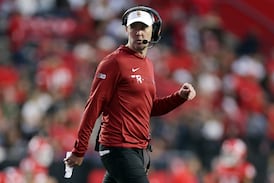
Walking through the hallways of the Chicago Hilton during Big Ten media days in late July, Lincoln Riley was taking questions in stride. They came all day long from every corner, every room. In some ways, the questions were different than the ones from his Oklahoma days; in other ways, they were the same. But it was Riley who said he had changed.
"Somebody asked me, 'Are you a better head coach now than you were before?'" Riley said. "By a mile. There's things that I've learned and know now that I wish I'd known then and would've helped us a lot."
The 42-year-old is now in his fifth year as USC's head coach, a fifth year of feeling the pressure from having never made a College Football Playoff appearance with the Trojans. The proverbial clock feels like it is ticking a bit faster now, the temperature of his seat getting a bit warmer. So, the questions came in flurries, perhaps more pointed than ever. At this moment, however, Riley was running on optimism, and he was not just introspective -- he appeared more relaxed than ever, and his responses had the bite to match.
"Frankly, I think that's why [USC] needed somebody like me," Riley told ESPN. "This wasn't going to turn around without some bumps along the way, especially just how scrutinized and the expectations are at a place like this."
It has been three full seasons now since the Trojans rode Caleb Williams' hot hand to an 11-3 campaign in 2022 that appeared to vindicate Riley's decision to leave Oklahoma in 2021 and shed light on what kind of program USC could become under him. Since then, the Trojans have gone 28-15 (Riley's 35-18 overall record at USC entering the 2026 season was the same as his predecessor, Clay Helton, had over his first 53 games), undergone various assistant coaching changes, an athletic director change and faced plenty of critiques about their shortcomings.
"No matter what the roster is, no matter what you inherit, no matter what the facilities are, no matter how aligned it is, the world doesn't give a s---, and that's OK. That's fine. I knew that," Riley said. "I'm not asking for anybody's sympathy. But I think that's why they needed or maybe wanted somebody that had been through it and done it at a big place and they could stay steady. I just think it's what we needed and I think that's why we're headed the way we're headed."
In the past, Riley stated how much work he and his staff had to do to get USC up to snuff to match the sport's other elite programs. At times, it has seemed like an excuse to couch expectations for the Trojans. Two years ago at Big Ten media days, Riley famously said he wasn't a "magician," and he couldn't just "wave a magic wand and everything just be perfect right away."
In the lead up to the 2026 season, Riley touted everything the Trojans do have instead of what they don't. They boast a deep and balanced roster that has been built more on development than acquisitions, the No. 1-ranked recruiting class in the nation, and a state-of-the-art facility that Riley has worked toward from the moment he arrived in Los Angeles -- USC has left no room for excuses. They know it too. Spend any time driving around Los Angeles this summer and you would likely run into one of several USC promotional billboards with a message that did not leave much room for interpretation.
"The Time is: Now."
Four games into a pivotal season, USC has four wins. At times the Trojans have looked dominant, while other times concerning shades of inconsistency have resurfaced. Yet as No. 20 Oregon arrives at the Coliseum on Saturday (7:30 p.m. ET, NBC), the pressure surrounding Riley's program and the demand for a signature victory has reached a boiling point.
"It's what it's supposed to feel like here," Riley said. "Expectations and all that are always there and I've never shied away from those."
OKLAHOMA IS NOW a distant fleck in Riley's rearview mirror. After this season, he will have been head coach of the Trojans for just as long as he coached the Sooners. because that was Riley's first head coaching gig, being at the center of a high-profile program is, as he put it, all he has ever known and all he can refer back to in times like these.
"I was heavily doubted when [hired] at OU and there's times there where we win a bunch of games and people say, 'Oh, you're this or that of a coach.' And things get blown out of proportion," Riley said. "I live in a world that's constantly blown out of proportion. So it's my job to stay steady."
Oklahoma and USC are both blue bloods of the sport, but the past few seasons have revealed that if Riley's role with the Sooners was to sustain greatness following the end of Bob Stoops' tenure, the task in Los Angeles has been to rebuild greatness.
That process of constructing strength and depth on the roster has been a slow burn, as was the journey to build and secure the top-ranked recruiting class in the country and modernize the program's NIL efforts and front office. The length of that process -- and by extension, the lack of results -- stems from a misguided decision (as Riley is not afraid to admit) after his first year to go all-in on acquiring ready-made talent through the transfer portal to bolster Williams' final season at USC. The strategy did not pan out.
"It's the biggest mistake I've made," Riley told ESPN before the 2025 season. "I know why I did it, I know why we did it ... but one of the reasons I was most excited to come to USC was to recruit high school and to develop and take advantage of where we were. We got to that a year late."
That identity shift has fully crystallized now. The Trojans' first two-deep roster ahead of the season opener featured five freshmen potentially in starting roles. And while Riley & Co. frequented the portal early on at USC, the team added just 10 transfers (6,608 Div. I snaps) for the 2026 season, which ranks last in the Big Ten and 63rd among Power 4 schools, according to research by ESPN's Max Olson.
That's not to say that the Trojans lack experience. Despite losing key players such as wide receiver Makai Lemon and safety Jamari Ramsey to the NFL, they lead the entire FBS with 15 returning starters, including nine on offense led by starting quarterback Jayden Maiava, who is in his third season in Riley's system and has the makings of a Heisman Trophy contender.
"The confidence really comes from Coach Riley," Maiava said of the expectations surrounding the team. "I think we're just ready."
Through four games, the freshmen have delivered. Wide receiver Trent Mosley (255 yards, four touchdowns) already looks like the No. 1 target for the offense, comfortably filling the role left by Lemon. And while Mosley might miss the Oregon game with an injury, fellow freshman Kayden Dixon-Wyatt has already become an impactful receiver as well (258 yards, two touchdowns). Then there's Mark Bowman -- the highly touted five-star tight end who looks to be as good a pass-catcher (160 yards, two touchdowns) as he is a blocker already.
On defense, all eyes have gravitated toward defensive end Luke Wafle. The 6-foot-6, 265-pound lineman has already wreaked havoc on opposing offenses.
"He's really the total package," Riley said.
It's safe to say USC's defense has longed for a player like Wafle in their quest to keep up with Riley's typically potent offenses. If there is a wrinkle this crucial season, a big one at that, it is whom Riley has tasked with handling USC's historically cantankerous defense following the departure of defensive coordinator D'Anton Lynn to Penn State. Instead of promoting from within for continuity or finding an up-and-coming coordinator elsewhere, Riley turned to a familiar foe: former TCU head coach Gary Patterson.
"I've never coached against somebody that I thought was more unique and tougher to go against than Gary," said Riley, who went 6-0 against Patterson in the Big 12 while at OU. "A lot of the OU versus TCU years that we competed against one another, we had a lot better players than he had top to bottom. They had good players, I don't want to disrespect anybody there, but the talent level was different."
Given how much is riding on this season and the fact that Patterson hadn't coached in a game since 2021, the hiring was a notable gamble. (Patterson spent a year at Texas as a special assistant to Steve Sarkisian and a year at Baylor as a consultant.) But Riley, for his part, has framed it instead as an opportunity he couldn't pass up.
Patterson seems to enjoy being back in the game. And with the landscape of the sport (and the structure at USC), the nature of his position is allowing him to obsess over just one thing: the actual product on the field.
"I help with the recruiting part [now], but I'm not on the road recruiting, not raising money," Patterson said. "So now 100% of my time just goes to football."
Patterson's genius has always been tied to his scheme -- a 4-2-5 formation that prioritizes speed and versatility -- but now, at USC, he has access to some of the best talent in the country, too. The combination is a tantalizing one, helped by what Riley considers to be a level of depth and talent on both lines "unlike any of my first four years at USC."
"Every year I expect to win, I expect us to compete for and win championships. That doesn't change," Riley said. "I certainly will give you what has changed. We're more equipped than at any point in the previous few years. That's not a hope or wish, those are facts."
It is that mix of returning talent, depth and youth that has Riley resolute ahead of this season. Players and coaches are following suit, both recognizing the potential they possess and also the pressure that looms. The first four games have delivered a mixed bag of promising potential, but it has also shown how far they have to go if they want this season to go beyond nine, even 10 wins. Last week, Patterson's defense gave up 35 points to a Rutgers team that had not shown any signs of life in its previous two games.
"Everybody knows the expectations," said linebacker Jadyn Walker. "We all know the urgency, we all know the goal this year. We're all moving in the same direction."
SHORTLY AFTER MEDIA days, Riley was speaking from a podium again -- this time inside the team's cavernous new meeting room within the Bloom Football Performance Center on campus. There is no timidity around the $200 million-plus price tag for the facility -- in fact, USC touts the number.
Moments later the architect who worked on the building would note to the assembled media that perhaps they noticed how no one's voices had echoed in the auditorium. Aside from having AI massage chairs, exclusive Nike Strength custom weight racks, a barbershop/players' lounge, omnipresent natural light and multiple spas and recovery options, the building had been crafted so there wouldn't be an echo too.
Much like Riley has been wont to do with his program, no detail was too small, especially when the vision for this building began with Riley writing it down on a napkin on that well-known overnight flight from Norman to Los Angeles. In fact, Riley said that asking for such a facility was not only a stipulation of his decision to leave Oklahoma for USC, but one of the ways in which he tested how committed and invested the program was in returning to its former glory.
"Even though when I took the job, I'd never been in an SC facility, there was still awareness around the country -- you knew SC did not have good football facilities," Riley said. "When [a new facility] was met with no hesitation, that was a pivotal part of me taking the job. I mean that's probably fair to say -- if that commitment hadn't been made, I probably wouldn't be here."
A vision now realized, the facility stands as both an expensive emblem of the sport's rapid professionalization and a testament to the university's investment in both football and in Riley.
"I don't want to sit here and act like I designed it, but I did get a chance to be involved every step of the way and be able to give a lot of feedback on what I felt like we needed," Riley said.
The structure also speaks to something Riley couldn't stop raving about in Chicago: the alignment between himself, athletic director Jen Cohen and other key cogs that are part of the enterprise that is USC football.
"I got a great vantage point in my years at Oklahoma of what great alignment, what steady leadership really looks like in a program," Riley said. "I can sit here today and say really for the first time at USC I feel all of those things are operating at a high level right now."
The proof of USC's investment is in the very checks they are signing -- those beyond Riley's 10-year, $110 million contract. Early last year, in need of a general manager to reshape USC's roster-building efforts, Cohen and Riley hired Notre Dame's Chad Bowden on a multiyear deal worth upward of $1 million. While USC was previously late to the game in name, image and likeness (multiple in-house NIL collectives shuttered), it was at the vanguard of this current era. With Bowden and increased resources, the Trojans were among a collection of Power 4 programs to take advantage of the pre-revenue sharing market this spring, investing in front-loaded deals for players before the spending cap kicked in with the House settlement on July 1. Its top-ranked recruiting class is said to have cost north of $9 million.
Underneath all the positive momentum, questions remain. How will Riley's triumphs away from the field -- the new building, the No. 1 recruiting class -- be framed if the team does not produce? If the results aren't there after this season, will Cohen -- who did not hire Riley -- look elsewhere for someone to lead the program? How does Riley's buyout (reportedly more than $80 million) factor in?
"Our expectations remain clear: to win championships," Cohen said in her annual State of Troy letter before the season.
The litmus test that arrives this week is both familiar and fitting. As USC has struggled to return to its glory days, Oregon has risen over the past 15 years, symbolizing a shifting power on the West Coast. Now it's the Ducks who have taken on the role of a powerhouse with championship expectations and yet, they have already dealt with the pitfalls of pressure, too; a loss to Oklahoma State two weeks ago makes their margin for error slimmer, their sense of urgency stronger. It makes Saturday's matchup carry the weight to send one team's season skyrocketing and the opposite effect on the other.
Yes, it's just one game, but there's no denying the gravity of it. USC still has No. 13 Penn State (Oct. 10), No. 7 Ohio State (Oct. 31) and No. 5 Indiana (Nov. 14) on the schedule, so this game is not just an opportunity for a statement but also a checkpoint that demands the team's best during a season that feels balanced on a razor's edge. If there is a playoff-caliber team at South Figueroa Street this year, this schedule will prove it.
"There's just a feeling with this team," said offensive line coach Zach Hanson, who has been at USC since Riley arrived. "And it starts with Coach Riley."
Riley is aware of what that notion means: the wins, losses and everything in between -- now more than ever, it all rests with him, too.