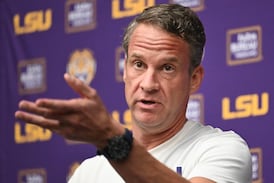
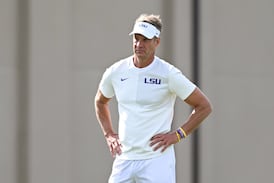
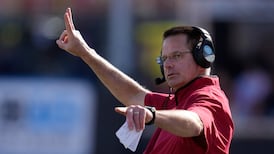
Three years, three programs and three national titles – as well as an indisputable upper hand on its rivals for the SEC. In the Big Ten, things are earned, not given – at least if you ask Indiana head coach Curt Cignetti.
Indiana stood alone this past January, fresh off a 16-0 season – the first in college football since Yale in 1894. And though the Hoosiers’ Ivy League counterpart ran through football factories such as Lehigh and Crescent Athletic Club 130 years ago, Cignetti’s path might’ve even been more difficult.
But Indiana handled its playoff opponents with relative ease, disposing of Alabama and Oregon by a combined score of 94-25 before grinding out a 27-21 over Miami in the National Championship.
Fernando Mendoza has touched down in Vegas, but the Hoosiers are still one of the betting favourites to be standing atop college football in five months. As is Ohio State, which enters the season as the numb No. 1-ranked team in AP Poll, while also boasting the most electrifying receiving prospect in decades in Jeremiah Smith. Oregon will have its say, eager to enter the Big Ten’s collection of national champions in its third year since the combustion of the prior iteration of the Pac-12 in 2023.
Michigan has a new leader in Kyle Whittingham, and so does Penn State, which is still experiencing aftershocks from the figurative earthquake that sent James Franklin packing last October in a season where the Nittany Lions were expected to contend for a national title.
Now, Matt Campbell is in College Station, followed by 24 players from Iowa State, and Bob Chesney has touched down at UCLA after leading James Madison to the playoffs, attempting to blaze a similar path to Cignetti’s when he moved from there to Bloomington three years ago.
With 18 teams, there remain questions about depth, and how the middle and lower tiers of Big Ten stack up with the SEC – even if some of those were debunked by Illinois and Iowa last bowl season.
But what’s clear is that the league up north won’t be pushed around. And like the past three years, the Big Ten is ready to prove it.
Without further ado, five storylines for this season:
Jeremiah Smith attempts to go out just like he came in – on a high note
Smith has been projected as the possible first-overall pick in the 2027 NFL Draft since his freshman year, when he obliterated Tennessee and Oregon in the playoffs before helping lead Ohio State past Notre Dame in the National Championship. He was just as good as a sophomore in 2025, finishing with 87 catches and 1,243 yards, and his 12 receiving touchdowns brought his total over his first two seasons to 27.
This year, Heisman finalist Julian Sayin is back at quarterback, and Smith has a new partner on the perimeter in five-star freshman Chris Henry Jr., who arrives with similar hype and promise to that surrounding Smith in 2024. After playing alongside first-rounders Emeka Egbuka and Carnell Tate in each of his first two seasons, Smith should again benefit from being alongside another playmaker who is certain to draw a share of attention from opposing defences.
If he goes first overall in next April’s NFL Draft, Smith will become the first wide receiver since Keyshawn Johnson in 1996 to be scooped up with the top pick, and just the third ever.
Considering his status as one of the greatest pass-catching prospects of this generation, Smith is a certain first-rounder, even if he doesn’t end up landing first overall. When that happens, he’ll become the seventh Ohio State wide receiver to be drafted in the first round since 2022, with at least one going in each year (Garrett Wilson, Chris Olave, Jaxon Smith-Njigba, Marvin Harrison Jr., Egbuka and Tate).
Smith shattered Hall of Famer Cris Carter’s freshman program records for catches, receiving yards and receiving touchdowns two seasons ago, and barring injury, will set new Ohio State standards in all three categories this year. He needs 43 receptions to pass Egbuka’s record of 163, 341 yards to eclipse Michael Jenkins’ high of 2,558, and nine touchdown catches to pass Olave’s 35.
And while we’re talking accolades, how about the Heisman Trophy? Smith is the runaway favourite amongst non-quarterbacks, and could become the fourth exclusive wide receiver to win the award (Travis Hunter excluded, having won while also playing cornerback in 2024), and just the second since 1991. Smith would also become the first Buckeye to win the award since quarterback Troy Smith in 2006.
Indiana is back for more
Think winning one national championship was enough to keep Cignetti satisfied?
Indiana reloaded in the portal in January even before finishing its business in last season’s playoffs, adding a handful of impact players on both sides of the ball, including quarterback Josh Hoover, wide receiver Nick Marsh and a boatload of impact defensive players.
Hoover will do his best to fill the hole left by Heisman winner and first-overall pick Mendoza, and Marsh joins junior Charlie Becker to form a perimeter tandem that could end up doing more damage than Omar Cooper and Elijah Sarratt did in their final seasons before landing in the NFL this past April.
Cooper and Sarratt were two of the steadiest pass-catchers in the Big Ten the past two years, but Becker was the one that emerged late in Indiana’s title run, with 564 of his 679 yards and three of his four touchdowns coming from November onward. Becker averaged 20.0 yards per reception for the season as a whole, which was nearly two yards more than Rutgers’ KJ Duff, who finished as the runner-up.
Marsh burst onto the scene as a five-star true freshman in 2024 at Michigan State, and caught 100 combined passes over his first two seasons on a Spartans team that managed just four total wins within the conference. But he’s still just 19 years old, and is regarded as one of the best receivers in the nation and is a likely first-round pick next April alongside Becker.
They’ll be catching balls from the active FBS passing yards leader in Hoover, who threw for a shade under 10,000 as a three-year starter at TCU, and finished second in the Big 12 with 29 touchdown passes in 2025.
On defence, Cignetti added edge rushers Tobi Osunsanmi (Kansas State) and Josh Burnham (Notre Dame), as well as some support on the back end in AJ Harris (Penn State), who has battled injuries in fall camp but should help fill the void left by second-round pick DeAngelo Ponds.
Oregon might be the deepest team – not just in the Big Ten, but in the entire sport
If you’re bargaining for a fourth different Big Ten program to win a national title for the fourth straight year, then Oregon is far and away your best bet.
Dan Lanning’s team returns 14 of its 22 starters from 2025, when it went 13-2 and didn’t lose to a team not named Indiana. In fact, over the past three years, the Ducks are a combined 38-5, with all five losses coming against teams that played in the National Championship – Washington in 2023, Ohio State in 2024, and the Hoosiers last season.
Quarterback Dante Moore is the headlining returner, after he spurned the NFL Draft – and the likelihood of being taken second overall by the New York Jets – for another year in Eugene.
He’ll be throwing to one of the deepest pass-catching corps in all of college football, with Evan Stewart returning from the patellar tear that cost him all of 2025 alongside a pair of breakout candidates in second-year receivers Dakorien Moore and Jeremiah McClellan. And though Oregon lost star tight end Kenyon Sadiq in last April’s first round – to the Jets, coincidentally, at 16th overall – it elevates another enormous target in 6-foot-5, 260-pound junior Jamari Johnson, who had nine catches and three touchdowns in three playoff games last year.
Moore will make his case to be the top pick in 2027, and Johnson might not be far behind. The Ducks also have up to four defensive players that could end up going on the first day, including tackle A’Mauri Washington, who might be the first interior lineman off the board, and edge rushers Matayo Uiagalelei and Teitum Tuioti. After losing Dillon Theineman in last year’s first round, Lanning reloaded by adding two-time All-Big Ten safety Koi Perich from Minnesota.
Can Michigan unlock some offensive firepower under its new regime?
Whittingham seemed destined to retire after stepping down after 21 seasons at Utah last December, but that was before one of the most sought-after head coaching positions in the sport rolled right up onto his doorstep.
After dismissing Sherrone Moore, Michigan flirted with bringing in Kalen DeBoer or Kenny Dillingham, but eventually came knocking for the 65-year-old Whittingham, who took a five-year deal that would keep him in Ann Arbor into his 70s if both sides see it through.
Whittingham brought six staffers with him from Utah, including offensive coordinator Jason Beck, who was the architect behind quarterback Devon Dampier’s ascent from New Mexico to the Big 12, where he accounted for accounted for 34 total touchdowns (24 passing, 10 rushing) as one of the best dual-threats in all of college football in 2025.
At Michigan, Beck will attempt to work the same magic on five-star Bryce Underwood, who was up and down as a true freshman last year, limiting his mistakes but finishing with just 11 touchdown passes in 13 games for the Wolverines. At 6-foot-4 and with elite arm strength, Underwood profiles as premier pocket passer, but his mobility (506 rushing yards last season, not including sacks) makes him an extremely interesting case for Beck.
Between Underwood, running backs Jordan Marshall and Savion Hiter (a true freshman, ranked by ESPN as its 25th-best recruit) and second-year receiver Andrew Marsh, Michigan has a set of playmakers that could provide a spark that’s been missing since Jim Harbaugh left following its national title season in 2023.
The potential hold up, though? The Wolverines have a gauntlet of a schedule, with visits to both Oregon and Ohio State, as well as in-conference home games against Penn State and Iowa and Week 2 matchup with Oklahoma that could end up determining the playoff fates of both teams.
Canadian Antwan Raymond is in line for another huge season
The past two years, one of the best running backs in the Big Ten has flown mostly under the radar.
Montreal’s Antwan Raymond rushed for 457 yards and eight touchdowns as a true freshman at Rutgers in 2024, then scored 13 times last year while finishing third in the conference with 1,241 yards. Last December, he was awarded the Jon Cornish Trophy as the top Canadian player in American college football.
Raymond spurned what would’ve been considerable portal interest by returning to Rutgers for a third season, and enters this season as the highest-gaining returning running back in the Big Ten after Nebraska’s Emmett Johnson and Penn State’s Kaytron Allen moved to the NFL.
Raymond’s two best games in 2025 came in November, when rushed for 240 yards – the most ever by a Rutgers player in a Big Ten matchup – in a win over Maryland, then followed it with 189 yards and a touchdown in a season-ending loss against Penn State.
At 5-foot-11 and 205 lbs., Raymond should have a high usage rate the second straight year, and his ability as a downhill runner makes him an NFL prospect, whether he decides to enter the draft following this year or in 2028. Should Raymond elect to play a fourth year and finish his college career elsewhere, he’d likely be highly sought after in the transfer portal next January.