It's a tradition like no other: We wait more than seven months for college football to return, and we overreact with vigor to all we see. We know we're going to regret some of the things we say when we're flying off the handle, but it's just so much fun to do it. So I make sure to do it after Week 1 each season.
Week 1 of the college football season wasn't a wall-to-wall thriller -- it almost never is -- but it was educational and sporadically entertaining, and on Saturday evening it gave us a couple of different opportunities to yell, "WHAT ARE YOU DOING?" (That could have been justifiably directed toward the timekeepers in Ann Arbor or the entire Clemson football program.)
In the end, we got plenty of overreaction fodder. So let's overreact.
 LSU is a national title contender
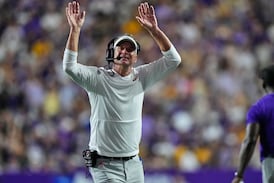
It should never be an overreaction to proclaim LSU awesome, but with zero top-10 finishes in the 2020s, the Tigers hadn't put together all that many awe-inspiring performances of late. But they annihilated Clemson 51-10 in Lane Kiffin's debut as LSU head coach. A transfer-heavy offense mowed down Clemson's defensive front to the tune of 309 rushing yards, and Arizona State transfer Sam Leavitt completed at least one 20-yard pass to four different receivers. Winston Watkins Jr., one of a few transfers from Ole Miss -- the school Kiffin so controversially left last season -- led the way with seven catches for 110 yards.
The defense was even more dominant than the offense. Kiffin smartly retained coordinator Blake Baker and supplemented a pretty experienced defensive core with some star transfers. Tennessee transfer Jordan Ross and Ole Miss transfer Princewill Umanmielen combined for four tackles for loss, 2.5 sacks and, via Ross, a pick-six. Returnees end Dylan Carpenter and linebackers Davhon Keys and (especially) Whit Weeks were endlessly disruptive. At halftime, LSU had gained 336 yards and allowed 54.
LSU did all this despite electing not to roster tight end Dae'Quan Wright and defensive tackle Zxavian Harris; the duo had signed with professional teams as undrafted free agents, but both were recently released and had declared their intentions to play for LSU. (Calling them "former pros," as has become customary from those who benefit from people being scared of this development, makes everything seem far more menacing.) LSU and the SEC had seemingly spent the past week in court arguing with each other about whether this was legal and what the repercussions might be if Wright and Harris played. In the end, the Tigers didn't need them at all.
Most top-ranked teams avoided serious challenges this weekend, but even in a sea of blowouts, this one stood out. LSU means business and looks quite interested in its first serious national title push of the decade.
 Dabo Swinney's laziest hire will doom him
Clemson's rise in the 2010s was the product of what might at first seem like two conflicting traits: Dabo Swinney's ability to trust his gut instincts and his humility in understanding what he didn't know. A career position coach and ace recruiter, Swinney had never been a coordinator when he landed the top job at Clemson late in 2008. After a bumpy start, he recruited two of the most exciting coordinators in the game: Tulsa offensive coordinator (and longtime Texas high school wizard) Chad Morris in 2011, then Oklahoma defensive coordinator Brent Venables in 2012.
He sought energy and innovation, landed the ace quarterbacks required to win big -- top-60 prospect Tajh Boyd in 2009, top-20 prospect Deshaun Watson in 2014, top-two prospect Trevor Lawrence in 2018 -- and proceeded to win big. Clemson enjoyed six straight AP top-four finishes, and although Nick Saban is the best coach in college football history, Swinney beat him in the national title game twice in three seasons (2016, 2018).
The product has regressed throughout the 2020s, and while Swinney is still trusting his gut, he has given up on the idea of innovation. Or humility. Or of sticking with the times at all. He seemingly had to be guilted into using the transfer portal -- he signed zero transfers as recently as 2024 -- and while he hired up-and-coming coordinator Garrett Riley in 2023, he quickly made it clear that he expected Riley to run the Clemson offense, not the Riley offense. When Riley inevitably failed at this, Swinney got rid of any remaining pretense and simply brought back Morris.
Morris' last season as a coordinator had been at Auburn in 2020; the Tigers' offense plummeted from 26th to 53rd in offensive SP+, and they fell from 9-4 to 6-5. The last time he was associated with a good offense in any major way was 2018. And while I can understand Swinney wishing it was still 2018, it's not. Defenses understand the 2010s-era spread offense. The old stuff doesn't work forever.
On Saturday night in Baton Rouge, Clemson brought no new offensive ideas to the table and executed old ideas horribly. The Tigers produced their first first down of the game with 10:19 left in the first quarter, then had to wait almost 30 full minutes for another one. They produced their fewest yards since 2009 (145) and allowed their most since 2012 (644). They botched handoffs. Linemen literally looked the other way while LSU defenders invaded the backfield. Starting quarterback Christopher Vizzina was panic-throwing into coverage and was lucky to suffer only one interception (which was returned for a TD). Including one sack, his 17 dropbacks gained just 82 yards. Freshman Tait Reynolds attempted nine passes that, including three sacks, netted 4 yards.
Clemson has gotten quite a bit of practice at rebounding from horrible starts -- a 10-3 dud against Georgia in 2021, a 28-7 pounding by Duke in 2023, a 34-3 pounding by Georgia in 2024, last year's 17-10 loss to LSU as a team that was supposed to have CFP hopes -- and has frequently rebounded. But the lazy and reductive hire of Morris is a hint that Swinney has never been further away from the right answers.
 Bryce Underwood is lost
One has to ache for Western Michigan. The Broncos bullied Michigan for much of their Saturday night loss to the Wolverines, unleashing a 20-play, 13:40 drive that ate up a huge portion of the second half and proved who had the more effectively physical team. The defense, dynamite in 2025 but forced to replace both its coordinator and almost every starter, allowed a touchdown on the opening drive then held UM scoreless for eight straight possessions. Backup kicker Dieter Kelly made four field goals, including a 52-yarder, and his final one, which came after the Broncos nearly moved the chains one last time to ice the game, sure seemed like it put his team in position for a historic win. All they had to do was break up a Hail Mary heave, and the upset was secure.
Well, two Hail Mary heaves, as it turned out. I'm not here to relitigate the most controversial ending of Week 1. It appears either the stadium clock (which we were shown on NBC) or the clock that replay officials used to grant Michigan one more second was out of sync with where it should have been, and WMU either got royally screwed (if the replay clock was off) or cruelly misled (if, as seems more likely, the stadium clock was off from the official count).
It was an inexcusable error regardless, considering the millions of dollars that go into these productions, and whatever happened doesn't change one simple fact: Michigan looked awful. The offensive line, which lost only two starters from last year's solid unit, badly lost its battle against WMU's rebuilt defensive front.
Meanwhile, Michigan's defensive front, which appeared to be a strength on paper, didn't lose its battle as badly but generated only one tackle for loss and, again, gave up a 20-play drive to a MAC team. WMU averaged only 3.3 yards per play -- overall, the UM defense was fine -- but Michigan got out-Michigan'd and needed a miracle to avoid an 0-1 start against what was, per preseason SP+ projections, the second-worst team the Wolverines will play this year. (It's not going to surprise me if WMU turns out to be quite a bit better than projected, but still.)
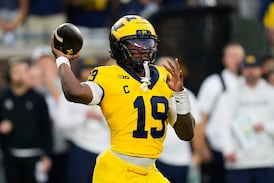
By far the most alarming part of the performance, however, was Bryce Underwood. Michigan's five-star sophomore quarterback had an up-and-down first season, and considering how much of Jason Beck's offensive structure relies on QB rushing and quality reads, I wondered if Beck and Underwood would create a solid partnership. Early verdict: not even slightly.
Underwood made a series of questionable reads, seemingly handing the ball off when he should have kept it and run. But even more worrisome was the simple fact that he couldn't see the field at all. He would lock on to one receiver and force the ball into an impossible window. He would escape the pocket to buy time, then throw to a totally blanketed receiver. He began the game 5-of-5 for 61 yards, but between that start and Hail Mary No. 2, he was 6-of-16 for 62 yards and a pick.
An underwhelming run game -- Jordan Marshall and Savion Hiter had a combined 16 carries for 59 yards and a dreadful 31.3% success rate -- forced the Wolverines behind schedule frequently, and Underwood couldn't catch them up. Even worse, his body language plummeted in the second half as the search for answers began to come up empty. Even Hail Mary No. 1 was poor, sailing out of the back of the end zone.
Even if Michigan avoided an 0-1 start, the Wolverines were outplayed for 59.999 minutes in their most dispiriting opener in years. But if you're looking for a positive spin, there's nowhere for Underwood to go but up.
 Alabama is fine
OK, yes, this is the exact opposite of an overreaction. But are you here for thematic consistency, or are you here for analysis?
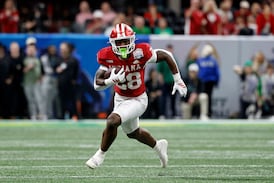
With how much I wrote about Bama this offseason, the Crimson Tide were guaranteed to get a spot in this piece whether they were awesome or terrible. As I wrote in Friday's Week 1 preview, "Both the Crimson Tide's offensive (36th) and overall (20th) SP+ rankings last year were their worst since 2007, and now they're asking a redshirt freshman quarterback [Keelon Russell] to fix things with a mostly unproven skill corps and a brand-new offensive line. We finally get a look at what a Russell-led Bama offense can do against an East Carolina team that is aggressive and well coached but is breaking in loads of new pieces. The Pirates should be athletic and competitive enough that, if Bama covers the four-touchdown spread, that's a very good sign."
The Tide indeed covered in their 48-10 win over ECU. The defense dominated a mistake-prone Pirates offense -- total yards: 160 (3.9 per play) -- but I wasn't particularly concerned about Bama's D. It was good to see the offense carrying its weight. Russell's debut as a starter was clean and exciting: He completed 18 of 30 passes for 256 yards, no picks and only one sack, and he proved his scrambling capabilities immediately, escaping pressure and rushing for 23 yards on the first third down of the game. Seven of his 12 carries (not including the sack) moved the chains, and three players (Ryan Coleman-Williams and sophomores Derek Meadows and Kaleb Edwards) had a catch of at least 20 yards.
The run game played its part, too, after a dismal 2025. Leading returning rusher Daniel Hill and star freshman EJ Crowell combined for 84 yards on 16 carries (5.3 per carry), and while there wasn't much explosiveness there, only one carry gained fewer than 2 yards. Bama stayed on schedule well.
Things weren't perfect. The line wasn't opening up gaping holes by any means -- we'll find out a lot more about that rebuilt unit at Kentucky next week -- and after suffering one of the worst cases of the yips you'll ever see last year, Coleman-Williams dropped his first downfield pass Saturday and dropped a potential touchdown pass as well. (The latter was negated by a defensive penalty.) But he made a huge 58-yard catch on third-and-long in the second quarter and finished with five catches and 130 yards, his best game since last September. Both he and the Bama offense left similar impressions: Last year's issues might be fixed and the upside is obvious, but bigger challenges await.
 Everything I said about Oklahoma State? Never mind
If I wasn't outright excited about Oklahoma State's turnaround possibilities this season, I was at least extremely intrigued. Eric Morris brought my favorite transfer class in the country with him to Stillwater, much of which came from Morris' 12-win North Texas team last season. I couldn't commit to any sort of "Dark horse Big 12 contender!" take, but I thought the Cowboys had at least top-40 potential because of the incoming personnel.
One thing I failed to take into account was the possibility that the Cowboys' offensive line might be much, much worse than North Texas' was last season. Morris brought two starting linemen with him from Denton, but he evidently should have brought even more. At Tulsa in Week 1, it seemed like quarterback Drew Mestemaker was facing more pressure than he had in his entire career. Tulsa was credited with only two sacks but 10 hurries -- App State transfer Thomas Davis had one of the sacks and four of the hurries -- and Mestemaker had a dreadful day: His 29 completions gained just 241 yards, and he threw two picks and lost a fumble.
Caleb Hawkins, a 1,400-yard rusher last year at UNT, gained just 79 yards on 18 carries. It all added up to a resounding 24-10 win for the Golden Hurricane, their second straight over their rivals to the west. I'm going to assume OSU still improves drastically over last season's awfulness (the Cowboys were 1-11 and 121st in SP+), but the offense, and especially the O-line, is a major work in progress.
 The ACC race is going to be a blast
I know. It sounds weird. The ACC race has been a lot of things through the years -- baffling, nonsensical, confusing, appalling. But while the confusion may only grow when we get to the finish line with teams having played both eight and nine conference games in this ridiculous 17-team conference, we could have quite a bit of fun on our way to that finish line.
We obviously can't count on Clemson to be a part of the race, but plenty of others might be able to give Miami a run. It's fair to assume the Hurricanes will be major players -- they entered the season as the favorites, and they looked great in blowing out Stanford. But at the very least, four teams looked like major players in their season debuts.
• Virginia, with one of the most experienced rosters in the country, played like a bunch of grown men, full of dad strength, dominating NC State 34-8 in Week 0. We'll see what happens when teams force Beau Pribula and the Cavaliers to pass -- lord knows the Wolfpack sure couldn't -- but they established a level of physicality that much of the ACC might struggle to match.
• Louisville lost its Sunday night matchup with Ole Miss in Nashville, but the Cardinals looked tantalizing in the process. New quarterback Lincoln Kienholz seemed to mature by two years over the course of the game and finished with 307 passing yards, a team-best 69 rushing yards and three combined touchdowns. The Cardinals couldn't stop the Ole Miss offense enough, and we'll see if defense becomes an issue, but the offense passed a major test, and their ACC schedule is pretty kind.
• Pitt ... wow. The Panthers dominated what should be a pretty solid Miami (Ohio) team 59-14 and quarterback Mason Heintschel threw for 453 yards and seven touchdowns in the process. They have to play at Miami and Louisville later in the season, but they could be about 6-1 when they head to Miami in Week 8.
• Virginia Tech obliterated a bad VMI team 73-3, but the attitude they brought to the table was noticeable. They were ruthlessly physical on the lines, Jeffrey Overton Jr. and Marcellous Hawkins Jr. formed a great RB duo (combined: 21 carries, 173 yards, 5 TDs), and Duke transfer Que'Sean Brown (six catches, 109 yards) looks like he's forming a nice partnership with quarterback Ethan Grunkemeyer. James Franklin's first Hokie team could be pretty spicy.
The winner of Monday night's SMU-Florida State game will automatically insert itself into the list, too. This could be a remarkably fun race to follow -- and in the normal way, not the "ACC Coastal vibes" sort of way.
Lots of good teams can't run the ball
It's sometimes difficult to gather decent information from teams while they're blowing out overwhelmed opponents in Week 1 buy games. They don't really give you red flags so much as hints of red flags.
Filtering out garbage time* -- which obviously filters out a lot in Week 1 -- the national success rate** for rushing this weekend was 45.6%. Despite mostly comfortable wins and lots of great passing, nine ranked teams fell below that mark, only eight ended up over 50%, and 11 fell below the national average for yards per carry (not including sacks). For five specific teams, I was somewhat confused by their lack of rushing success.
• No. 6 Indiana got just 91 yards in 29 carries from backs Turbo Richard and Lee Beebe Jr. against North Texas. Filtering out garbage time, the Hoosiers currently rank 115th in rushing success rate (30.0%).
• The first eight carries for No. 1 Ohio State's Bo Jackson against Ball State netted 18 yards with a 12.5% success rate until he finally broke free for a 65-yard touchdown in the third quarter.
• No. 18 Penn State produced just a 42.1% non-garbage time rushing success rate and no explosiveness whatsoever: Of its 44 rushes for the game, one gained more than 10 yards -- a 16-yarder from Cam Wallace in the fourth quarter.
• Despite playing an extremely low-ranked FCS opponent in Arkansas-Pine Bluff, No. 25 Missouri managed just a 44.4% rushing success rate before garbage time, and like Penn State, the Tigers produced almost no big run plays. Jamal Roberts, a vital piece for Mizzou as Ahmad Hardy continues his rehabilitation from an offseason gunshot wound, gained just 47 yards on 13 carries (3.6 per carry).
• No. 7 Miami saw its running backs carry 22 times in the first three quarters against Stanford on Friday night. They gained 76 yards (3.5 per carry), and none went more than 10 yards.
Now, the five teams I highlighted there won their games by a combined 252-39. This is more of a pre-concern than an actual concern. But for all the great passing these teams produced in blowouts, the run game will have to come through at some point moving forward.
(* Snaps that take place with a scoring margin outside of 43 points in the first quarter, 37 in the second, 27 in the third and 21 in the fourth are logged as garbage time snaps.)
(** Success rate: How frequently an offense is gaining 50% of necessary yardage on first down, 70% on second or 100% on third or fourth.)
Harding needs a new conference
The 2023 Division II national champion and 2025 runner-up, Harding is the resident powerhouse in the Great American Conference, a conference based entirely in Arkansas and Oklahoma. The GAC makes all the geographic sense in the world, and with what we're forced to deal with in the FBS, that's to be admired. But from 2023 to 2025, the Bisons (with an "s") went 32-1 in conference play, outscoring opponents by an average of 50.3 to 8.1 and losing only to a top-10 Ouachita Baptist team in 2024. And Thursday in Searcy, Arkansas, they absolutely humiliated Northwestern Oklahoma State.
This section was simply an excuse to share with you one of the meanest box scores you'll ever see.
Total yards: Harding 747, NWOSU minus-26
Yards per play: Harding 12.9, NWOSU minus-0.7
First downs: Harding 28, NWOSU 0
Northwestern's longest gain was 7 yards, or 5.9 fewer than Harding's average play. And the score could have been worse! The Bisons lost fumbles in consecutive second-quarter possessions!
Obviously there are plenty of "smash your overwhelmed opponent's head into the turnbuckle for 60 straight minutes" games in a given Week 1, but good gracious.
Biggest surprises of the week (according to the nerd stats)
SP+ is a strong predictor, but in any given week -- especially Week 1 -- there can be some pretty big whiffs. Here are the five biggest FBS vs. FBS whiffs of the week.
UMass 37, Rutgers 21 (difference between projection and reality: 54.1 points). Hell yeah, UMass. As I always say, fielding a college football team is so ridiculously hard: From the equipment costs, to the roster size, to the hundreds of people you need besides coaches and players -- the bus drivers, the officials, the media officers, the families and fans who make the entire enterprise worth the trouble -- it's a huge undertaking even if you stink. Every team, therefore, deserves to celebrate a win at least once in a given season, and with last year's 0-12 campaign, UMass didn't get that chance.
Maybe it was worth the wait. I'm betting Week 1 is not the last time the Minutemen get to celebrate a win in 2026. Pop Watson was a crisp 19-of-22 passing, Curtis Kimmons IV and Elijah Faulkner (a survivor of the 0-12 year) combined for 140 rushing yards, and Minutemen defenders forced four turnovers -- Jahmad Harmon grabbed a pair of interceptions.
I wrote in this year's MAC preview that I always felt like UMass had a solid plan and identity last season, but the Minutemen lacked the talent to execute it. It seems that might no longer be the case.
Nevada 49, Western Kentucky 14 (36.9 points). Most of my Saturday night focus went to LSU-Clemson and UCLA-Cal, but in the bottom of the quad box, Nevada just kept scoring touchdowns. Carter Jones threw for two, Dominic Kelley ran for two, and the Wolf Pack, who haven't won more than three games (or finished higher than 116th in SP+) since 2021, put out quite the statement against a WKU team that has won at least eight games for five straight years.
Pitt 59, Miami (Ohio) 14 (32.3 points). I joked in my Friday preview that Pitt never does what I expect and that the Panthers should therefore expect a huge season since I don't expect much of them. Consider this a hell of a start. Mason Heintschel threw for 453 yards, and five players had at least 50 receiving yards as Pitt raced to a 21-0 lead, allowed Miami to trade blows for a moment, then pitched a 28-0 shutout in the second half.
LSU 51, Clemson 10 (31.2 points). SP+ ranked LSU 10th to start the season. Overachieving by this much is quite the statement of intent, even if your opponent was absolutely hapless.
Texas 59, Texas State 7 (24.6 points). This one could have been interesting had Texas State taken advantage of early offensive success. But in consecutive trips into Texas territory, the Bobcats failed on a fourth down, missed a chip-shot field goal and lost a fumble that Graceson Littleton returned for a score.
Of course, since Texas scored touchdowns on six of its first seven drives, more TXST points would have just meant Arch Manning had a chance to rack up even bigger numbers. He went 20-of-27 for 305 yards, four TDs and one interception, while Ryan Wingo and Cam Coleman combined for 10 catches for 191 yards.
My 10 favorite games of the weekend
Did I have to lean on the small-school ranks to come up with 10 particularly good games? I did. But college football's long tail always provides.
1. Division III: No. 5 Wheaton 24, No. 3 Mount Union 23. We got a pair of top-five matchups in the Division III ranks, and while top-ranked North Central pummeled No. 2 Bethel 44-21, the other headliner lived up to its billing. In front of a crowd of 3,227, plus another 2,800 (including me) watching live online at the end, Wheaton took the lead on a short Mark Forcucci-to-Malachi Jones touchdown pass with 5:28 left. Kayden Minner scored for Mount Union with 22 seconds remaining, but Aidan Byrne blocked the ensuing PAT, and the Thunder scored their first-ever win against the D-III giants.
2. No. 9 Ole Miss 41, No. 24 Louisville 38. We got only one ranked-versus-ranked matchup this week, but it was dynamite. Both teams were cautious and uncertain early in Nashville, and it was just 10-6 Ole Miss at halftime, but the second half was a riot. Both teams topped 30 second-half points, both quarterbacks (Ole Miss' Trinidad Chambliss and Louisville's Lincoln Kienholz) topped 300 passing yards, and we got four touchdown passes of more than 50 yards (including three of exactly 62). And after Louisville erased a 14-point fourth-quarter deficit, Chambliss completed a huge third-down pass to Caleb Odom, and Lucas Carneiro booted in the game-winning 48-yard field goal at the buzzer. Super fun.
3. Colorado 14, Georgia Tech 13. I loved Deion Sanders' transfer class, and it looked pretty transformative Thursday night. Linebackers Gideon ESPN Lampron (formerly of Bowling Green) and Liona Lefau (Texas) and safety Randon Fontenette (Vanderbilt) combined for 22 tackles, and a rebuilt defensive front led by Lamont Lester Jr. (Monmouth) helped hold Georgia Tech's Justice Haynes and Malachi Hosley to 3.1 yards per carry. Colorado trailed 13-7 until the final minute, but Julian Lewis -- who struggled for much of the evening -- unleashed a perfect eight-play, 75-yard drive, capped with a 20-yard touchdown to Charlie Williams. Alberto Mendoza drove Tech into field goal range, but Tennessee transfer Boo Carter said, "Nope!"
4. Division III: No. 20 Susquehanna 23, Union 17 (OT). We had a D-III upset in the making when Union's Trey Rezendes took an interception 44 yards to the house to give Union a 17-7 lead midway through the fourth quarter. But Tommy Wright's 34-yard strike to Reese Gaughan with two seconds left tied the game, then Wright didn't even have to touch the ball in overtime: Jaydon Handy blocked Union's 40-yard field goal to start OT, and Bezy Nwanonyiri returned it 65 yards for the winning points.
5. No. 2 Oregon 34, Boise State 27. Boise State always brings its best against Oregon. The Broncos seemingly won every key play for the first three quarters or so, capitalizing on a muffed punt, leading for almost the entire first half and tying the game with a fourth-down score with 8:45 left. But an incredible Dakorien Moore juke-and-go gave Oregon the lead, and a pair of last-ditch BSU efforts went nowhere.
Oregon was a little sloppy early on but looked good in the second half, and if BSU plays like this the rest of the way, the Broncos will be front-runners for the Group of 6's playoff slot.
6. The Citadel 43, Charlotte 41 (3OT). After giving up touchdowns on three consecutive second-half drives, Charlotte rallied to force overtime with a late score. But magical running by Gavin Garcia (137 yards, three TDs) allowed The Citadel to keep pace through two overtime drives, and Whit Hobgood's 2-point reception in the third OT gave the Bulldogs their first win over an FBS team since their 2019 upset of Georgia Tech.
7. Auburn 17, Baylor 16. College football has this magical way of serving you a big pile of slop that turns into absolute magic in the closing seconds. Auburn led this ridiculously messy game into the final minute, but all-or-nothing DJ Lagway threaded an unreal 28-yard pass to Gavin Freeman on fourth-and-10 to keep the Bears alive, then found Freeman again on fourth-and-goal to get Baylor within a point. But he didn't lead Matthew Klopfenstein properly on the 2-point pass. It cost the Bears the game.
8. Tarleton State 20, Bowling Green 13. Down 20-10 early in the fourth quarter, Bowling Green coach Eddie George elected to kick a field goal on fourth-and-1 from the TSU 12 to make it a one-score game. The Falcons could have used the four extra points a touchdown would have provided. They failed on fourth down on the next drive, and when Tarleton State inexplicably gave them one more bite of the apple with a fumble into BGSU's end zone with 1:40 left, Bowling Green got as far as the Texans' 23. But a second late stop gave Tarleton State its second win over an FBS opponent in as many seasons.
9. NAIA: No. 24 Northwestern (Iowa) 43, No. 7 Morningside 35. In a battle of two of the NAIA's strongest programs lately, Northwestern pulled a bit of an upset. Colby Duncan scored five touchdowns as the Raiders built leads of 21-7 and 40-28, but Morningside drove to the Northwestern 16 with a chance to tie in the final seconds. Ayden Klein recovered a Colin Gordon fumble, and the Raiders prevailed.
10. Buffalo 21, Albany 17. It wasn't the most encouraging performance for Buffalo, but winning's better than losing. The Bulls trailed with five minutes left, but Elijah Holmes found Chance Morrow for a go-ahead score, and when Albany set up a first-and-goal with 1:19 left, Buffalo stopped the Great Danes 3 yards short.