KANSAS CITY, Mo. -- This summer for Chris Jones was different.
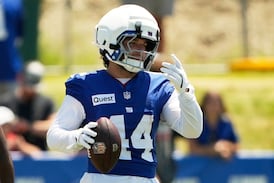
The realization really hit Jones, the Chiefs’ star pass rusher, in early June, when he kept looking around in the huddle. He was reminded again in early August, during one of the Chiefs’ first fully-padded practices. A large number of the reps taken featured Jones lined up next to rookie defensive tackle Peter Woods, the Chiefs’ second of two first-round picks. On the other side of Jones, the defensive end sometimes was R Mason Thomas, another rookie, this one the Chiefs selected in the draft’s second round.
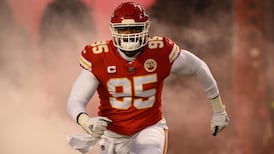
Of course, Jones is aware that Woods, 21, and Thomas, 22, are a decade younger than him. And of course, one of the teammates Woods and Thomas have gravitated to the most ahead of the upcoming season is Jones, who at age 32 is the Chiefs’ best defender -- and their longest-tenured, too.
“That’s a nice way to say you’re old,” Jones said, laughing. “I’ve been in the league going on 11 years, so, I mean, if they paid attention to the Chiefs any bit, then they’ve probably seen me on the field.”
Youth is just one element of the Chiefs’ changes on defense. Even Jones’ fellow starting interior lineman is Khyiris Tonga, who joined the team in free agency. All those major changes surrounding Jones -- who has always been the sun around which the Chiefs defense has revolved during their dynastic run -- were what the Chiefs believe this offseason was necessary for the franchise to return to contention after missing the playoffs for the first time since 2014.
No other part of the roster received as many newcomers, draft capital and overhaul from the previous year than along the Chiefs’ defensive line. In fact, Woods and Thomas are the first duo of defensive linemen the Chiefs selected in the first and second rounds of the same draft since 2002 (defensive tackle Ryan Sims and defensive end Eddie Freeman). All those efforts, led by coach Andy Reid, general manager Brett Veach and longtime coordinator Steve Spagnuolo, were made to fix one of the team’s biggest issues: the pass rush.
“Besides Chris, you want guys that can [get] pressure,” Reid said. “If you leave these quarterbacks [time] in this league, and let them sit there [in the pocket], they’re going to rip you apart. You’ve got to make them uncomfortable -- and you have to have the guys to be able to do that.
“The guys Brett bought in have that ability. It’s just a matter of getting it done.”
Unlike any previous year under Spagnuolo, who joined the Chiefs in 2019, this year’s path for the defense to be its most effective is expected to be made through the improved production of the linemen.
In early August, one particular rep was a glimpse of what the Chiefs hope to see plenty in the future. With the offense in a passing situation, quarterback Patrick Mahomes received the snap from the shotgun. One side of the Chiefs’ pass rush was Jones and defensive end George Karlaftis, the four-year veteran and team’s most experienced and accomplished edge rusher. Woods and Thomas worked from the left side. Together, the four players -- and an overload blitz with two extra defenders -- were able to pressure Mahomes, forcing the quarterback to throw a short pass in less than two seconds. The result of the play was an interception by nickel cornerback Chris Roland-Wallace.
The following week, during camp’s hardest stretch, something occurred that rarely happened last season: Jones was on the sideline -- and the defense was still able to beat the offensive line’s protection. In a matchup against left tackle Josh Simmons, Woods was able to leap in the air and use his right hand to knock down Mahomes’ pass without touching the quarterback. When the play was over, the second-closest defender next to Mahomes was Thomas.
“We got some dawgs in the room,” Jones said. “Peter Woods, I love that guy. He’s a young bull. R Mason is going to contribute a lot for us in the pass rush.”
Later this month, the Chiefs will open their season on “Monday Night Football” against the Denver Broncos. Much of the Chiefs’ 2026 campaign -- after finishing last season with an underwhelming 6-11 record -- will be determined by the play of Mahomes, who is on track to be the team’s starter for Week 1 after recovering from the torn ACL and LCL in his left knee.
For Jones, he was blunt when he shared how he will measure the defense’s overall performance, the one statistic he believes has to change the most.
“We’ve got to get more sacks,” Jones said after the Chiefs had just 35, the fifth fewest in the league, last season, including just 21.5 recorded by the D-line. “It affected the defense tremendously. If we want this defense to be a success, we’ve got to get more sacks.”
ALMOST A YEAR ago, the troubling signs for the Chiefs’ pass rush were evident as early as their first game.
In São Paulo, the Chiefs barely touched Los Angeles Chargers quarterback Justin Herbert when they didn’t blitz (their two sacks were a byproduct of sending extra defenders). Frustrated by being double-teamed for most of the game -- and the lack of pressure from his fellow teammates -- Jones switched positions and lined up on the edge to get a one-on-one matchup for the Chargers’ pivotal third-and-14 snap. With the Chargers leading by six points, Spagnuolo’s unit was one play away from giving the ball back to Mahomes for a potential game-winning drive.
However, Jones wanted to get pressure on Herbert so quickly that he lost outside contain, allowing the quarterback to scramble near the sideline for a 19-yard gain. Jones’ mistakes, which he acknowledged after the game, led to a verbal confrontation between him and linebacker Drue Tranquill.
As the Chiefs lost one-score game after one-score game -- finishing last season with a league-worst 1-9 record in such games -- the burden grew larger and larger for Jones: If he didn’t impact the quarterback, his D-line teammates, other than Karlaftis, didn’t provide much help.
Against the Jacksonville Jaguars, Jones played 48 of 58 total snaps, the most of any defensive lineman. Jones showed that he was fatigued in the midst of the Jaguars’ game-winning drive in the final minute, his final snap his most embarrassing. Quarterback Trevor Lawrence stumbled under center with the Jaguars at the 1-yard line trailing by four with just 30 seconds left. Jones, realizing he was going to be double-teamed again, didn’t pursue Lawrence with maximum effort. A few seconds later, Jones watched Lawrence get up and scramble across the goal line for the winning touchdown.
“This year, I plan to start high -- and go higher,” said Jones, who led the Chiefs last season with seven sacks.
Karlaftis struggled in the second half of the season, too, recording only one sack in his final seven games while he played through a nagging thumb injury. In November, during a four-game stretch, the Chiefs’ defensive ends combined to get only one sack.
“It was a humbling offseason,” Karlaftis said. “It was the first offseason not coming off a Super Bowl [appearance]. I had to get my mind right. There was a month there that I was kind of looking at the man in the mirror and trying to figure out how I can help do my part so that what happened last year never happens again.”
Veach had a similar feeling. Most of the roster moves he made last season for the pass rush failed. Veach re-signed Charles Omenihu and Mike Danna, both of whom helped the Chiefs win two Super Bowls. Jerry Tillery and Janarius Robinson joined the team, too. None of them made significant contributions.
The plan for the interior resulted in a bizarre outcome. The Chiefs didn’t re-sign Derrick Nnadi after the 2024 season, choosing to retain Mike Pennel. But the Chiefs released Pennel after the preseason and then made a small trade with the New York Jets to acquire Nnadi. Once it was clear Nnadi wasn’t an upgrade, the Chiefs in late October re-signed Pennel, who was released after playing eight games for the Cincinnati Bengals.
Another reason Pennel rejoined the Chiefs was because Omarr Norman-Lott sustained a season-ending torn ACL in his right knee. Prior to the injury, Norman-Lott, the 2025 second-round pick, showed some pass-rushing potential -- skills the Chiefs were hoping to further cultivate with more snaps in the second half of the season.
Too often, Spagnuolo was forced to blitz, a tactic offenses found easy ways to outwit. Although the Chiefs blitzed on 192 snaps (seventh most in the league), they allowed 7.2 yards per play (tied for fourth most), according to TruMedia. The Chiefs’ 43.6% third-down conversion rate also ranked 29th.
“Getting after the quarterback with four is significant,” said Brandon Thorn, the creator of “Trench Warfare,” a website dedicated to analysis of offensive and defensive line play. “I think the love of corners and exotic blitzes has been at least partly, I would speculate, just sheer necessity because he hasn’t had the dudes up front to win rushing four.
“The addition of Thomas and Woods signal they may have had enough of having to manufacture [pressure] and rely on [Jones] as much as they have.”
THE SHIFT WITHIN the Chiefs’ defense, and placing more of an emphasis on the front four, began March 4. That day, the Chiefs traded cornerback Trent McDuffie, a two-time All-Pro and their second-best defender, to the Los Angeles Rams for a package of four draft picks, including the No. 29 overall selection in this year’s draft.
The move by Veach, although it was difficult, was one that he had done before. In the 2022 offseason, the Chiefs began the second phase of their dynastic run by trading receiver Tyreek Hill, a three-time All-Pro at the time, to the Miami Dolphins in exchange for five draft picks.
Entering that year’s draft with 12 picks, Veach used the Chiefs’ two first-round picks to acquire McDuffie and Karlaftis. That draft class also included reliable defenders such as safety Bryan Cook, linebacker Leo Chenal and cornerback Jaylen Watson, all of whom left the Chiefs in free agency this offseason.
Once again, Veach knew what he had to do after trading McDuffie.
“We’ve got to nail these picks,” Veach said before the draft.
The Chiefs’ biggest swing in hoping to add another star player next to Jones in this year’s draft didn’t occur in the opening round. Instead, that moment happened in the second round with Thomas, who, listed at 6-foot-2 and 249 pounds, is not the ideal size that Spagnuolo often prefers with his edge rusher (6-foot-3 or taller and at least 265 pounds).
At Oklahoma, though, Thomas’ burst was undeniable, leading him to collect 22 sacks in his final two college seasons.
The Chiefs have learned that Thomas’ tenacity is just as evident in the film room as when he’s on the field. Throughout his college career, Thomas studied Broncos edge rusher Nik Bonitto, who influenced him to play at Oklahoma. Other NFL players Thomas has admired -- and adapted parts of their playing style -- are Micah Parsons (Green Bay Packers), Von Miller (Dallas Cowboys), Dallas Turner (Minnesota Vikings) and even Hall of Famer Dwight Freeney. He enjoys figuring out what nuances, such as their alignment and what information from the offense they identified before the snap of the ball, have led to their success.
“Technique outweighs the weight room a little bit,” Thomas said. “You can be Hercules, right? [If] you don’t bring your feet underneath yourself or you’re falling down or your splits are too wide, [proper] technique kind of saves you when you may not be the ideal strength.”
Thorn believes Thomas is the Chiefs’ first defensive end with elite quickness and bend since former outside linebacker Dee Ford, who last played in Kansas City in 2018.
“If R Mason Thomas can do something opposite of Karlaftis, it would give them a speed guy,” Thorn said. “That dynamic, theoretically now, is more in place than it has been since Tamba Hali and Justin Houston. We’ll see in six, seven weeks what [Thomas] looks like.”
In camp and the preseason, Thomas has proven to be a quick study.
In one-on-one drills, Thomas was able to surprise Simmons, leading the former first-round pick to say that he needed to time his pass set with the exact moment of the snap to have the proper angle to block his teammate. Thomas demonstrated a couple times he could hold his own against tight ends when the Rams ran the ball toward him in the preseason opener. The next week, Thomas generated quick pressure off the edge and he made an impressive leaping deflection on a pass that was meant for a bubble screen. And in the preseason finale against the Seattle Seahawks, Thomas overwhelmed two blockers, left tackle Logan Brown and tight end Elijah Arroyo, to sack quarterback Jalen Milroe -- who fumbled the ball -- in less than three seconds.
“He’s got some stuff you just can’t teach,” Woods said of Thomas. “That makes my job easier. That’s going to make him a better player, being able to use those [skills] that are just God-given. I’m really excited about him.”
The Chiefs’ final two exhibition games also showcased Woods’ potential to present quality pass-rushing juice while playing next to Jones.
After not missing a practice in camp while battling a left ankle injury, Woods’ athleticism was easy to notice against the Tampa Bay Buccaneers and Seahawks. While Thomas was pressuring the quarterback from the edge, Woods was pushing the pocket from the interior. When the Seahawks tried to run between the tackles, Woods used his footwork, quickness and agility to evade being blocked by Brown and left guard Christian Haynes, to tackle running back Jacardia Wright for no gain.
“You see the efforts the front office and the coaches made in the draft, going defense, defense, defense, like they did with Trent and I in 2022,” Karlaftis said of Woods and Thomas. “Those guys are going to be studs. They have the right mind frame. They’re humble, they want to work and they listen. You can’t ask much more from a rookie.”
Before the preseason, Woods was one of the Chiefs’ most stellar performers in camp. Woods created several highlights in the trenches, sometimes even blowing by All-Pro center Creed Humphrey on 11-on-11 reps for running back Kenneth Walker III. Listed at 6-foot-3 and 310 pounds, Woods even surprised Mahomes when he was able to sprint and chase down the quarterback to end a rep.
“He’s got a little bit of that alpha dog in him,” Spagnuolo said of Woods. “He’s got a serious tone about him that I really, really like.”
Recognizing Woods’ talent, Jones has been eager to be the rookie’s main mentor. Jones has been pleased with how much Woods is willing to learn from him. After a fully padded practice last week, Jones spent several minutes on the field with Woods, the two going through a variety of pass-rushing techniques. Woods played the role of an offensive lineman so that Jones could demonstrate when to use certain swim moves or the footwork needed to evade a lineman’s hands to better set up an outside rush move.
“I value it a lot,” Woods said of Jones’ expertise. “That’s a future Hall of Famer that I have an opportunity to learn from and play beside. Every opportunity that we’ve been given to have one-on-one time together and talk through things and bounce knowledge off each other, he’s been super willing, almost even initiating for that to happen. I’m very appreciative.”
IN EARLY MARCH, on the same day that Walker, the reigning Super Bowl MVP, agreed to join the Chiefs, the team also made perhaps its most underrated move of the offseason: adding defensive tackle Tonga.
Veach signed Tonga, a five-year veteran, to a three-year, $21 million contract, including $14 million guaranteed. Last season, Tonga, 30, was a steady force in the middle of the New England Patriots defensive line, helping the team reach the Super Bowl. His strength at the point of attack made it easier for the Patriots to control the line of scrimmage. In the Patriots’ postseason run, Tonga helped crush the pocket at times, recording seven tackles, one sack and two quarterback hits.
“This is the biggest addition to the defensive line, for sure, because we’ve seen him play as a pro,” Thorn said. “Tonga, we know, can stop the run. It just adds flexibility for third down when he comes off the field. You can be more dynamic now.”
In camp, Tonga proved his value when competing against Humphrey, pushing the center backward at times that even Joe Cullen, the defensive line coach, said he hadn’t seen in his five years with the team.
“Being with Chris, plays are going to come,” Tonga said. “It just elevates all of us to be better in our roles.”
The Chiefs are confident that Tonga, whom Cullen described as a quiet assassin, can provide legitimate relief for Jones, who played 762 snaps last season. With Tonga expected to be on the field on first- and second-down snaps, the Chiefs know an ideal scenario would lead to Jones to play fewer snaps than last season but have him be more impactful on critical third downs. Woods’ presence and development should also help Jones stay fresh for the fourth quarter of close games, when he is expected to be the defense’s closer to protect the lead on the scoreboard.
“I’m 99% confident that he can have a double-digit sack season,” Thorn said of Jones. “If you watch his pressures in relation to every other defensive tackle in the NFL, he is still, in my opinion, the best pass-rushing defensive tackle in the league. He had 43 high-quality pressures last season, which was more than any [other] defensive tackle in the NFL.
“Chris is still as lethal as anyone in football.”
One of the most revealing days last season for Jones was in early November, when the Chiefs fell to the Buffalo Bills. Quarterback Josh Allen finished the game completing 88.5% of his passes, the highest percentage in team history (minimum 15 attempts). After the game, Jones voiced his frustration.
“We’ve got to take advantage of one-on-one [matchups],” Jones said that night. “When we get a single block, you’ve got to win.”
In addition to the new players on the roster, the Chiefs have reasons for optimism that the linemen who will orbit around Jones this season -- even the rotational members -- can win more of their individual matchup in the trenches.
One backup to watch is Felix Anudike-Uzomah, the 2023 first-round pick who missed all of last season after having surgery on his right hamstring. In the preseason, Anudike-Uzomah flashed his improved athleticism with a fast, blind-side sack of Buccaneers quarterback Jake Browning. Anudike-Uzomah, who is in the final year of his rookie contract, could be the starter opposite Karlaftis on opening night against the Broncos.
“He really wants it,” Karlaftis said of Anudike-Uzomah’s potential for a breakout season. “He feels this is his chance, his moment. He’s got a lot to prove and he knows it. He’s doing everything he can to improve and show not just Kansas City, but the whole league what he’s got.”
Two second-year players, Norman-Lott and defensive end Ashton Gillotte, are expected to make valuable contributions later this season. Norman-Lott hopes to be activated from the physically unable to perform list before October, which would be his return to the field less than a year after sustaining his knee injury. Gillotte is rehabbing from a ruptured plantar fascia. The Chiefs think Gillotte, if his rehab goes well, has a chance to be available against the Broncos.
Healthy again himself, Karlaftis has vowed to be a better pass rusher this season, returning to the form he had in 2023, when he had a career-high 10.5 sacks and a forced fumble.
“It starts with our group,” Karlaftis said of the D-line. “We can take this defense wherever we want as a front. We want to get back to the promised land. We want to get back to getting all those sacks.”