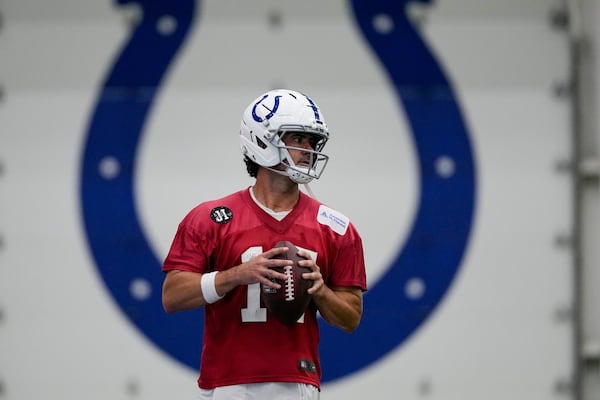
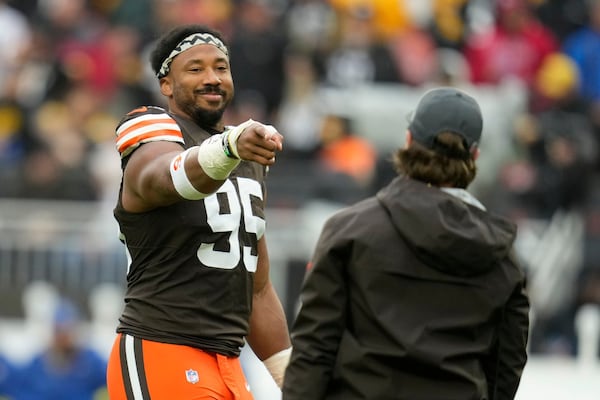
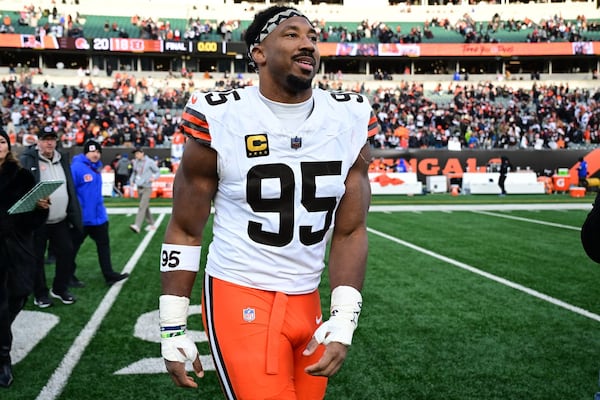
In the NFL's relentless attempt to colonize every day of the American sporting calendar, 2026 might be the year that the league officially plants a flag and takes over June 1. On a day when the football landscape was already prepared for an A.J. Brown trade and learned about the de facto retirement of a legendary quarterback in Russell Wilson, the Los Angeles Rams and Cleveland Browns one-upped everyone and made the biggest move of the offseason.
Months after Andrew Berry insisted that any conversation about trading "career Brown" Myles Garrett would amount to wasting breath, the Browns general manager shipped off the best player in the modern history of the franchise to the Rams. And weeks after drafting Ty Simpson and raising concerns that the Rams weren't sufficiently all-in around reigning MVP Matthew Stafford in 2026, Rams general manager Les Snead confidently pushed all of his chips into the middle. Los Angeles traded a first-round pick in 2027, a second-round pick in 2028, a third-round pick in 2029 and a wildly talented edge rusher in third-year pro Jared Verse to Cleveland in exchange for Garrett.
Subscribe: 'The Bill Barnwell Show'
Some trades are difficult to understand. This one is not. The Rams, who are competing for a Super Bowl this season, just added a future Hall of Famer. They'll be the first team to field the reigning Most Valuable Player on the offensive side of the ball and the Defensive Player of the Year on the other since the 1970 merger. And the Browns added draft capital and a very talented young player who better aligns with their competitive window, which is two or three years away. That part of the trade doesn't require detailed analysis.
But does this trade really put the Rams over the top? Did the Browns get enough back? Is Garrett the best player to ever be traded in the prime of his career? Let's get into those sorts of questions as we break down one of the more dramatically unexpected deals in recent league history.
Jump to:
Why'd the Rams do it?
Why'd the Browns do it?
Will it work out for both sides?
Why the Rams did it
I don't believe that a month of criticism over the Simpson pick really mattered all that much to Snead and the Rams' front office, but it was fair to wonder whether the team was being as aggressive as its situation seemed to dictate. Stafford, coming off his first MVP campaign, is 38 years old. Coach Sean McVay has flirted with the idea of retiring and joining the media in years past, most notably after a disappointing 2022 campaign.
McVay chose to return, and while the 5-12 season was a colossal disappointment, it turned out to be a bit of a blessing in disguise for the Rams. Los Angeles cleared out a difficult cap situation and drafted well over the ensuing couple of seasons, with opportunities opening up for young players. As they were set to enter the 2026 offseason, the Rams were blessed to have star talent on rookie deals on both sides of the ball, with Puka Nacua on offense and an entire defensive line -- Verse, Byron Young, Kobie Turner and Braden Fiske -- on the other.
That window gave the Rams a chance to spend. A year ago, they signed Davante Adams in free agency. This offseason, they traded one of their first-round picks to the Chiefs for Trent McDuffie and signed the top cornerback to a four-year, $124 million extension. They also signed fellow corner Jaylen Watson to join his former Kansas City teammate in L.A. The Rams were 25th in projected cash spending in 2026 before the Garrett trade after ranking 32nd in 2023 and 31st in both 2024 and 2025.
If there was ever a time to put Stan Kroenke's financial pedal to the medal, it was now, before all of those young players sign extensions and Stafford joins old friend Clayton Kershaw in retirement. And yes, there were understandable criticisms after the Rams used their remaining first-round pick to add a quarterback who doesn't project to be on the field to help the organization in 2026. But if the Rams were really going to be all-in to win a title in 2026, it always made sense to target a veteran in the prime of his career who was more likely to make an immediate impact than a rookie as the big splash move.
Last week on "NFL Live," I speculated that Snead might use his 2027 first-round pick to add that veteran at the trade deadline, having dealt two picks for Von Miller in 2021 while attempting to make massive moves for Christian McCaffrey and Brian Burns in years past. Instead, Snead dealt away that first-rounder on the opening day of June. Of course, Snead's attitude towards picks (that are likely to fall at the bottom of Round 1) is essentially a meme at this point. And with Simpson in the fold, Los Angeles' biggest long-term concern -- their quarterback of the future behind Stafford -- is already resolved. The Rams are stacked at the most important and expensive positions.
If the Rams were going to add any one player to their roster in the hopes of winning a championship in 2026, Garrett might have been the pick. It's fair to wonder whether he might have been the best player in football in 2025, even if he didn't garner serious MVP consideration by virtue of playing on the Browns. He was comfortably the most productive defensive player in the game, though.
In addition to setting the single-season sack record, Garrett produced 33 tackles for loss, the second-highest total in modern league history behind J.J. Watt's 39-TFL season in 2012. He was one of the league's best finishers, turning just under 30% of his pressures into sacks. NFL Next Gen Stats says Garrett had eight unblocked sacks in 2025, but that is a data glitch -- Garrett was simply so explosive that the blockers who were trying to get in his way weren't close enough for the system to register them as relevant. And he did all of this while being chipped or double-teamed on more than 40% of his snaps as an edge rusher, the highest rate in the league for any defender with 200 or more snaps.
Over the past three years, Garrett leads the NFL in sack rate (3.7%) and is second in quick pressure rate (9.0%) behind Micah Parsons, again, all while being chipped or double-teamed more often than any other edge rusher. He's about to get a massive talent upgrade of teammates in Los Angeles, and given what the gravity of Garrett did for players like Alex Wright, Maliek Collins and Isaiah McGuire a year ago, the other standouts up front for the Rams are all in position to have career seasons.
On top of all that, Garrett's an impactful run defender, which will allow the Rams to play with light boxes and lean even further into their dime packages, which they ran at the highest rate in the NFL last season. While losing Verse obviously hurts, Garrett simply projects to be an upgrade on any edge defender if we're focusing on projected performance in a vacuum in 2026.
In fact, I think there's a reasonable argument to be made that Garrett's the best player to be traded in the modern NFL during the prime of his career. At 30, he is coming off two Defensive Player of the Year awards over the past three seasons. He's a five-time first-team All-Pro, having picked up all of those honors over the past six seasons. And Garrett has done that while toiling with a Browns team that has won one playoff game over that six-year span. He has probably already done enough to earn a spot in the Hall of Fame before ever taking a snap in a Rams uniform.
Who else might come close? Legendary quarterbacks like Brett Favre, John Elway and Steve Young were traded at the very beginning of their careers, before they emerged as stars. Micah Parsons is a spectacular player, but he's not as accomplished as Garrett. Champ Bailey hadn't made a first-team All-Pro appearance before he was dealt to the Broncos. Tony Gonzalez was shipped to the Falcons in his mid-30s. And Marshall Faulk's run of dominant seasons only came after joining the Rams.
The most competitive candidates might be Randy Moss and Eric Dickerson, the latter of whom had won two Offensive Player of the Year awards across his first four seasons before being dealt to the Colts in 1987. Dickerson was younger and played what was viewed to be a premium position at the time. Other superstars, like Reggie White, left their teams in free agency for greener pastures. But if Garrett isn't the best player to be dealt at what might be considered his peak over the past half-century of NFL history, I'm not sure he's far off from the top.
Are the Rams the best team in football after this trade? Well, I would have argued that they were the best team in football before the Garrett trade. They were neck-and-neck with the Seahawks in full-season DVOA for 2025, with both teams well ahead of the rest of the pack. ESPN's Football Power Index had the Rams as the best team at the end of the regular season, with the Seahawks just behind.
While the Seahawks beat the Rams to win the rubber match between the two in the postseason, the gap between the two teams was razor-thin. Both should be excellent again in 2026, but the Seahawks lost offensive coordinator Klint Kubiak and three valuable defensive contributors in Boye Mafe, Coby Bryant and Riq Woolen. They've made no major additions to their roster this offseason.
The most notable Rams departure was Cobie Durant, and while I believe the now-Cowboys cornerback is an underrated player, Snead ably replaced him by trading for McDuffie and signing Watson. On top of all that, the Rams just added the reigning top defensive player in football. While there are quibbles we can raise about the roster, I don't know how anyone can comfortably say that a team is clearly better than the Rams. Every roster is susceptible to injuries or bad luck, but all things being equal, the Rams look like the best team in football on paper heading into 2026.
The Rams also aren't on the hook for an exorbitant deal given Garrett's impact. The structure of Garrett's contract makes it likely that the Rams will pay their new star edge rusher through 2028, although we've seen them pull the rip cord earlier than expected in the past to move on from the likes of Todd Gurley and Brandin Cooks. If the Rams don't address Garrett's contract, which still has five years remaining, they'll pay the future Hall of Famer $98 million over the next three seasons, or $32.7 million per year. Parsons, who was traded just before the start of the 2025 season, will make $119.8 million over that same span.
With that being said, this is obviously the sort of move that only becomes a success if the Rams win a Super Bowl and Garrett plays a key role along the way. You can decide what sort of discount you might want to place on picks in 2029, but if we treat the three selections the Rams are sending to the Browns as the 28th pick in 2027, the 52nd pick in 2028 and the 80th pick in 2029, the Rams are paying an additional $21.4 million in lost surplus value each year by making this move.
Just as Parsons becomes a $50 million-plus per year player by virtue of factoring in the value of the picks the Packers traded to acquire him, the Rams are really paying Garrett something more like $54 million per season as part of this deal. That's without including Verse, who was still a year away from being eligible for an extension and could be playing for a fraction of his real value over the next two years.
And while I loved (and still love) the Parsons move for the Packers, there are real repercussions. The defense wasn't able to hold up after Parsons tore his ACL late in the season. And the Packers were forced to cut back on their spending this offseason and lost several starters without being able to shop for significant external replacements.
Garrett's in a different situation. The Packers were acquiring Parsons hoping to land a player who could dominate over the next decade. If the Rams get three elite seasons out of Garrett and win a Super Bowl, they'll be thrilled. There's real, legitimate risk to this trade for the Rams, but this is the right sort of risk for them to embrace.
Why the Browns did it
Well, you saw what the short-term future looked like for the Browns last season. Garrett had one of the greatest campaigns we've seen by a defensive player in recent NFL history. He elevated the players around him, helping rookie linebacker Carson Schwesinger win Defensive Rookie of the Year. The Browns were a legitimately very good defense after adjusting for pace and context, ranking eighth in full-season DVOA and sixth in points allowed per drive. With all due respect to the likes of Denzel Ward, that success was driven by the presence of No. 95 on the field.
And even with that defense, the Browns were still light years from contention. Facing the league's 12th-easiest schedule, Cleveland went 5-12. Berry had an excellent draft in 2025, but the Browns don't have much else on the roster in terms of homegrown support. There are a total of three starters remaining in the building from a five-draft span between 2018 and 2022: Ward, Alex Wright and safety Grant Delpit. The Browns didn't have first-round picks in 2023 or 2024 as a result of the Deshaun Watson trade, and while they landed a few rotational pieces in 2023, the 2024 draft looks like a disaster outside of seventh-round pick Myles Harden.
Injuries to potential young cornerstones like Jedrick Wills Jr., Jeremiah Owusu-Koramoah, and Martin Emerson Jr. helped derail Berry's plans, but Wills and Emerson are out of the organization, and Owusu-Koramoah will miss his second consecutive season after suffering a serious neck injury in 2024, raising questions about whether he'll ever suit up for another NFL game. And of course, the Watson trade obviously turned out to be a colossal, franchise-altering disaster. At this point, those decisions are sunk costs. The Browns had to face the future with the roster they have, not the one they were hoping to have.
And that roster simply wasn't close to competing for a title, even with Garrett on the field. The Browns were another great draft away from being another great draft away. Berry had five top-90 picks in 2026 and added four offensive pieces, including receivers KC Concepcion and Denzel Boston and left tackle Spencer Fano, but the Browns still don't have any quarterback of note on the roster. Watson's a free agent after the season and coming off a season lost to an Achilles injury, while Shedeur Sanders' 18.9 Total QBR was the second-worst mark of any signal-caller in the NFL who threw at least 100 passes last season.
The Browns repeatedly restructured Watson's contract to create cap space, which will come to roost after the season. Berry will need to account for $86.2 million in dead cap for Watson, and the only way he'll be able to spread that over two seasons would be through negotiating some sort of short-term deal with Watson to keep him on the roster for a brief period after 2026. It's unclear whether ownership or Watson's representation would be amenable to that idea. There's a decent chance that the Browns simply eat the largest single-season dead cap number in NFL history for Watson next year.
From that perspective, the Browns weren't going to be able to field a competitive team until 2028, at which point Garrett will be turning 33 and looking toward what would likely be his last big contract as a pro. I wouldn't have faulted the Browns for holding onto Garrett for that span and treating him as an unmoveable franchise player, like they did with legendary left tackle Joe Thomas -- but trading Garrett was the logical thing to do.
The Browns flirted with that idea last offseason, when Garrett requested a trade out of town, before signing the star defender to a massive extension. The presence of a no-trade clause made it seem like Garrett wasn't going anywhere, but a procedural move made months ago hinted at a potential departure. In March, Garrett agreed to push the $10 million roster bonus he was set to receive in late-March back to September. He agreed to the same date switch for similar bonuses in 2027 and 2028.
Garrett gained nothing from the move, given that this money was already guaranteed or practically guaranteed. The Browns didn't clear out cap space as part of the move. The only real benefit was creating a window in which it would be easier for the Browns to justify trading Garrett. They weren't going to pay Garrett $10 million in 2026 and trade him weeks later. And while they could have traded him early in the 2026 league year, no trade offer seemed to be on the books, which is why Berry famously suggested that even talking about trading Garrett would be a waste of time.
By waiting until June 1, Berry gets to spread the dead money for Garrett over two years. Between Watson and Garrett, the Browns will be on the hook for $101.5 million in dead money in 2027, a figure that will likely rise as more players move on over the course of typical business. But the cap will be clear in 2028, and the Browns will have as much financial flexibility as any team in the league to add talent moving forward.
Clearing out cap space is one thing, but did the Browns actually get enough to justify trading away their best player? I suspect the offers were better this year than they were last year, given that we've seen the league heavily lean toward paying premiums to acquire veteran defensive linemen like Quinnen Williams, Dexter Lawrence II and Maxx Crosby, even if the latter's deal ended up being annulled.
It would have been surprising to see a team trade two first-round picks for a 29-year-old edge rusher last year, even one as talented and productive as Garrett. But one year later, with the Browns already having paid $25 million of his deal, anything short of two first-round picks would have seemed like a discount. Garrett's a year older, but he's also coming off what might be his most dominant pro season. And in this market, teams like the Browns are empowered to ask for more while having realistic comparables to justify big price tags.
The picks are valuable for a team with a huge hole in its draft history, of course. Even if we assume that the first-rounder falls toward the very bottom of the round, the Browns found what looks to be a franchise cornerstone in Schwesinger at No. 33 in 2025. And if Stafford does retire after the 2026 season, the second- and third-round picks in future drafts could be closer to the top of those rounds than it seems at the moment. The Rams have happily traded future first-round picks away and lived to tell the tale, and the Stafford trade became a triumph once they won a title. But the Rams did end up sending the sixth overall pick to the Lions in 2023, and that landed Detroit two key young players in Jahmyr Gibbs and Sam LaPorta after a trade down.
The most important piece for the Browns -- and the player who should decide how this deal turns out for Cleveland in the long run, independent of whether Garrett wins a ring in Los Angeles -- is Verse. If the Browns were going to insist on landing a young pass rusher in return for Garrett, Verse was one of the best options they had a realistic shot of landing. Teams like the Giants (Abdul Carter) and Steelers (Nick Herbig) weren't going to be getting Garrett. The Eagles were out of the running after trading for Jonathan Greenard. A three-team trade might have been plausible under the right circumstances, but if it was going to be a two-team deal, the Rams and their crop of young linemen were the obvious fit for both sides.
And while he didn't have the most sacks or the gaudiest numbers over the past two seasons, Verse was likely the most appealing candidate of the Rams linemen. Kobie Turner and Braden Fiske play on the interior, where the Browns already have Maliek Collins and 2025 first-rounder Mason Graham. Byron Young just earned a trip to the Pro Bowl with a 12-sack season, but he's also one year away from unrestricted free agency and is already 28 years old.
Verse, meanwhile, still has three years of cost control, with two years left on his rookie contract before a potential fifth-year option in 2028. After winning Defensive Rookie of the Year amid a weak class during his debut season with the Rams, Verse was devastating during their brief playoff run in 2024, racking up two sacks and a 57-yard fumble return for a score.
I was one of the many who had hopes that Verse could take a leap and challenge to be among the league's most impactful pass rushers in 2025. That sort of season never really came together. Verse was named to the Pro Bowl for the second time and tallied 7.5 sacks, but he was overshadowed at times by Young and Turner. He did lead the team with three tackles for loss and seven quarterback hits during the postseason run, but at first glance, it felt like Verse left some meat on the bone in his sophomore season.
Under the hood, I'm not sure those concerns are warranted. Verse's 27 quarterback knockdowns were just two short of Young's team-leading 29. Verse matched his fellow edge rusher in terms of pressure rate (just under 14%) and quick pressure rate (4%). And he did that while being double-teamed twice as often as Young. Verse's 4.0% quarterback pressure over expectation rate (QBPOE) led the team, per Next Gen Stats.
Verse has already been very good, and I'm still very optimistic that he can be the best player on an elite defense. Garrett's athleticism makes other NFL players look like they're stuck in quicksand. Verse isn't quite that devastating, but he has to have some of the heaviest hands and rates as one of the most physical edges in the league. He's a hammer on twists, to which Mekhi Becton can attest, and he has the physical strength to manhandle even elite linemen like Tristan Wirfs and Joe Thuney on snaps. (Verse driving Thuney backwards is what got Caleb Williams running backward on the Bears' game-tying Hail Mary touchdown in the fourth quarter of the divisional round classic.)
Verse also has the athleticism to beat linemen into gaps or rush around them. Last season, the Rams even used Verse lined up over the center and saw him destroy Colts pivot Tanor Bortolini. The play was reminiscent, of course, of how Jim Schwartz and the Browns used Garrett as a stand-up rusher to torment interior linemen in years past. Verse was the best player on the field in that game against Indy, soundly beating both Bortolini and left tackle Bernhard Raimann.
In a league where great pass rushers are going to be commanding a minimum of $30 million per season moving forward, Verse will make just $5 million over the next two years combined before an eventual 2028 fifth-year option, where he'll still likely be undervalued. Surplus value doesn't mean quite as much when the Browns don't expect to compete over the next couple of seasons, but Verse represents a building block who projects to be in his peak when the Browns are out from under their cap mess and presumably have a quarterback they want to build around. There's a non-zero chance he's more productive than Garrett over the next three to five years at a fraction of the cost, which would make this an enormous victory for Cleveland.
If the Rams had decided to shop Verse, I believe they would have been able to land a first-round pick and a significant additional selection, potentially a second-round pick, for their young edge rusher. Factor all that in and this return looks pretty strong for the Browns, who land the equivalent of two first-round picks, two second-round picks and a third-round selection for Garrett. If the organization had decided that it was going to trade Garrett, I'm not sure the return was ever going to be richer than this.
Are there scenarios where this doesn't work for either side?
Of course. Starting from the Rams side, they're exacerbating what was already going to be a medium-term problem. They were going to have a very expensive defensive line, and by swapping out Verse for Garrett, it's only going up. Verse's next deal might cost more than what the Rams currently have on the books for Garrett, but it would hardly be a surprise if the latter pushed for a contract sweetener over the next 12 months. The Rams have been happy to redo deals with the likes of Stafford, Cooper Kupp and Aaron Donald over the past few years.
Given what they paid to acquire Garrett, I would expect a pay bump to come next offseason, even if it's not as significant as a brand-new contract. Does that preclude the Rams from re-signing Young, Fiske or Turner? It depends on what they're willing to spend elsewhere. Puka Nacua will inevitably sign an extension, but Davante Adams is a free agent after the season. Stafford could retire, which would free up plenty of cash. And while the Rams were facing this problem with Verse, who would have been eligible for a contract extension after 2026, it's possible that they didn't intend or expect to sign their former first-rounder to an extension in the long run (although I think that's unlikely).
I do believe that Garrett was the best player the Rams had a realistic shot of using their first-round pick (and more) to acquire in aid of the 2026 team. Was edge rusher really their biggest position of need, though? No. I thought they could have looked at help along the offensive line or at wide receiver in Round 1. They still might be one defensive back short of a dominant secondary, even if they're much improved there. And their off-ball linebackers remain among the least imposing group in football.
Snead might not have used the team's first-round pick to address those issues right now, but he won't have that pick at the deadline. What if Nacua goes down with a torn ACL in September? What if Stafford's back doesn't respond to summer treatment and the Rams don't think Simpson's ready to play? I can't fault the Rams for using their 2027 first-round pick to go after Garrett, but we might look back and say that they had bigger needs or only made a marginal move by swapping out Verse for Garrett.
Injuries could also limit Garrett. While he has been able to stay on the field over the past few years, a shoulder injury badly hampered Garrett down the stretch in 2023, when the Browns fielded an elite defense for most of the year. Garrett had 13 sacks through the first 10 games of the season, but he managed only one over his final seven appearances. The Browns sustained their defense through takeaways, but with Garrett a non-factor, they allowed the Texans offense to score 31 points in a blowout loss that postseason. Anyone can get hurt, but with so much tied up in one player between salary and acquisition costs, anything short of a spectacular 17-game season and deep playoff run from Garrett would mean the Rams were underwater on his deal.
At 30, the aging curve could also come for Garrett. I don't have any concerns about him from what I saw on tape last year, and his get-off still rates among the best in the NFL. But even the relatively modest aging curves for great edge rushers come with a pretty wide range of variance. T.J. Watt was a perennial first-team All-Pro in his 20s and then took a pretty noticeable step backwards over the second half of 2024 and throughout 2025, his age-30 and age-31 seasons. Chandler Jones had 19 sacks in his age-29 season, was a first-team All-Pro, missed most of his age-30 season and was out of football two years later. Von Miller had a 14.5-sack season at 29 in the middle of a Hall of Fame career and hasn't topped double-digit sacks since then.
I think Garrett will be productive for years to come, and the Rams are understandably focusing on what he does over the next couple of seasons as their primary concern, but nothing's for certain in the NFL. There's also a scenario where Stafford suddenly declines or misses significant time with injuries, leaving the Rams in a world where they get what they wanted out of Garrett, only for it not to matter.
The Browns might also look back and wonder why they traded a Hall of Famer for a player who hasn't topped eight sacks as a pro. Verse might top out as a good-but-not-great pass rusher who shows more flashes of brilliance than sustained elite play. He'd still be a valuable player on a rookie deal in that scenario, but most of that will come over the next two years, when the Browns aren't going to be good either way. If the Browns trade Garrett for a solid pass-rusher and the 32nd pick in the draft as the two biggest pieces of the return, that might not feel suitable in a deal for a future Hall of Famer.
Those scenarios exist, but in the most likely universe, this trade ends up making sense for both parties. The Browns realized a significant and logical return for a player whose best remaining seasons were going to be wasted alongside a hopeless roster, and they'll be in a better position to build a winner two years from now. The Rams can't guarantee a title by adding Garrett, and it hurts to lose Verse, but this was a chance to bring in what might potentially be the most talented and productive peak player acquired in any trade during most of our lifetimes.
It's a rough day to be an Eagles fan, given that Philly just saw a potential NFC contender add a superstar while the Eagles traded one away for a future pick. Teams like the Lions, 49ers and Bears saw their chances of rising up the NFC get squeezed. And while the Seahawks don't fear the Rams after knocking them out in Seattle last January, life just got that much harder for the defending champs.
Nobody does all-in quite like the Rams. And the last time they loaded this much up for a single season, the Super Bowl ended with McVay and his team celebrating on their home turf in Inglewood. Anyone know where the Super Bowl happens to be this season?