TODD MONKEN'S ENTRY into the coaching ranks seemed predestined, but the same couldn't be said for an ascension to one of the top jobs in the NFL.
However, after three-plus decades of chasing a dream, a monthlong hiring process and three rounds of days-long interviews, Monken finally got the news of a lifetime from the Cleveland Browns.
In late January, Browns owner Jimmy Haslam texted Monken to ask if he could join yet another video call meeting. At this point, Monken knew the hiring process was nearing its end, so he asked if he could wear a sweatshirt instead of a suit.
Haslam obliged, and when the two connected, the owner asked if Monken was wearing Browns paraphernalia.
"I said, 'No, but I can take a crayon here and draw a logo on it like a fifth-grader,'" Monken recalled to NFL Network at the scouting combine in February. "... Even throughout the whole process, I've had other opportunities and to not get one of those jobs, [it's] not that you come to the thought that you'll never get one, but to finally have it come to fruition, again, pretty neat."
Monken turned 60 on Feb. 5, two days after the Browns introduced him as the franchise's 19th noninterim head coach and 11th since returning to Cleveland in 1999. He had enjoyed a decades-long career in coaching, and had this Browns opening not worked out, he had a job waiting for him as the New York Giants' offensive coordinator, working with former boss John Harbaugh.
Now, in what outsiders are already calling a lost season primed to take advantage of a hyped 2027 quarterback draft class, Monken has set his sights on maximizing the QBs he has on the roster and a once-in-a-lifetime opportunity as a first-time NFL head coach, beginning Sunday on the road against the Jacksonville Jaguars (1 p.m. ET, CBS). People who know Monken best say his passion, intellect and ability to connect with others can cut through for a young Cleveland team in need of a firm culture and new identity after winning just eight games over the past two seasons.
"I'm not getting any younger, let's be real honest here," Monken said at his introductory news conference. "Although I'll say this, the version you're getting of me now is a hell of a lot better than it would have been 15, 20 years ago."
COINCIDENTALLY, CLEVELAND'S PRESEASON opener against the Chicago Bears on Aug. 15 brought Monken back to the roots of his almost-40-year rise through the coaching ranks.
In Wheaton, a suburb about 30 miles west of Chicago, Monken grew up in a football family with a storied history. His father, Bob, was a legendary coach at Lake Park High School in Roselle, Illinois, for 30 years. As the Browns' plane descended into Chicago, Monken could spot the football fields that were named after his father.
"Todd's from a kind of coaching royalty in Illinois," said Randy Oberembt, Monken's football coach at Knox College (Illinois).
Monken's dad, along with four uncles who all coached high school football in the area, was inducted into the Illinois Coaches Hall of Fame. The five Monken boys had seven sons, all of whom got into coaching at some level. Monken's coaching generation also includes his cousin Jeff, who is the head football coach at Army. Monken's 25-year-old son, Travis, is an offensive analyst with the Browns.
"I think as kids, we loved the game because we saw our dads loved the game and put that joy into football," Jeff Monken told ESPN. "There were a lot of us that followed our fathers into that profession. Not every single Monken boy cousin did it, but darn near all of us."
At its essence, though, Monken's father and his mother, Jo Ellen, a second-grade teacher, were educators. That upbringing served as the foundation for everything Monken has done as a football coach. Joe Ellen died in 2023 and Bob died in 2024.
"We didn't make a ton of money. We didn't have that," Monken told ESPN. "But what they did for me, helping me, engaged in our lives and then disciplining me, I think that's where you see highly successful people; that is the starting point. That's not the end-all. There's plenty of people that were as lucky as I am, but I'm just saying that gives you a f---ing head start. To me, that's where privilege comes from."
DESTINED TO FOLLOW in his forebears' footsteps, Monken began his college career as a quarterback at Western Illinois -- "I realized I could evaluate talent and I wasn't very good" -- but then transferred to the College of DuPage, a junior college, where he played baseball before landing at Division III Knox College.
"I knew then at that moment I wanted to coach," Monken told ESPN. "I helped my dad out my first year at the junior college, and I knew I wanted to coach. I loved it, loved being part of a team. So I thought if I wanted to coach, I felt like I had to play. I felt like I had to go play, whether I was right or wrong."
Years before he inherited Cleveland's quarterback quandary and oversaw the competition between Deshaun Watson and Shedeur Sanders, Monken was in the middle of his own at Knox. He was in a quarterback competition with the incumbent, multiyear starter and All-American Bob Monroe. After suffering an injury and spending his first season at Knox as a backup, Monken split playing time with Monroe in his second season; Monroe played the first and third quarters, while Monken played the second and fourth quarters.
As odd as the dynamic was, it failed to cause friction between the two then and now; they have remained close friends after their playing days. Monroe was even in attendance for Monken's introduction as the Browns' head coach.
The next season, with Monroe graduating, Monken became a full-time starter and was named a 1988 Division III All-American, leading the nation in pass attempts, completions and completion percentage. He was also a two-sport athlete, lettering in baseball, and was inducted into the athletic department's hall of fame.
"We wanted him to stay with us for another year, and we would've gladly turned the offense over to him in 1989, but he wanted to get into [coaching]," Oberembt told ESPN.
"And that to me was very telling because he was willing to go up to Grand Valley State, be a [graduate assistant] without really knowing what was going to happen up there. And it turned out that that was one of the great coaching laboratories in college football, if you look at what those guys went on and did. And then the rest of his trips, I think what we learned is he was always willing to take the hard job, and he's a ferocious worker."
MONKEN BEGAN HIS coaching journey at Grand Valley State as a graduate assistant in 1989 -- he worked alongside then-defensive coordinator Brian Kelly -- and then bounced around the country in various assistant roles. This also included a four-year stint from 2007 to 2010 in Jacksonville as the Jaguars' wide receivers coach.
At his higher-profile stops, a theme in Monken's coaching résumé emerged: He could connect with all types of quarterbacks and produce high-octane offenses. There was Brandon Weeden at Oklahoma State. Monken's lone head-coaching job was at Southern Mississippi, where he inherited a winless program and brought it a conference championship with Nick Mullens by Year 3.
"The difference with him was he has an extremely high level of confidence," former Oklahoma State coach Mike Gundy told ESPN. "I would go in his office and ask him what he thought about the game this week. And he would say, 'I'll be disappointed if we have to punt one time.' And he was serious. ... And he always had the ability to instill a high level of confidence in the players."
Similar success for Monken carried into the NFL, when Dirk Koetter tapped him to be the Buccaneers' offensive coordinator. But after a forgettable one-year stint in Cleveland in 2019 -- Monken was the OC for Freddie Kitchens but didn't call plays during a disappointing 6-10 season -- the staff was fired, and Monken returned to the college ranks, where he joined Kirby Smart as Georgia's offensive coordinator in 2020.
Over the next three seasons in Athens, Georgia, he made magic with another quarterback, this time former walk-on Stetson Bennett, as the Bulldogs won back-to-back national championships.
"Every day in the meetings he was the same guy," Bennett told ESPN. "He would go on and ramble in the QB meetings for five, 10 minutes at a time. If you could pick up some golden nuggets out of there, that would help you a lot.
"He's always coaching us. He was always there with the wideouts because he's a wide receiver guy at heart, making sure they got their feet right, their technique right, and what we were trying to accomplish with the play. And over time, over years, that added up to a really good offense."
Monken, though, still eyed an opportunity to coach at the highest level, and after reaching the pinnacle of college football, he got the chance to return to the NFL.
Harbaugh tapped Monken to replace Greg Roman and work with Lamar Jackson in Baltimore in 2023. Already an MVP in a run-oriented scheme, Jackson won his second MVP in his first season with Monken. A No. 1-scoring offense followed the next season. The Ravens, though, couldn't break through in the playoffs, and Monken, despite his success as a playcaller and head-coaching interest, couldn't land one of the coveted jobs. His final season in Baltimore, a frustrating campaign in which Jackson dealt with injuries and the Ravens missed the playoffs, ended with Harbaugh's firing. Questions surfaced about Monken's relationship with Jackson and how his demanding personality might have caused friction.
"I didn't coach Lamar well enough," Monken told the "Ryan Ripken Show" in January. "I didn't have as good of a relationship as I could have. I didn't do the things we needed to do this year to win enough games to give ourselves a chance. I believe that.
"Lamar and I, to me, had a good relationship," Monken said. "Could it have been better? Of course. Lamar and I never had an issue."
The nature of Monken's relationship with Jackson and how his taxing style might wear on players were points of discussion during the hiring process. However, it didn't deter the Browns from bringing him in, and ultimately hiring him after firing Kevin Stefanski on Jan. 5.
MONKEN WAS THE last hire made in this past season's job carousel that saw 10 teams hire new head coaches. Despite the team's focus on several up-and-coming assistants much younger than him, such as Los Angeles Rams offensive coordinator Nate Scheelhaase and Jaguars OC Grant Udinski, Cleveland's decision-makers insist that the sexagenarian was firmly at the top of their list of candidates from the beginning of the process.
"He was my favorite from the get-go," Haslam said. "And we had some good coaches, and people drop out, and people don't turn out the way you thought. But he was my pick from the first, and everybody says he's never been a head coach and is 60, but you have the choice of taking that or somebody who has never been a head coach who's 32 or 33. So I like our odds."
Where younger assistants might have offered untapped potential, Cleveland saw a proven playcaller in Monken with a track record of working with numerous systems and passers. It was an appealing background for a Browns team with a talented but unproven core and persistent questions about the quarterback position.
Monken had not only remained in contact with Haslam over the years but also with Browns general manager Andrew Berry, as the two briefly overlapped amid changing regimes.
"Todd's awesome. The best way to describe him is he's old-school discipline with new-school relationships and football," Berry said.
Monken, in his own words, earned a "doctorate in coaching" from Smart and Harbaugh, but it's his unique style -- a fiery resolve with blunt honesty -- that he has brought to Cleveland. When peppered with questions at his introductory news conference on whether he would retain defensive coordinator Jim Schwartz, who behind the scenes was voicing his frustration at being passed over, Monken delivered a resounding message to Schwartz and fans alike: "I didn't take this job because of Jim Schwartz." Schwartz resigned a week later.
"He'll speak from his heart, and he won't bulls--- you," Gundy said.
Monken's energy and passion have already boiled over at times. By the end of mandatory minicamp, he had to cancel a post-practice news conference; his voice had become hoarse from projecting it too much on the practice field. During a training camp practice, his radio for calling in plays went flying, and practice was abruptly ended after a string of pre-snap penalties by his offense.
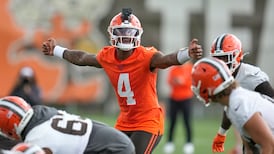
Monken conducted a grueling, physical training camp in the sweltering heat and alternated practice reps in a polarizing quarterback competition between Watson and Sanders. But he didn't let that get in the way of overseeing the entire team's development. The longtime wide receivers coach's gaze was often focused as much on the pass catchers as it was on the passers, stopping drills to animatedly direct the precise way he wanted routes run.
"He's going to tell you how it is," Browns linebacker Quincy Williams said. "He's going to tell you what he wants. He's going to tell you what he expects. And if you're not giving that, he's going to let you know right then and right there. So I love that part about it because it ain't no question about where you stand with him."
"Todd can be whatever he needs to be," Gundy told ESPN. "... He can communicate with private school kids, he can communicate with city kids, he can communicate with farm kids, he can communicate with country kids. It don't make a difference. And so he has the ability to communicate with people. And because of that, he could get everybody on the same playing field and get everybody pulling in the same direction. And he could do the same thing with staff, with the guys that work for him in the offensive room."
When Monken named Watson the starter on Aug. 24, a controversial decision just days after Watson struggled in the Browns' second preseason game and then lashed out after the game at fans who were booing him, Monken was defiant in the aftermath of external backlash: "Who would I be if I let someone outside of the building decide who plays?"
Gundy said Monken has always been a coach who can stand on his decisions despite what others might think.
"In my opinion, in 21 years as a head coach, that's what you have to be able to do because we make decisions all the time and we hope that most of them are right and we know that some of them are going to be wrong, but you got to make a decision," Gundy said. "So if you're out bird hunting, you can't just keep aiming forever at the bird. You got to eventually shoot the gun, or you're never going to get any birds."
That conviction, and delivery on it, is needed in Cleveland. The Browns have the second-youngest team -- Cleveland's average age after the initial roster was set was 26 years and 4 days -- behind only the rebuilding Miami Dolphins. Haslam admitted the roster, now without two-time Defensive Player of the Year Myles Garrett, isn't expected to contend until 2027. If Monken is able to elevate Cleveland's offense, the lowest-scoring unit in the NFL over the past two seasons, it'll have to be with Watson -- who is trying to regain his Pro Bowl form after two Achilles tears and a nearly two-year layoff. If not Watson, maybe it will be Shedeur Sanders, a talented but inexperienced player who has drawn Monken's praise as a playmaker.
It's an uphill battle for a coach who has an irrational irritation for what he calls "s---ty football."
MANY OF THE contemporaries Monken rose through the coaching ranks with and served under have exited a profession that has changed dramatically at both the college and pro levels amid the era of NIL and the transfer portal. Monken, though, has found a way to evolve -- on and off the field -- with a passion that's still palpable.
"A lot of guys that get to be around that age, they kind of lose their lust and desire for the game-planning side of it, the grind of, 'OK, we have 17 or 18 games, we're going to have to bust our ass for four months.' And he hasn't," Gundy said.
That resolve will be tested in a city where the team is projected to produce another double-digit-loss season, the 2027 quarterback draft class is already front of mind, and fans have become predisposed to look to the future -- at quarterback, coach, GM. But Monken can't help but remember that this moment wasn't promised.
"At this point, especially being 60, this is probably my last job," Monken told ESPN. "I mean, I hope it is. I hope it's my last job, and I decide when I don't want to be here, and it's everything that I've worked for. So, what's there to fear? What's there to worry about? What's there to complain about other than give it everything you've got and then let the cards or the chips fall where they may?"
ESPN reporter Sarah Barshop contributed to this report.