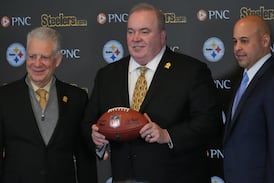
LATROBE, Pa. -- After leaving their first team meeting of the 2026 training camp Wednesday morning, the Pittsburgh Steelers found new shirts hanging in their lockers at St. Vincent College.
“Tempered” stretched across the black shirt in gold lettering, and the back expanded on the definition of the slogan: “More than talented. More than tough. Tempered.”
“[It’s about] the parallels between the city of Pittsburgh, the Steel Mill industry, the tempering process of how steel was built -- and still is today -- and the parallels between coming together as a football team,” coach Mike McCarthy told ESPN.
McCarthy said as much to his team in their first meeting, that they should be a reflection of the city’s gritty heritage. It’s why McCarthy chose “tempered” as the defining word of his first training camp as the Steelers’ new head coach.
“We have to be tough, hard, and this is a blue-collar town,” Steelers guard Spencer Anderson said, relaying what McCarthy told them. “Button up, bring your lunch pail and let’s go, because that’s always where we’ve been since 1933. ... Can’t fold under the heat. And when the heat comes, you got to make steel -- or I guess do the right things, so to speak.”
But tempered in McCarthy’s use has dual meanings. Not only can it mean toughened and made resilient, but it can also mean being controlled. To McCarthy, tempered isn’t just about raw strength. It’s about being controlled in the approach to building that strength. And through a week of training camp, McCarthy’s practices have been deliberately, even scientifically, tempered to train the mind as much as the body.
“Everything’s calculated,” McCarthy said, adding that he relies on GPS data on devices worn by players to help construct his practice plan. “Everything’s regulated. There’s obviously science behind it. We’re in tune with the conditioning of our players. The commitment the players made in the spring was evident. ... This is all by design. There’s history behind it. ... Everybody has a genetic background that you pay attention to. Some guys can rev higher than others. And so this is part of the process.”
Through five practices, the differences between McCarthy’s approach and former coach Mike Tomlin’s are palpable. One isn’t necessarily better than the other, players stressed, but the practices are different.
“We’re used to a hundred miles an hour, nonstop, and we’re kind of dead tired by the end of practice,” Anderson said. “But now we can kind of temper it down, and we still have maybe 10% left in the tank. But obviously don’t tell [McCarthy] I said that.”
Part of that, of course, is the team is still in its ramp-up period with shorter practices as mandated by the collective bargaining agreement. But McCarthy is also heavily reliant on sports science in formulating his practice plans. That’s why Monday’s practice, the Steelers’ first in pads, was noticeably less physical than the first padded practices in the Tomlin era (2007 to 2025).
“It did feel different when I’m used to all that physical,” Pittsburgh running back Jaylen Warren said Monday. “But I understand why we don’t do it, and the philosophy behind it. Just adapting to it. ... At the end of the day, we’re trying to keep guys up, keep them healthy. The season’s the most important thing and winning is the most important thing.”
Warren told reporters Saturday he was certain that even with McCarthy’s changes, the team would still go through the signature backs-on-backers drill. During Tomlin’s tenure, it was a highlight of padded practices, often beginning with the first one, in which running backs and linebackers matched up in a one-on-one battle. Monday, though, the running backs and linebackers didn’t square off. Instead, the offensive linemen and pass rushers went against one another while the skill position players worked in a 7-on-7 period.
“As long as we have it, I’m prepared,” Warren said of backs-on-backers. “I’m trusting the process that they got us going through, so I ain’t complaining about nothing.”
McCarthy, who said he is “absolutely” a fan of backs-on-backers, might still have the drill in a future padded practice, but one thing he won’t have is live tackling. While most of the league also spurns live tackling in camp, Tomlin embraced it in his ultra-physical late afternoon practices.
“The only thing that’s different is we don’t want to go to the ground and risk injury, but I think everything else will look the same,” McCarthy said, affirming that his practices would still be plenty physical.
To coach tackling without actually doing it, McCarthy and his staff are breaking down the basic elements of the skill. In fact, the majority of McCarthy’s early practices are all about the fundamentals -- the “Steelers Six” -- coached through meticulously scripted and executed individual periods. That’s a departure from a Tomlin era that featured extensive team periods and always opened with “Seven Shots,” an intense goal line competition.
“A lot of Coach T’s camps, it was a lot of team periods and mano-a-mano type of thing, but this is kind of more, get good work, working smart and hard,” Anderson said. “Not to say that we weren’t working smart back then, but it’s just Coach McCarthy explains to us that he’s a big sports science guy, so he’ll never run us into the ground or do things that’ll make us feel like we’re dead tired. I think it’s a good balance of work and taking care of us.”
Through five practices, McCarthy’s training camp hasn’t featured a single goal-line team period. Instead, in addition to the extensive individual periods, McCarthy has emphasized situational football -- working first on two-minute offense and then beginning the second week of camp with third and fourth downs. By stressing those situations in his up-tempo practices, McCarthy is strengthening the team’s nervous system and mental fortitude.
“Everybody talks about the physical and the mental stress of a physical camp,” McCarthy said, explaining the cadence of his practices. “Well, what the hell about the nervous system? Who’s training that? How are you tapping that? How are you pushing that? Where are you getting that at? Where’s the mental toughness? Where’s the emotional toughness? How do you train that on a football field? This is all by design.”
And though McCarthy’s approach is an adjustment for players who grew accustomed to Tomlin’s camps, many are embracing change.
“I got to,” said Cam Heyward, the longest-tenured Steeler. “The dinosaurs didn’t, and look what happened to them.”