WINNIPEG — The Winnipeg Jets are entering a pivotal off-season burdened by a harsh reality.
Just one year removed from capturing the Presidents’ Trophy, the organization must now prove its aging roster is still good enough to compete for a Stanley Cup, while facing an NHL landscape that no longer views them as legitimate contenders.
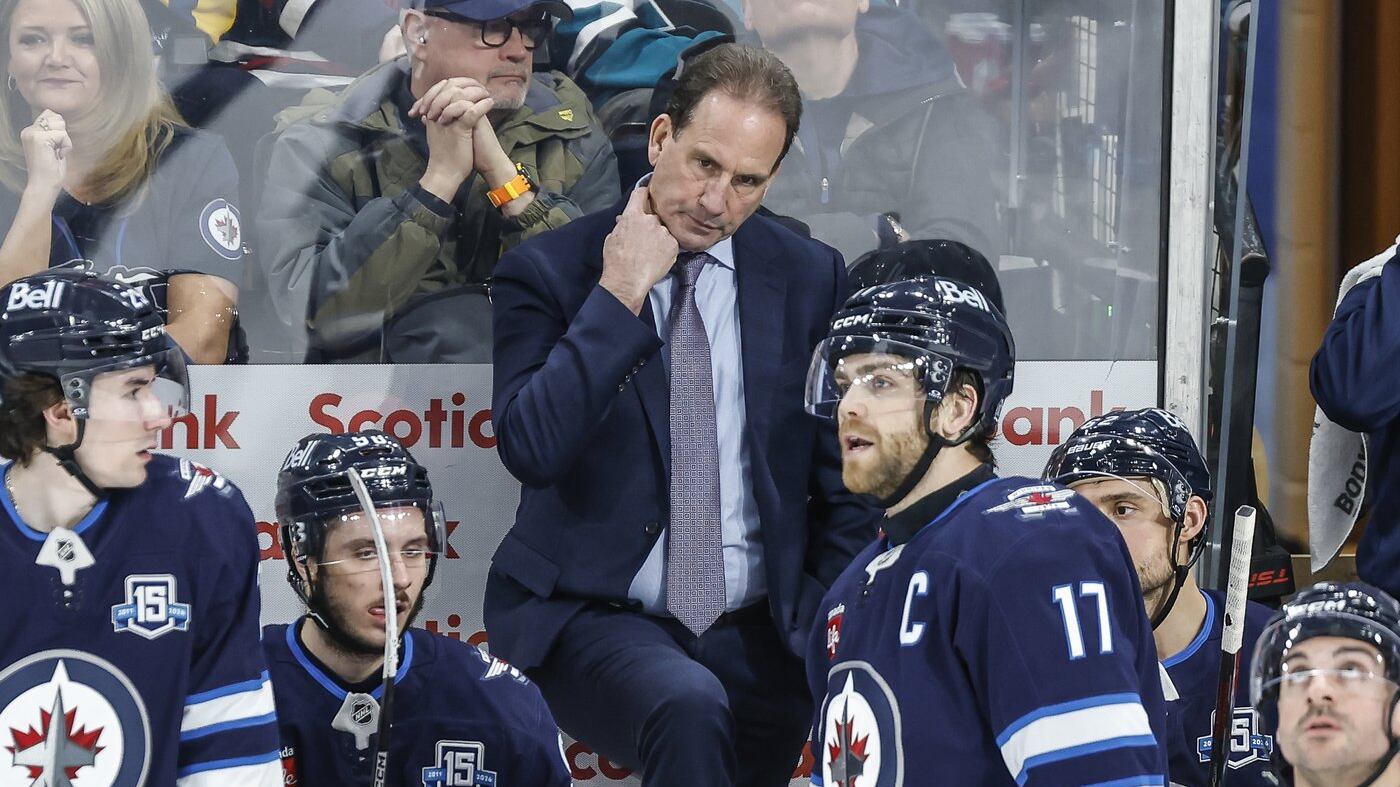
Following a 35-35-12 campaign that left them outside the playoff picture, general manager Kevin Cheveldayoff and head coach Scott Arniel addressed the media on Monday. Together, they detailed a season derailed by inconsistency, a lack of overall team speed and a lost defensive identity.
Cheveldayoff also admitted the organization may have suffered from overconfidence following back-to-back Jennings Trophies — awarded each year to the team with the best goals-against average — and a first-place regular-season finish a year ago.
“Did we think we were going to get to college without going to high school? Did we skip a step?” Cheveldayoff asked. “So, that’s where I have to grade myself, too. Did I feel overconfident?”
The urgency to rebound from a down year is only amplified by the mounting frustration inside the locker room. Goaltender Connor Hellebuyck, the reigning Hart Trophy and Vezina Trophy winner, bluntly stated that the team can’t afford to run it back without notable adjustments.
“Complacency is not going to get us moving forward,” Hellebuyck said in his exit interview last week. “To just put that same product on the ice, I don’t think it worked for a reason.”
Both Cheveldayoff and Arniel maintained their belief in the current roster, while acknowledging the need to inject youth and find a way to increase their overall team speed to adjust to the modern NHL. But executing that plan presents a significant organizational challenge, considering the club’s salary cap space is heavily anchored by a veteran core.
Hellebuyck, at 32 years old, joins players like Mark Scheifele (33), Kyle Connor (29), Neal Pionk (30) and Adam Lowry (33) on long-term deals taking them into their late 30s. These contracts came with management’s promise to compete for the Stanley Cup each year, only adding to the pressure to deliver.
While Cheveldayoff still has belief in the foundation of the team, he made a notable concession regarding the untouchable status of his stars. Acknowledging the price paid for trading away draft capital in recent years to keep this contention window open, the GM didn’t rule out the possibility of a franchise-altering move.
“Certainly open to talk about anybody,” Cheveldayoff said when asked about moving a core piece. “But anything we do is about making this group one step closer to winning a championship.”
One of the main areas of improvement Hellebuyck and others hoped to see is a return to a team who prides itself on speed — hard on the forecheck, relentless in puck pursuit and overall tougher to play against. Following the departure of Nikolaj Ehlers, the Jets attempted to build a heavier roster.
Arniel, who has one year remaining on his contract, admitted that trying to implement his systems with a lineup lacking foot speed was a persistent hurdle.
“I have to coach what’s in front of me,” Arniel said. “I’d love to be a 100-mph team; I really would. We came off a Presidents’ Trophy year, with hopefully adding to it — getting stronger, maybe heavier. Maybe that was right, wrong or indifferent, the decision we made. At the end of the day, now we got to shift, we got to figure it out.”
The coach lamented a lack of reliable secondary scoring, forcing him to overplay his top lines.
That dependence led to longer shifts, defensive breakdowns and the team frequently chasing the puck in their own zone. It culminated in an 11-game losing streak that created a hole the Jets ultimately could not overcome, even if they played some of their best hockey down the stretch.
Winnipeg has notoriously struggled to attract top-end unrestricted free agents, and with their nosedive in the standings this year, the Manitoba capital will not be atop players’ lists for a trade, especially if they have some form of protection. That will likely mean looking to improve from within, with Arniel challenging prospects like Brad Lambert, Brayden Yager and Nikita Chibrikov to force management’s hand come training camp in September.
“Go beat somebody out for a job,” Arniel said. “Go do what you can to get yourself to become a Winnipeg Jet full-time.”
With four and a half months until training camp, management is officially on the clock to improve the team and keep their playoff window open. Reflecting on the team’s steep decline, Arniel outlined the organization’s mandate for the summer.
“There’s a phrase out there: You either win or learn,” Arniel said. “If you don’t go out and find out why you didn’t win, you’re just going to end up repeating the same thing.”
This report by The Canadian Press was first published April 20, 2026.
Jeff Hamilton, The Canadian Press